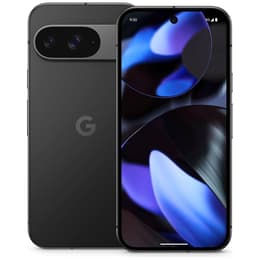



Compare models
Google Pixel 9 Vs Google Pixel 9a
- 1-year minimum warranty
- Free delivery on all orders
- Free 30-day returns
Differences at a glance
The Google Pixel 9 (2024) and Google Pixel 9a (2025) represent Google's approach to modern smartphone design, combining smart capabilities with everyday utility. While both smartphones share the same core processor architecture, they differ significantly in build construction, camera configurations, and physical dimensions. Running on the Android operating system with identical long-term software update commitments, these devices cater to slightly different user preferences within the same ecosystem.
Available Models
Colour
Storage (GB)
Scores
Durability
When examining longevity and durability, both devices offer extensive software lifespans and sturdy builds, though they differ slightly in release timing and repair considerations.
- Software support duration: Both smartphones receive seven full years of operating system and security updates from their respective release years, ensuring long-term software relevance.
- Build and materials: The Pixel 9 features robust glass backing and aluminum framing, while the Pixel 9a utilizes alternative composite materials matched with an IP68 dust and water resistance rating.
- Expected practical lifespan: Due to current-generation internal components and extended update timelines, both models are well-equipped to maintain reliable daily operation for many years.
Year of Release
2024
2025
Compatible with latest Update
Yes
Yes
OS
Android
Android
Foldable
No
No
Performance
Performance capabilities are largely matched across both models due to sharing the same foundational processing engine, though memory allocation and thermal behavior create minor real-world variations.
- Multitasking and memory: The Pixel 9 includes additional RAM capacity that helps keep multiple demanding applications active simultaneously, whereas the Pixel 9a handles standard everyday multitasking smoothly with its baseline memory configuration.
- Battery behavior: The Pixel 9a features a larger battery capacity that sustains longer continuous usage periods, while the Pixel 9 relies on moderately faster wired charging speeds.
- App responsiveness: Both devices load heavy applications quickly, navigate menus fluidly, and manage daily productivity tasks without noticeable stutter or delay.
Screen quality
Display characteristics are closely aligned in size and sharpness, offering clear and vibrant viewing experiences for daily media consumption and outdoor readability.
- Display technology: Both devices use vibrant OLED panels measuring 6.3 inches diagonally with crisp resolutions that render text and images sharply.
- Refresh rate and smoothness: Both screens support a variable 120Hz refresh rate, ensuring smooth scrolling through web pages and responsive touch interactions during gaming.
- Brightness levels: Both models reach high peak brightness thresholds that maintain clear visibility when used outdoors under direct sunlight.
Resolution
1080 x 2424
2424 x 1080
Audiovisual
Photography and media capture differ noticeably in hardware setup, affecting versatility across various shooting environments and lighting conditions.
- Camera hardware: The Pixel 9 employs a higher-resolution main sensor alongside a wider ultrawide auxiliary lens, while the Pixel 9a uses a streamlined dual-sensor arrangement.
- Everyday and low-light photography: Both models utilize advanced image processing software to produce balanced, natural-looking photos in dim environments, though the standard Pixel 9 captures finer details in complex lighting.
- Audio and media output: Stereo speakers on both units deliver clear sound for voice calls and casual video viewing, supported by reliable multi-microphone arrays for noise reduction.
Front camera
10.5 megapixels
13 megapixels
Miscellaneous
Practical daily usability elements, physical dimensions, and connectivity options shape how each device feels and operates in hand.
- Handling and dimensions: The Pixel 9 features slightly more compact dimensions and a polished metallic frame, while the Pixel 9a adopts a flat-backed profile that sits flush on flat surfaces.
- Connectivity standards: Both smartphones support widespread 5G networks, modern Wi-Fi standards, and Bluetooth for reliable wireless accessory pairing.
- Biometric security: Fast and responsive under-display fingerprint sensors are integrated into both displays for secure unlocking.
Weight
198 g
186 g
Screen size (in)
6.3
6.3
Network
5G
5G
SIM card
Physical SIM + eSIM
Physical SIM + eSIM
Carrier compatibility
Unlocked
Unlocked
Connector
USB-C
USB-C
What the community thinks
User feedback from online communities highlights strong appreciation for the clean software interface, reliable all-day battery performance, and dependable camera outputs found on both devices. Common discussions often center on trade-offs between physical finish quality and battery capacity, with users noting that the standard Pixel 9 feels denser in the hand, while the Pixel 9a focuses on straightforward utility.
Users prioritizing camera versatility and slightly higher multitasking headroom may prefer the Google Pixel 9. Conversely, users prioritizing extended battery capacity and a flush rear profile will find the Google Pixel 9a well-suited to their needs. For those exploring sustainable purchasing decisions, quality-assured refurbished options provide an eco-friendly alternative for acquiring either model without compromising on performance or longevity.