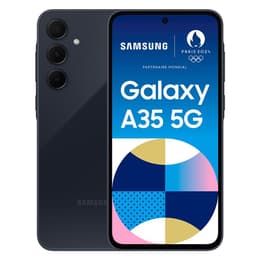
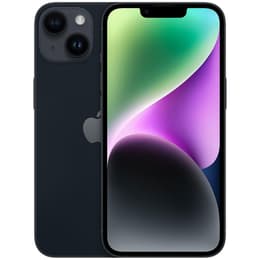


Galaxy A35 Vs iPhone 14

Galaxy A35
Galaxy A35
Starting at

Refurbished price:206.00

Versus €431.43 new

See options
iPhone 14
iPhone 14
Starting at

Refurbished price:287.25

Versus €759.00 new

See options

Ratings

The Samsung Galaxy A35, released in March 2024, and the iPhone 14, launched in September 2022, are two distinct smartphones from different ecosystems. The Galaxy A35 operates on Android with Samsung's One UI, while the iPhone 14 runs on Apple's iOS. Key differentiators include their display technologies, camera philosophies, and overall software experiences.

Scores

Durability

When considering the long-term usability of these devices, their release timelines and software support are important factors.

  • Software Longevity: The Samsung Galaxy A35, being a newer device, is promised four years of Android OS updates and five years of security updates, extending its software support well into the future. The iPhone 14, released earlier, typically receives iOS updates for approximately five to six years from its launch, meaning its software support will conclude sooner than the A35's. [1, 5, 23, 39]
  • Physical Durability: The iPhone 14 features a Ceramic Shield front cover and an IP68 rating for dust and water resistance, offering robust protection against environmental elements. The Galaxy A35 comes with Gorilla Glass Victus+ on the front and an IP67 rating, providing strong resistance to dust and water. [4, 9, 23, 43]
  • Repairability Considerations: The Galaxy A35 has a repairability score of 8.4 out of 10 in France, indicating good access to spare parts and ease of repair for many components. The iPhone 14 initially received a high repairability score due to its internal redesign making hardware more accessible, but this was later downgraded to 4 out of 10 by iFixit due to software limitations and parts pairing requirements for repairs. [11, 12, 18, 20, 21, 28, 32, 33, 37, 40]

Year of Release

2024

2022

Compatible with latest Update

Yes

Yes

OS

Android

iOS

Foldable

No

No

Performance

The performance of a smartphone is crucial for daily tasks, app usage, and multitasking efficiency.

  • Processing Power: The iPhone 14 is equipped with a powerful processor that handles demanding applications, graphics-intensive games, and complex multitasking with smooth responsiveness. The Galaxy A35 features a capable processor designed for efficient everyday use, managing common apps and moderate gaming effectively. [2, 15, 23, 30]
  • Multitasking and Storage: The iPhone 14 comes with 6GB of RAM, contributing to its fluid multitasking capabilities. It offers storage options up to 512GB. The Galaxy A35 is available with 6GB or 8GB of RAM, providing ample capacity for running multiple applications simultaneously, and offers storage up to 256GB, with the added flexibility of expandable storage via a microSD card. [1, 2, 4, 5, 7, 10, 15, 23, 29, 30]
  • Battery Endurance: The Galaxy A35 is noted for its robust 5000mAh battery, often lasting a full day and a half with typical usage, or around 7 hours of screen-on time. The iPhone 14, with its 3279mAh battery, provides up to 20 hours of video playback, offering reliable power for a full day for most users. Both devices support fast charging, though the Galaxy A35's 25W charging is slower than some competitors, and the iPhone 14 supports both Qi and MagSafe wireless charging. [1, 5, 6, 8, 9, 15, 23, 24, 27, 30]

Memory (GB)

6 GB

6 GB

Screen quality

The display is a primary interface for user interaction, and both devices offer distinct visual experiences.

  • Display Technology and Clarity: Both the iPhone 14 and Galaxy A35 feature OLED display technology, known for deep blacks and vibrant colors. The iPhone 14 has a 6.1-inch Super Retina XDR OLED display with a resolution of 2532x1170 pixels, resulting in a sharp 460 pixels per inch. The Galaxy A35 boasts a larger 6.6-inch Super AMOLED display with a 1080x2340 pixel resolution, offering a clear Full HD+ viewing experience. [1, 2, 3, 4, 15, 16, 22, 23, 24, 29, 42, 43]
  • Smoothness and Brightness: The Galaxy A35 features a 120Hz refresh rate, providing a noticeably smoother scrolling and animation experience compared to the iPhone 14's standard 60Hz refresh rate. Both displays offer good brightness levels, with the iPhone 14 reaching 800 nits typical and 1200 nits peak (HDR), and the Galaxy A35 offering 1000 nits peak brightness in high brightness mode, ensuring good visibility in various lighting conditions. [1, 2, 3, 4, 16, 22, 23, 24, 29, 43]
  • Viewing Experience: The iPhone 14's display is protected by Ceramic Shield, while the Galaxy A35 uses Gorilla Glass Victus+. The larger screen of the Galaxy A35 may appeal to users who prioritize immersive media consumption, while the iPhone 14 offers a compact yet high-quality visual experience. [4, 22, 23, 43]

Resolution

1080 x 2340

1170 x 2532

Screen type

Super AMOLED

Super Retina XDR OLED

Audiovisual

The camera systems on both smartphones are designed to capture moments, but they approach photography with different strengths.

  • Rear Camera Systems: The iPhone 14 features a dual-camera setup with a 12MP main sensor (f/1.5 with sensor-shift OIS) and a 12MP ultrawide sensor (f/2.4). The Galaxy A35 offers a triple-camera system, including a 50MP main sensor (f/1.8 with OIS), an 8MP ultrawide sensor (f/2.2), and a 5MP macro sensor (f/2.4). [3, 4, 5, 16, 23, 29, 30]
  • Photography Performance: The iPhone 14 benefits from its Photonic Engine, which enhances low-light performance and overall image quality, producing detailed and color-accurate photos. The Galaxy A35's 50MP main camera captures detailed images, often with vibrant, slightly saturated colors typical of Samsung phones, and performs well in good lighting. Its ultrawide camera is decent, but the macro camera has limited utility. [4, 5, 6, 16, 23, 31, 35]
  • Video Capabilities: Both devices are capable of recording 4K video at 30fps, with the iPhone 14 also offering 4K at 24, 25, and 60fps, along with Cinematic mode for depth-of-field effects and Action mode for stabilized footage. The Galaxy A35's video recording is generally good with its main camera, though stabilization can be inconsistent, and it cannot switch between main and ultrawide cameras at higher resolutions. Both have capable front-facing cameras, with the iPhone 14 featuring a 12MP sensor with autofocus and the Galaxy A35 a 13MP sensor. [2, 3, 4, 5, 16, 19, 23, 27, 30, 31, 35, 43]

Main camera

50 megapixels

12 megapixels

Front camera

13 megapixels

12 megapixels

Miscellaneous

Beyond core features, several practical elements contribute to the overall user experience of these smartphones.

  • Connectivity and Ports: Both the Galaxy A35 and iPhone 14 support 5G connectivity, Wi-Fi 6, and Bluetooth 5.3 for modern wireless communication. The iPhone 14 utilizes a Lightning port for charging and data transfer, while the Galaxy A35 features a USB-C port. The Galaxy A35 does not include a 3.5mm headphone jack. [2, 4, 5, 6, 23, 29]
  • Biometric Security: The iPhone 14 relies on Face ID for secure facial recognition. The Galaxy A35 incorporates an in-display fingerprint scanner for biometric authentication, offering a convenient alternative. [23, 24, 27, 29]
  • Design and Handling: The iPhone 14 has a compact design with a 6.1-inch display, weighing 172 grams. The Galaxy A35 is a larger device with a 6.6-inch display, weighing 209 grams. Both feature glass backs and flat side frames, contributing to a premium feel. The iPhone 14 has an aluminum frame, while the Galaxy A35 has a matte plastic frame. [3, 4, 27, 29, 34, 39]

Weight

209 g

172 g

Screen size (in)

6.6

6.1

Network

5G

5G

SIM card

Dual Physical SIM

Physical SIM + eSIM

Carrier compatibility

Unlocked

Unlocked

Connector

USB-C

Lightning

User sentiment for the Samsung Galaxy A35 often highlights its vibrant display, reliable battery life, and capable camera system as strong points, especially considering its positioning. Some users note that while the main camera performs well, the ultrawide and macro lenses are less impressive, and video stabilization could be improved. The design, with its glass back, is frequently praised for feeling more premium. [5, 6, 9, 24, 31, 35, 39]

For the iPhone 14, common praise centers on its consistent performance, the quality of its OLED display, and the robust iOS ecosystem. Users appreciate its strong camera performance, particularly with the Photonic Engine enhancing low-light shots, and its video capabilities including Cinematic and Action modes. A frequent point of discussion, however, is its 60Hz refresh rate, which some users find less fluid compared to higher refresh rate displays on other devices. The repairability concerns due to software-locked parts have also been noted by the repair community. [2, 4, 13, 20, 22, 23, 32, 37, 40, 42]

Users prioritizing a larger, smoother display with a 120Hz refresh rate and expandable storage may find the Samsung Galaxy A35 well-suited to their needs. Its strong battery life and commitment to software updates also make it a compelling choice for those seeking long-term Android support. Conversely, users who value a highly optimized software experience, consistent camera performance with advanced video features, and a more compact form factor may lean toward the iPhone 14. Both devices offer a quality-assured refurbished option, providing an eco-friendly alternative for consumers. Ultimately, the decision depends on individual preferences for operating system, display characteristics, and specific camera priorities.

See all articles

Our recent comparisons