
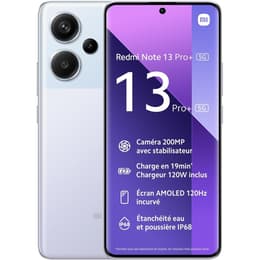


Xiaomi Redmi Note 13 Vs Xiaomi Redmi Note 13 Pro+

Xiaomi Redmi Note 13
Starting at

Refurbished price:139.00

Versus €299.00 new

See options
Xiaomi Redmi Note 13 Pro+
Starting at

Refurbished price:196.00

Versus €449.00 new

See options

Ratings

The Xiaomi Redmi Note 13 and the Xiaomi Redmi Note 13 Pro+ are two smartphones released as part of the same series, offering distinct experiences for different user needs. The Redmi Note 13, launched globally in January 2024, provides a balanced set of features for everyday use. The Redmi Note 13 Pro+, introduced in September 2023 in China and globally in January 2024, elevates several key specifications, including camera capabilities, display quality, and charging speed. Both devices operate on Android 13 with Xiaomi's MIUI 14 interface, with updates to HyperOS expected.

Scores

Durability

When considering the long-term usability of these devices, their release timelines and software support are important factors.

  • Release Timeline: The Redmi Note 13 Pro+ was initially released in September 2023, followed by a global launch in January 2024. The Redmi Note 13 also saw its global release in January 2024. This means the Redmi Note 13 Pro+ has a slightly earlier initial release date, though both became widely available around the same time.
  • Software Support: The Redmi Note 13 is expected to receive two major Android OS updates and three to four years of security updates. The Redmi Note 13 Pro+ generally offers a longer support window, with promises of three major Android OS upgrades and four years of security updates.
  • Physical Durability: The Redmi Note 13 features Corning Gorilla Glass 5 for screen protection and an IP54 rating for splash and dust resistance. The Redmi Note 13 Pro+ steps up with Corning Gorilla Glass Victus for enhanced display durability and an IP68 rating, indicating more robust protection against dust and water immersion.
  • Repairability: Both models are designed with repairability in mind for common issues such as screen, battery, and camera component replacements, with various service providers offering these services.

Year of Release

2024

2023

Compatible with latest Update

Yes

Yes

OS

Android

Android

Foldable

No

No

Performance

The performance of these smartphones is influenced by their internal components, affecting how smoothly applications run and how efficiently they manage power.

  • Processing Power: The Redmi Note 13 is equipped with a processor that handles daily tasks and light gaming smoothly. The Redmi Note 13 Pro+ features a more advanced processor, providing a noticeable boost in performance for demanding applications, intensive multitasking, and graphic-heavy games.
  • Multitasking and Responsiveness: Both devices offer various RAM configurations, with the Redmi Note 13 Pro+ generally providing higher RAM options and faster storage technology (UFS 3.1 compared to UFS 2.2 on the Redmi Note 13), contributing to quicker app loading and more fluid transitions between applications.
  • Battery Behavior: Both phones house a 5000mAh battery. The Redmi Note 13 typically offers over a day of usage, with some users reporting up to 1.5 days on a single charge. The Redmi Note 13 Pro+ also provides a full day of use, though some active use tests suggest its battery life might be less impressive despite the capacity, potentially due to its more powerful components and higher resolution display.
  • Charging Speed: A significant difference lies in charging. The Redmi Note 13 supports 33W fast charging, capable of reaching a substantial charge in about half an hour. The Redmi Note 13 Pro+ boasts 120W fast charging, allowing for a full charge in a significantly shorter time, often under 30 minutes.

Memory (GB)

6 GB

12 GB

Screen quality

The visual experience on both devices is delivered through their displays, which share some characteristics while offering key distinctions.

  • Display Technology: Both smartphones feature a 6.67-inch AMOLED display, known for producing deep blacks and vibrant colors.
  • Resolution and Clarity: The Redmi Note 13 offers a Full HD+ resolution (1080x2400 pixels), providing clear and sharp visuals for everyday content. The Redmi Note 13 Pro+ steps up to a 1.5K resolution (2712x1220 pixels), offering a slightly crisper image with finer detail, which can be noticeable when viewing high-resolution media.
  • Brightness and Refresh Rate: Both models feature a 120Hz refresh rate for smooth scrolling and animations, and both can reach a peak brightness of 1800 nits, ensuring good visibility even in bright outdoor conditions.
  • Design and Protection: The Redmi Note 13 has a flat display protected by Corning Gorilla Glass 5. The Redmi Note 13 Pro+ features a curved display with the more durable Corning Gorilla Glass Victus, contributing to a more premium feel and enhanced scratch resistance.

Resolution

1080 x 2400

1220 x 2712

Screen type

AMOLED

AMOLED

Audiovisual

The camera systems on these devices offer different capabilities, particularly in their main sensors and overall image processing.

  • Main Camera: The Redmi Note 13 is equipped with a 108-megapixel main camera that performs well in daylight, capturing detailed images with balanced contrast and saturation. The Redmi Note 13 Pro+ features a 200-megapixel main camera, utilizing a larger sensor for potentially better light gathering and finer detail, especially in well-lit conditions.
  • Ultra-wide and Macro Lenses: Both phones include an 8-megapixel ultra-wide camera and a 2-megapixel macro camera. User feedback suggests that while the main cameras are capable, the performance of the ultra-wide and macro lenses on both models is generally considered adequate but not exceptional, particularly in challenging lighting.
  • Low-Light Photography: The Redmi Note 13 uses automatic night mode processing for low-light shots, yielding likable results with good exposure. The Redmi Note 13 Pro+ also shows impressive low-light performance from its main camera, producing detailed photos with good dynamic range and minimal noise.
  • Video Recording: The Redmi Note 13 records video at 1080p, with natural colors but sometimes lacking in dynamic range. The Redmi Note 13 Pro+ supports 4K video recording with its main camera, offering a higher level of detail and good electronic stabilization.
  • Selfie Camera: Both devices feature a 16-megapixel front-facing camera, capable of capturing selfies with good detail and natural colors in favorable lighting.

Main camera

108 megapixels

200 megapixels

Front camera

16 megapixels

16 megapixels

Miscellaneous

Beyond the core specifications, several other features contribute to the overall user experience and practical utility of these smartphones.

  • Connectivity: Both devices support 5G connectivity. The Redmi Note 13 supports Wi-Fi 5Ghz and Bluetooth v5.1, while the Redmi Note 13 Pro+ offers Wi-Fi 6 and Bluetooth v5.3, providing faster and more stable wireless connections.
  • Ports and Audio: The Redmi Note 13 includes a 3.5mm headphone jack, a feature absent on the Redmi Note 13 Pro+. Both phones utilize a USB Type-C port for charging and data transfer and feature stereo speakers with Dolby Atmos support for an enhanced audio experience.
  • Biometric Security: The Redmi Note 13 (5G variant) typically features a side-mounted fingerprint sensor. The Redmi Note 13 Pro+ incorporates an in-display fingerprint sensor, offering a more integrated and often faster unlocking experience. Both also support face recognition.
  • Build Materials and Dimensions: The Redmi Note 13 has a flat-edged design, measuring 7.97mm thick and weighing around 190g. The Redmi Note 13 Pro+ has a slightly thicker profile at 8.9mm and weighs 204.5g, featuring curved edges and a glass back that contributes to a more premium feel.

Weight

175 g

204 g

Screen size (in)

6.67

6.67

Network

4G

5G

SIM card

Dual Physical SIM

Dual Physical SIM

Carrier compatibility

Unlocked

Unlocked

User feedback for the Redmi Note 13 often highlights its strong display, reliable performance for daily tasks, and generally good battery life as key strengths. Some users note that its ultra-wide and macro cameras are functional but not outstanding, and that its battery life, while good, might not be class-leading in all scenarios.

The Redmi Note 13 Pro+ receives praise for its premium design, vibrant and high-resolution curved display, and impressive main camera performance, particularly in good lighting. Its exceptionally fast 120W charging is also a frequently lauded feature. Common criticisms include the inconsistent performance of its secondary cameras (ultra-wide and macro) and the presence of pre-installed applications. Some users also find its battery life, despite the large capacity, to be average in active use, though the rapid charging mitigates this concern for many.

Users prioritizing a device for everyday communication, media consumption, and light productivity, who appreciate a headphone jack and solid overall performance, may find the Redmi Note 13 well-suited to their needs. Those who seek a more premium build, a sharper display, significantly faster charging, and a more capable main camera for photography, even if it means a slightly higher investment and the absence of a headphone jack, will likely lean towards the Redmi Note 13 Pro+. Both devices offer a quality-assured refurbished option, providing a sustainable choice for consumers.


See all articles

Our recent comparisons