

iPhone 16 Pro Vs Xiaomi Redmi Note 13 Pro+

iPhone 16 Pro
iPhone 16 Pro
Starting at

Refurbished price:650.00

Versus €1,239.00 new

See options
Xiaomi Redmi Note 13 Pro+
Starting at

Refurbished price:198.00

Versus €449.00 new

See options

Ratings

The iPhone 16 Pro, released in September 2024, and the Xiaomi Redmi Note 13 Pro+, launched in January 2024, represent distinct approaches to modern smartphone design and functionality. While both devices offer advanced features, they cater to different user priorities through their core specifications and overall ecosystem. The iPhone 16 Pro emphasizes a refined user experience with its proprietary operating system and advanced imaging capabilities, whereas the Redmi Note 13 Pro+ focuses on high-resolution photography and rapid charging technology.

Scores

Durability

When considering the long-term usability of these devices, several factors contribute to their expected practical lifespan, including software support and physical resilience.

  • Software Longevity: The iPhone 16 Pro, running on iOS 18 at launch and currently on iOS 26.4, typically receives operating system updates for an extended period, often five to six years from its release. This provides a longer window for accessing new features and security enhancements. The Redmi Note 13 Pro+, initially on Android 13, is upgradable to Android 14 and is expected to receive major Android updates for approximately three years and security patches for four years, aligning with common support cycles for its segment.
  • Physical Durability: Both smartphones offer robust protection against environmental elements. The iPhone 16 Pro features a Ceramic Shield front and a titanium frame, contributing to its overall resilience. It also carries an IP68 rating for dust and water resistance, allowing submersion up to 6 meters for 30 minutes. The Redmi Note 13 Pro+ is protected by Corning Gorilla Glass Victus on its display and also boasts an IP68 rating, signifying strong resistance to dust and water.
  • Repairability: While specific repairability scores can vary, both manufacturers design their devices with a balance of durability and serviceability. Users considering a quality-assured refurbished option for either model can expect devices that have undergone thorough testing and repair to ensure functionality and longevity.

Year of Release

2024

2023

Compatible with latest Update

Yes

Yes

Foldable

No

No

Performance

The performance of a smartphone is largely determined by its internal processing power, memory, and storage solutions, impacting everything from app responsiveness to multitasking efficiency.

  • Processing Power: The iPhone 16 Pro is equipped with Apple's A18 Pro chip, featuring a 6-core CPU, 6-core GPU, and a 16-core Neural Engine. This architecture is designed for demanding applications, complex graphics, and advanced machine learning tasks, providing a fluid experience across the iOS ecosystem. The Redmi Note 13 Pro+ utilizes the MediaTek Dimensity 7200-Ultra processor, an octa-core chip built on a 4nm process. This processor delivers capable performance for everyday use, gaming, and multitasking within the Android environment.
  • Multitasking and Storage: The iPhone 16 Pro comes with 8GB of memory and offers storage configurations ranging from 128GB to 1TB. The Redmi Note 13 Pro+ is available with 8GB or 12GB of memory, with an option for up to 12GB of memory extension, and storage options of 256GB or 512GB using UFS 3.1 technology. Both devices provide ample storage for applications, media, and documents, with the iPhone offering a higher maximum capacity.
  • Battery Behavior: The iPhone 16 Pro features a larger battery than its predecessor, rated for up to 27 hours of video playback by Apple, and showing around 18 hours of active use in some tests. The Redmi Note 13 Pro+ houses a 5000mAh battery, which, despite its size, has shown varied results in active use tests, sometimes requiring more frequent charging for heavy users. However, its 120W HyperCharge technology allows for exceptionally fast charging, reaching a full charge in approximately 19-25 minutes.

Memory (GB)

8 GB

12 GB

Screen quality

The display is a primary interface for smartphone interaction, and both devices offer high-quality viewing experiences with distinct characteristics.

  • Display Technology and Clarity: The iPhone 16 Pro features a 6.3-inch Super Retina XDR OLED display with a resolution of 2622 x 1206 pixels, resulting in a pixel density of 460 ppi. The Redmi Note 13 Pro+ sports a slightly larger 6.67-inch AMOLED display with a 2712 x 1220 pixel resolution, offering a pixel density of 446 ppi. Both displays provide sharp visuals and deep blacks characteristic of OLED technology.
  • Brightness and Refresh Rate: Both phones feature a 120Hz refresh rate, ensuring smooth scrolling and responsive interactions. The iPhone 16 Pro offers a typical brightness of 1000 nits and a peak outdoor brightness of 2000 nits, with a minimum brightness of 1 nit for comfortable low-light viewing. The Redmi Note 13 Pro+ reaches a peak brightness of 1800 nits and supports HDR10+ and Dolby Vision, enhancing media consumption with vibrant colors and dynamic contrast.
  • Design and Protection: The iPhone 16 Pro has thinner display borders and Ceramic Shield protection. The Redmi Note 13 Pro+ features a curved display protected by Corning Gorilla Glass Victus, which some users find enhances the immersive viewing experience and makes swiping gestures more fluid.

Resolution

1206 x 2622

1220 x 2712

Screen type

LTPO Super Retina XDR OLED

AMOLED

Audiovisual

Photography and videography capabilities are key considerations for many users, and both the iPhone 16 Pro and Redmi Note 13 Pro+ offer advanced camera systems.

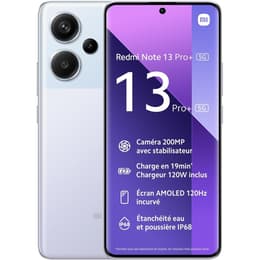
  • Rear Camera Systems: The iPhone 16 Pro boasts a versatile triple-camera setup, including a 48MP wide lens with sensor-shift OIS, a 48MP ultra-wide lens, and a 12MP telephoto lens offering 5x optical zoom. It supports 4K video recording at up to 120 frames per second and ProRes video. The Redmi Note 13 Pro+ features a 200MP main camera with OIS and EIS, an 8MP ultra-wide camera, and a 2MP macro lens. Its 200MP sensor allows for up to 4x lossless zoom, providing detailed images even when digitally magnified.
  • Low-Light and Video Performance: Both devices are capable in low-light conditions, with the iPhone 16 Pro's larger sensors and computational photography excelling in capturing detail and managing noise. The Redmi Note 13 Pro+'s 200MP main sensor with pixel binning also performs well in challenging lighting. For video, the iPhone 16 Pro offers higher frame rates for 4K recording, including spatial video capabilities. The Redmi Note 13 Pro+ records 4K video at 30fps from its main camera.
  • Front Camera and Audio: The iPhone 16 Pro includes a 12MP front camera with autofocus and OIS. The Redmi Note 13 Pro+ features a 16MP front camera. Both phones offer stereo speakers, with the Redmi Note 13 Pro+ supporting Dolby Atmos for an enhanced audio experience. The iPhone 16 Pro also includes improved audio recording features like wind reduction.

Main camera

48 megapixels

200 megapixels

Front camera

12 megapixels

16 megapixels

Miscellaneous

Beyond core performance and display, practical features like connectivity, physical design, and biometric security contribute to the overall user experience.

  • Connectivity and Ports: The iPhone 16 Pro supports the latest Wi-Fi 7 standard, Bluetooth 5.3, and 5G connectivity, along with a second-generation Ultra Wideband chip for enhanced spatial awareness. It uses a USB-C port for charging and data transfer. The Redmi Note 13 Pro+ also offers Wi-Fi, Bluetooth, and 5G connectivity, featuring a USB Type-C port. Neither device includes a traditional 3.5mm headphone jack.
  • Physical Design and Handling: The iPhone 16 Pro has dimensions of 149.6 x 71.5 x 8.25 mm and weighs 199 grams, featuring a titanium frame. The Redmi Note 13 Pro+ measures 161.4 x 74.2 x 8.9 mm and weighs 204.5 grams. Its curved design, while visually appealing, may make it prone to slipping for some users, suggesting the use of a protective case. The iPhone 16 Pro also introduces a new Camera Control button for quick access to camera functions.
  • Biometric Security: The iPhone 16 Pro relies on Face ID for secure facial recognition. The Redmi Note 13 Pro+ incorporates an in-screen fingerprint scanner for biometric authentication, which users generally find to be responsive and accurate.

Weight

199 g

204 g

Screen size (in)

6.3

6.67

Network

5G

5G

SIM card

eSIM

Dual Physical SIM

Carrier compatibility

Unlocked

Unlocked

The iPhone 16 Pro and Xiaomi Redmi Note 13 Pro+ offer distinct strengths, making them suitable for different user preferences. Users often praise the iPhone 16 Pro for its powerful processing capabilities, consistent software experience, and advanced camera system, particularly its video recording features and the new Camera Control button. Some users, however, have noted that while battery life is improved over previous models, it may still require daily charging for heavy use.

The Redmi Note 13 Pro+ is frequently lauded for its stunning high-resolution AMOLED display, incredibly fast 120W charging, and its 200MP main camera which delivers detailed photos, especially with its 4x lossless zoom. Common criticisms sometimes point to its battery life, which, despite a large capacity, can be inconsistent for power-intensive tasks, though software updates have shown to improve this for some users. The MIUI interface, while customizable, may also contain pre-installed applications that some users prefer to avoid.

Users prioritizing a highly integrated ecosystem, long-term software support, and advanced video capabilities may find the iPhone 16 Pro aligns better with their needs. Those who value a vibrant, large display, exceptionally fast charging, and high-megapixel photography with versatile zoom options might lean towards the Redmi Note 13 Pro+. Both devices represent strong contenders in their respective categories, and for those seeking a more sustainable choice, exploring quality-assured refurbished options for either model can provide an excellent way to access these technologies.


See all articles

Our recent comparisons