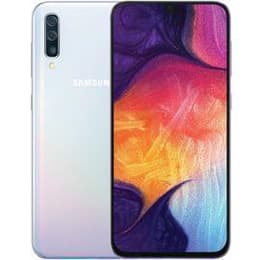
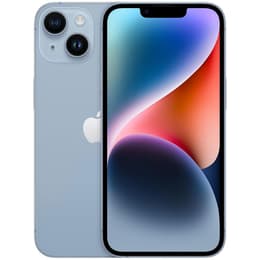


Galaxy A50 Vs iPhone 14

Galaxy A50
Galaxy A50
Starting at

Refurbished price:107.00

Versus €349.00 new

See options
iPhone 14
iPhone 14
Starting at

Refurbished price:287.25

Versus €759.00 new

See options

Ratings

The Samsung Galaxy A50, released in February 2019, and the iPhone 14, launched in September 2022, represent distinct approaches to smartphone design and functionality from different eras. The Galaxy A50 operates on the Android platform, offering a customizable experience, while the iPhone 14 runs on iOS, known for its integrated ecosystem. A primary differentiator lies in their release timelines, leading to significant differences in processing power, camera capabilities, and software support. Both devices, however, can be considered as quality-assured refurbished options, providing an eco-friendly alternative for consumers.

Scores

Durability

The practical lifespan and software support differ considerably between these two devices due to their respective release dates.

  • Release Timeline: The Samsung Galaxy A50, launched in early 2019, has reached the end of its major Android operating system update cycle, having received updates up to Android 11. In contrast, the iPhone 14, released in late 2022, benefits from Apple's extended software support, ensuring several more years of iOS updates and security patches.
  • Software Longevity: Users prioritizing long-term software support and access to the latest features will find the iPhone 14 more suitable, as it will continue to receive updates for a significantly longer period. The Galaxy A50 will continue to function, but without new OS features or the latest security enhancements.
  • Physical Durability: The iPhone 14 features a Ceramic Shield front and a glass back within an aerospace-grade aluminum frame, contributing to its robust build. It also boasts an IP68 rating for dust and water resistance, allowing submersion up to 6 meters for 30 minutes. The Galaxy A50 utilizes a plastic back and frame with a Gorilla Glass 3 front, offering a less premium feel and lacking an official IP rating for water and dust resistance.

Year of Release

2019

2022

Compatible with latest Update

No

Yes

OS

Android

iOS

Foldable

No

No

Performance

Performance capabilities vary significantly, reflecting the technological advancements between their release years.

  • Processing Power: The iPhone 14 is equipped with a current-generation processor, delivering fast app loading times, smooth multitasking, and responsive navigation. This allows it to handle demanding applications and graphics-intensive games with ease. The Galaxy A50, powered by its processor, performs well for everyday tasks like web browsing and social media, but may experience slowdowns with numerous apps open or during intensive gaming sessions.
  • Multitasking and Storage: The iPhone 14 comes with 6GB of RAM and offers internal storage options up to 512GB, providing ample space and smooth operation for multiple applications. The Galaxy A50 was available with 4GB or 6GB of RAM and 64GB or 128GB of internal storage, with the added flexibility of expandable storage via a microSD card up to 512GB.
  • Battery Behavior: The iPhone 14 is designed for efficient power management, offering reliable battery life for typical daily use. The Galaxy A50 features a 4000mAh battery, which some users found sufficient for a full day of moderate use, while others reported it to be underwhelming under heavy usage.

Memory (GB)

4 GB

6 GB

Screen quality

Both devices offer vibrant displays, but with differences in technology and specifications that impact the viewing experience.

  • Display Technology and Clarity: The iPhone 14 features a 6.1-inch Super Retina XDR OLED display with a resolution of 2532x1170 pixels, resulting in sharp text and detailed images. The Galaxy A50 has a larger 6.4-inch Super AMOLED Infinity-U display with a 2340x1080 pixel FHD+ resolution. Both OLED technologies deliver deep blacks and vibrant colors.
  • Brightness and Outdoor Visibility: The iPhone 14 offers a typical maximum brightness of 800 nits, with a peak brightness of 1200 nits for HDR content, enhancing visibility in bright outdoor conditions. The Galaxy A50's display provides good brightness for indoor use, but may be less visible under direct sunlight compared to the iPhone 14.
  • Refresh Rate and Smoothness: Both the iPhone 14 and the Galaxy A50 feature a standard 60Hz refresh rate, providing a consistent visual experience for most content. This means scrolling and animations will appear smooth, though not as fluid as devices with higher refresh rates.

Resolution

1080 x 2340

1170 x 2532

Screen type

Super AMOLED

Super Retina XDR OLED

Audiovisual

The camera systems on these smartphones reflect different generations of mobile photography, impacting image and video output.

  • Rear Camera System: The iPhone 14 features a dual-camera system with a 12MP main sensor (f/1.5 aperture, sensor-shift optical image stabilization) and a 12MP ultra-wide sensor (f/2.4 aperture, 120° field of view). It incorporates advanced computational photography features like Photonic Engine and Night mode for improved low-light performance. The Galaxy A50 offers a triple rear camera setup, including a 25MP main sensor (f/1.7 aperture), an 8MP ultra-wide sensor (f/2.2 aperture), and a 5MP depth sensor.
  • Front Camera and Video: For selfies, the iPhone 14 includes a 12MP TrueDepth front camera with autofocus and Photonic Engine, enhancing clarity and detail. It supports video recording up to 4K Dolby Vision HDR at 60 frames per second, along with Cinematic mode and Action mode for stabilized video. The Galaxy A50 has a 25MP front-facing camera, which received positive feedback for its detail. Its video recording is limited to 1080p.
  • Audio Experience: The iPhone 14 provides a clear audio experience for calls and media consumption through its stereo speakers. The Galaxy A50 offers a standard audio output suitable for everyday use.

Main camera

25 megapixels

12 megapixels

Front camera

25 megapixels

12 megapixels

Miscellaneous

Beyond core features, several practical elements differentiate the user experience of these two devices.

  • Connectivity: The iPhone 14 supports 5G cellular networks, Wi-Fi 6, and Bluetooth 5.3, offering faster data speeds and more reliable wireless connections. The Galaxy A50 supports 4G LTE, Wi-Fi 802.11ac, and Bluetooth 5.0.
  • Ports and Biometrics: The iPhone 14 uses a Lightning port for charging and data transfer and relies on Face ID for secure facial recognition. It does not include a traditional headphone jack. The Galaxy A50 features a USB-C port, a 3.5mm headphone jack, and an in-display fingerprint sensor for unlocking.
  • Design and Handling: The iPhone 14 measures 146.7 x 71.5 x 7.8 mm and weighs 172 grams, offering a compact and manageable form factor. The Galaxy A50 is slightly larger at 158.5 x 74.7 x 7.7 mm and weighs 166 grams, providing a larger screen in a relatively lightweight build. The iPhone 14's build materials include Ceramic Shield and aerospace-grade aluminum, while the Galaxy A50 uses a plastic construction.

Weight

166 g

172 g

Screen size (in)

6.4

6.1

Network

4G

5G

SIM card

Dual Physical SIM

Physical SIM + eSIM

Carrier compatibility

Unlocked

Unlocked

Connector

USB-C + Jack 3.5mm

Lightning

The Samsung Galaxy A50 and the iPhone 14 cater to different user expectations, largely influenced by their release timelines and operating systems. User feedback for the Galaxy A50, particularly around its launch, often praised its Super AMOLED display and capable camera for its segment, though some noted its performance could be strained by heavy use and its battery life was sometimes described as underwhelming. The iPhone 14, on the other hand, is consistently lauded for its robust performance, advanced camera system with features like Photonic Engine, and the reliability of the iOS ecosystem.

Users prioritizing a modern, high-performance device with extensive software support, advanced camera features, and a strong emphasis on durability and security will find the iPhone 14 well-suited to their needs. Its efficient processor handles demanding applications smoothly, and its IP68 water resistance provides added peace of mind. Conversely, users seeking a device for essential daily tasks, who appreciate expandable storage and a traditional headphone jack, might consider the Galaxy A50. While it no longer receives major OS updates, it remains a functional device for basic communication and media consumption. When making a choice, considering quality-assured refurbished options for either model can be a sustainable way to acquire technology.
See all articles

Our recent comparisons






