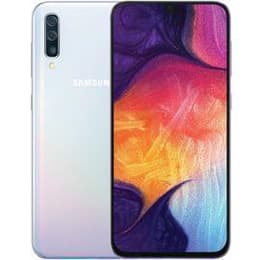
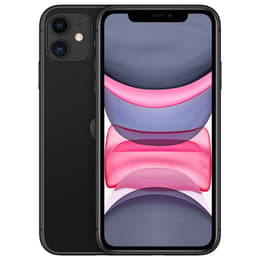


Galaxy A50 Vs iPhone 11

Galaxy A50
Galaxy A50
Starting at

Refurbished price:107.00

Versus €349.00 new

See options
iPhone 11
iPhone 11
Starting at

Refurbished price:153.79

Versus €639.00 new

See options

Ratings

The Samsung Galaxy A50, released in February 2019, and the Apple iPhone 11, launched in September 2019, are smartphones from the same year that cater to different user preferences. While the Galaxy A50 offers an Android experience with a vibrant AMOLED display, the iPhone 11 provides Apple's iOS ecosystem with a focus on robust performance and camera capabilities. Both devices present distinct approaches to smartphone design and functionality.

Scores

Durability

When considering the long-term usability of these devices, their release timelines and software support play a significant role.

  • Release Timeline: The Samsung Galaxy A50 was introduced in early 2019, while the iPhone 11 followed later in September of the same year. This difference in launch dates impacts their respective software support cycles.
  • Software Longevity: The Galaxy A50 received major Android OS updates up to Android 11 and its official security updates concluded around April 2023. In contrast, the iPhone 11 is anticipated to receive major iOS updates, likely up to iOS 26 in Fall 2026, with security patches continuing for an additional one to two years, aligning with Apple's typical seven-year support trend. This suggests a longer period of active software support for the iPhone 11.
  • Repairability: The Galaxy A50 has a repairability score of 7.0 out of 10, with accessible battery and screen components, though adhesive is used for the back cover and battery. The iPhone 11 has a repairability score of 6 out of 10, with critical display and battery repairs being prioritized in its design.

Year of Release

2019

2019

Compatible with latest Update

No

Yes

OS

Android

iOS

Foldable

No

No

Performance

The performance of a smartphone dictates its responsiveness and ability to handle various applications and tasks.

  • Storage Options: The Galaxy A50 offers configurations with 64GB or 128GB of internal storage, expandable via a microSD card up to 512GB. The iPhone 11 is available with 64GB, 128GB, or 256GB of internal storage, without expandable options.
  • Everyday Task Handling: The Galaxy A50's processor handles basic tasks like email, web browsing, and social media adequately, but users may experience slowdowns when more than half a dozen apps are open or during demanding gaming. The iPhone 11, equipped with a more powerful processor, delivers very good performance, handling demanding apps and multitasking smoothly, with users reporting it remains responsive even years after its release.
  • Battery Behavior: The Galaxy A50 features a 4000 mAh battery, which generally provides a full day of use for many users, even with heavy usage. The iPhone 11 comes with a 3110 mAh battery, and many users report it can also last through a full day of typical use.

Memory (GB)

4 GB

4 GB

Screen quality

The display is a primary interface for smartphone interaction, and both devices offer different visual experiences.

  • Display Technology and Clarity: The Samsung Galaxy A50 features a 6.4-inch Super AMOLED display with a resolution of 2340 x 1080 pixels, providing deep blacks and vibrant colors. The iPhone 11 has a 6.1-inch Liquid Retina HD display, which is an IPS LCD panel with a resolution of 1792 x 828 pixels. While the iPhone 11's display offers good color accuracy, the Galaxy A50's AMOLED technology generally provides higher contrast.
  • Brightness Levels: The iPhone 11 offers a typical maximum brightness of 625 nits. The Galaxy A50's Super AMOLED display is also known for being bright and contrasty, suitable for various lighting conditions.
  • Screen Size and Viewing: The Galaxy A50 provides a slightly larger 6.4-inch screen compared to the iPhone 11's 6.1-inch display, which can offer a more expansive viewing experience for media consumption.

Resolution

1080 x 2340

828 x 1792

Screen type

Super AMOLED

Liquid Retina IPS LCD

Audiovisual

Camera systems are a key differentiator, influencing how users capture and share their experiences.

  • Rear Camera System: The Galaxy A50 is equipped with a triple rear camera setup, including a 25MP wide lens, an 8MP ultra-wide lens, and a 5MP depth sensor. The iPhone 11 features a dual 12MP rear camera system, comprising a wide and an ultra-wide lens.
  • Photography Performance: The Galaxy A50 performs well in bright light conditions, capturing well-defined subjects and accurate colors, but its low-light performance is less impressive. The iPhone 11 is praised for its camera quality, especially its Night mode, which significantly improves low-light photography, and its Deep Fusion feature for enhanced image processing.
  • Video Recording Quality: The iPhone 11 offers strong video recording capabilities, including 4K video at various frame rates, with excellent image stabilization. The Galaxy A50's default camera app limits video recording to 1080p, despite its chipset supporting 4K.

Main camera

25 megapixels

12 megapixels

Front camera

25 megapixels

12 megapixels

Miscellaneous

Beyond core features, several practical elements contribute to the overall user experience.

  • Connectivity Options: Both devices support 4G LTE, Wi-Fi, and Bluetooth. The iPhone 11 does not support 5G networking, which is available on later models.
  • Port Types: The Galaxy A50 includes a USB-C port and a 3.5mm headphone jack. The iPhone 11 uses Apple's proprietary Lightning connector and does not feature a headphone jack.
  • Biometric Security: The Galaxy A50 incorporates an in-display optical fingerprint scanner, though some users have reported it can be inconsistent. The iPhone 11 relies on Face ID for secure facial recognition.
  • Build Materials and Dimensions: The Galaxy A50 has a plastic build with a glass front, weighing 166g. The iPhone 11 features a glass front and back with an aluminum frame, weighing 194g. The iPhone 11 also carries an IP68 rating for water and dust resistance, meaning it can withstand submersion in up to 2 meters of water for 30 minutes.

Weight

166 g

194 g

Width

7,47 cm

7,57 cm

Height

15,85 cm

15,09 cm

Depth

0,77 cm

0,83 cm

Screen size (in)

6.4

6.1

Network

4G

4G

SIM card

Dual Physical SIM

Physical SIM + eSIM

Carrier compatibility

Unlocked

Unlocked

Connector

USB-C + Jack 3.5mm

Lightning

User sentiment for the Samsung Galaxy A50 often highlights its excellent Super AMOLED display and generally good battery life as strong points. Criticisms frequently mention its just-average performance, particularly with multiple apps open or during gaming, and the inconsistent in-display fingerprint sensor. The camera is generally considered good in daylight but struggles in low-light conditions.

For the iPhone 11, users consistently praise its robust performance, capable camera system (especially Night mode and video quality), and reliable battery life. Common concerns include the LCD display, which some find less vibrant than OLED alternatives, and the lack of expandable storage.

Users prioritizing a vibrant, high-contrast display and expandable storage, along with the Android ecosystem, may find the Galaxy A50 well-suited to their needs. It offers a solid experience for everyday tasks and media consumption. Conversely, users who prioritize consistent, powerful performance, superior camera capabilities for both photos and videos (especially in challenging lighting), and the long-term software support of iOS may lean toward the iPhone 11. Both devices, available as quality-assured refurbished options, present an eco-friendly alternative for consumers seeking reliable smartphones.

See all articles

Our recent comparisons







