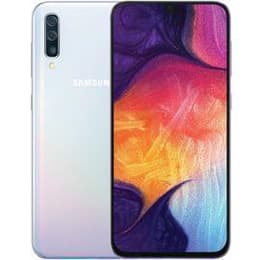



Compare models
Galaxy A50 Vs Galaxy S20
- 1-year minimum warranty
- Free delivery on all orders
- Free 30-day returns
Differences at a glance
The Samsung Galaxy A50, released in February 2019, and the Samsung Galaxy S20, launched in February 2020, represent different tiers within Samsung's smartphone lineup. While both devices run on the Android operating system with Samsung's One UI, the Galaxy S20 introduces a more advanced display, enhanced camera capabilities, and a more powerful internal architecture compared to its predecessor. These distinctions cater to varying user expectations regarding performance and features.
Available Models
Colour
Storage (GB)
Scores
Durability
The longevity of a smartphone is influenced by its initial release date and the duration of software support it receives.
- Release Timeline: The Galaxy A50 was released in February 2019, making it an older device compared to the Galaxy S20, which launched in February 2020. This one-year difference impacts their respective software support cycles.
- Software Support: The Galaxy A50 originally shipped with Android 9 and received updates up to Android 11, with official software support concluding in April 2023. The Galaxy S20, starting with Android 10, was updated to Android 13, and its software support officially ended in March 2025. This means the Galaxy S20 offered a longer period of official updates.
- Repairability: The Galaxy A50 generally has a repairability score of 7.0 out of 10, indicating relatively accessible components like the battery and screen. The Galaxy S20 also has a repairability score of 7.0 out of 10, with positives including accessible battery and screen components, though adhesive use for the back cover and battery is noted as a negative.
Year of Release
2019
2020
Compatible with latest Update
No
No
OS
Android
Android
Foldable
No
No
Performance
Performance differences between these two models are notable, impacting daily usage from app responsiveness to multitasking capabilities.
- Processing Power: The Galaxy A50 is equipped with an internal processor that handles everyday tasks smoothly, suitable for general browsing, social media, and light gaming. The Galaxy S20 features a more advanced processor, providing significantly faster speeds and smoother operation for demanding applications, intensive gaming, and efficient multitasking.
- Memory and Storage: The Galaxy A50 typically comes with 4GB or 6GB of RAM and 64GB or 128GB of internal storage, with expandable storage via a microSD card. The Galaxy S20 offers higher base memory configurations, usually 8GB or 12GB of RAM, paired with 128GB of internal storage, also supporting expandable storage. This increased RAM on the S20 contributes to more fluid multitasking.
- Battery Behavior: Both devices house a 4000mAh battery. While the Galaxy A50 is often noted for its solid battery life in typical use, the Galaxy S20's more powerful components and higher refresh rate display can lead to more rapid battery consumption, especially with heavy use. However, the S20 supports faster wired charging and includes wireless and reverse wireless charging capabilities, which the A50 lacks.
Screen quality
The visual experience on these devices differs significantly due to advancements in display technology.
- Display Technology and Resolution: The Galaxy A50 features a 6.4-inch Super AMOLED display with a resolution of 1080x2340 pixels. The Galaxy S20 boasts a 6.2-inch Dynamic AMOLED 2X display, offering a sharper resolution of 1440x3200 pixels. This results in a noticeably clearer and more detailed image on the S20.
- Refresh Rate and Smoothness: The Galaxy A50 has a standard 60Hz refresh rate, providing a smooth but conventional viewing experience. The Galaxy S20 elevates this with a 120Hz refresh rate, which makes scrolling, animations, and gaming appear significantly smoother and more fluid.
- Brightness and Protection: Both displays offer vibrant colors and deep blacks characteristic of AMOLED technology. The Galaxy S20's Dynamic AMOLED 2X panel generally achieves higher peak brightness, improving visibility in bright outdoor conditions. The A50 uses Corning Gorilla Glass 3 for screen protection, while the S20 features the more robust Corning Gorilla Glass 6.
Resolution
1080 x 2340
1440 x 3200
Screen type
Super AMOLED
Dynamic AMOLED 2X
Audiovisual
Camera capabilities are a key differentiator, with the Galaxy S20 offering a more advanced imaging system.
- Rear Camera System: The Galaxy A50 features a triple rear camera setup with a 25-megapixel main sensor, an 8-megapixel ultrawide lens, and a 5-megapixel depth sensor. It is capable of recording video at 1080p. The Galaxy S20 also has a triple rear camera system, but with a 12-megapixel wide lens, a 64-megapixel telephoto lens, and a 12-megapixel ultrawide lens. This configuration allows for greater versatility, including improved zoom capabilities and better low-light performance.
- Video Recording: The Galaxy S20 significantly outperforms the A50 in video recording, offering the ability to capture 4K video at 60 frames per second and even 8K video, which is a substantial upgrade from the A50's 1080p limit.
- Front Camera and Audio: The Galaxy A50 has a 25-megapixel front camera. The Galaxy S20 features a 10-megapixel front camera, which, despite a lower megapixel count, often produces higher quality selfies due to better processing. Both devices include loudspeakers, and the Galaxy A50 retains a 3.5mm headphone jack, which is absent on the Galaxy S20.
Main camera
25 megapixels
12 megapixels
Front camera
25 megapixels
10 megapixels
Miscellaneous
Beyond core features, several practical elements distinguish these two smartphones.
- Connectivity: The Galaxy A50 supports 4G LTE, Wi-Fi 802.11 a/b/g/n/ac, and Bluetooth 5.0. The Galaxy S20 offers more advanced connectivity, including 5G support (depending on the variant), Wi-Fi 6 (802.11ax), and Bluetooth 5.0, providing faster and more reliable wireless connections.
- Ports and Sensors: The Galaxy A50 includes a USB-C port for charging and data transfer, along with a 3.5mm headphone jack. It features an in-display optical fingerprint sensor. The Galaxy S20 uses a USB-C port but omits the headphone jack. It incorporates an ultrasonic in-display fingerprint sensor and supports face recognition.
- Build and Durability: The Galaxy A50 has a plastic back, contributing to its lighter weight of 166g. The Galaxy S20 features a glass back (Gorilla Glass 6) and an aluminum frame, weighing 163g. The S20 also boasts an IP68 rating for dust and water resistance, a feature not present on the A50, offering enhanced protection against environmental elements.
Weight
166 g
163 g
Width
7,47 cm
6,91 cm
Height
15,85 cm
15,17 cm
Depth
0,77 cm
0,79 cm
Screen size (in)
6.4
6.2
Network
4G
4G
SIM card
Dual Physical SIM
Dual Physical SIM
Carrier compatibility
Unlocked
Unlocked
Connector
USB-C + Jack 3.5mm
USB-C
What the community thinks
The Samsung Galaxy A50 and Galaxy S20 cater to different user priorities, reflecting their respective positions in Samsung's product hierarchy. Users often praise the Galaxy A50 for its solid battery life and vibrant Super AMOLED display, especially considering its release year. However, common criticisms point to its more modest performance and camera capabilities compared to higher-end devices.
Conversely, the Galaxy S20 is frequently lauded for its exceptional Dynamic AMOLED 2X display with a high refresh rate, powerful performance, and versatile camera system capable of advanced video recording. Some users, however, note that its advanced features can lead to faster battery drain, and the absence of a headphone jack might be a drawback for some.
Users prioritizing a smooth, high-performance experience with advanced camera features and a premium display will find the Galaxy S20 well-suited to their needs. Its faster processor, higher refresh rate screen, and IP68 water resistance make it a more robust option for demanding tasks and environments. On the other hand, individuals seeking a reliable device for everyday communication, media consumption, and casual use, who may also appreciate the presence of a headphone jack, might find the Galaxy A50 to be a practical choice. Both models are available as quality-assured refurbished options, providing an eco-friendly alternative for consumers.