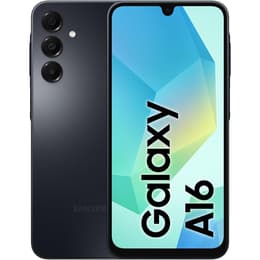



Galaxy A16 Vs iPhone 17

Galaxy A16
Galaxy A16
Starting at

Refurbished price:134.00

Versus €250.00 new

See options
iPhone 17
iPhone 17
Starting at

Refurbished price:704.00

Versus €979.00 new

See options

Ratings

The Samsung Galaxy A16, released in late 2024 and early 2025, and the Apple iPhone 17, launched in September 2025, represent distinct offerings in the smartphone market. While the Galaxy A16 is positioned as a feature-rich device within the Android ecosystem, the iPhone 17 continues Apple's tradition of premium iOS devices. This comparison will explore their core differences in design, performance, and user experience to help consumers make an informed decision.

Scores

Durability

When considering the long-term usability of a smartphone, both the Samsung Galaxy A16 and the iPhone 17 offer substantial software support, though their release timelines and update strategies differ.

  • Release Timeline and Age: The Galaxy A16 became available in late 2024 and early 2025, making it a relatively recent addition to the Android mid-range segment. The iPhone 17 followed in September 2025, positioning it as a newer flagship device.
  • OS Support Duration: Samsung has committed to providing six generations of Android OS upgrades and six years of security updates for the Galaxy A16, extending its support until October 2030. Apple typically offers five to six years of major iOS updates for its devices, with security updates often continuing for longer, suggesting a comparable, if not slightly longer, practical lifespan for the iPhone 17.
  • Practical Lifespan and Repairability: Both devices are designed for durability, with the iPhone 17 featuring Ceramic Shield front glass and an IP68 rating for water and dust resistance, indicating robust protection against environmental factors. The Galaxy A16 offers IP54 protection, providing a good level of resistance against dust and splashes. The availability of parts and repair services for both brands generally ensures that these devices can be maintained over several years, especially when considering quality-assured refurbished options as a sustainable choice.

Year of Release

2024

2025

OS

Android

iOS

Foldable

No

No

Performance

The performance capabilities of the Galaxy A16 and iPhone 17 cater to different user expectations, reflecting their respective market segments and operating systems.

  • Processing Power: The iPhone 17 is equipped with Apple's A19 chip, designed to handle demanding applications, complex multitasking, and advanced gaming with smooth responsiveness. The Galaxy A16, depending on the variant, utilizes a mid-range processor such as the Exynos 1330 or MediaTek Dimensity 6300, which provides reliable performance for everyday tasks, social media, and moderate gaming.
  • System Responsiveness and Multitasking: Users of the iPhone 17 can expect fluid navigation and quick app loading times, benefiting from the tight integration between hardware and software. The Galaxy A16 offers a capable experience for general use, with sufficient power for switching between applications and browsing.
  • Storage and Memory: The iPhone 17 starts with 256GB of internal storage, with options extending to 2TB, and includes 8GB of RAM, providing ample space and memory for extensive app libraries and media. The Galaxy A16 typically comes with 4GB or 6GB of RAM and 128GB or 256GB of internal storage, with the added flexibility of a microSD card slot for storage expansion up to 1.5TB, which can be beneficial for users with large media collections.

Memory (GB)

4 GB

8 GB

Screen quality

The visual experience on both devices is a key differentiator, with each offering distinct display technologies and features.

  • Display Technology and Clarity: The iPhone 17 features a 6.3-inch Super Retina XDR OLED display, known for its deep blacks, vibrant colors, and high contrast. The Galaxy A16 sports a larger 6.7-inch Super AMOLED display, also delivering rich colors and good contrast, characteristic of AMOLED panels.
  • Resolution and Brightness: The iPhone 17 offers a resolution of 2622x1206 pixels at 460 pixels per inch, providing sharp and detailed visuals. It also boasts impressive brightness levels, reaching 1000 nits typical, 1600 nits peak for HDR content, and up to 3000 nits for outdoor visibility. The Galaxy A16 has a Full HD+ resolution (1080x2340 pixels) and a 90Hz refresh rate, offering a smooth viewing experience for its class.
  • Refresh Rate and Special Features: The iPhone 17 includes ProMotion technology, enabling an adaptive refresh rate up to 120Hz for exceptionally smooth scrolling and animations, along with an Always-On display and the Dynamic Island for interactive notifications. The Galaxy A16's 90Hz refresh rate provides a noticeable improvement in fluidity over standard 60Hz displays, enhancing the overall user interaction.

Resolution

1080x2340

2622x1206

Screen type

Super AMOLED

Super Retina XDR

Audiovisual

Both smartphones offer capable camera systems, but they are designed with different photographic priorities and capabilities.

  • Rear Camera Systems: The iPhone 17 features a dual-camera setup on the rear, including a 48-megapixel Fusion Main camera that also provides 2x optical quality telephoto capabilities, and a 48-megapixel Fusion Ultra Wide camera. This system is designed for versatility and high-resolution imaging. The Galaxy A16 comes with a triple-camera array, comprising a 50-megapixel main sensor, a 5-megapixel ultrawide lens, and a 2-megapixel macro camera, offering a range of photographic options.
  • Photography Performance: The iPhone 17's advanced image processing and larger sensors contribute to strong low-light performance and detailed everyday photography. Its front-facing 18-megapixel camera supports Center Stage for improved video calls. The Galaxy A16's 50-megapixel main camera is capable of capturing clear and vibrant photos in good lighting conditions, and its ultrawide and macro lenses add creative flexibility.
  • Video Recording and Audio: The iPhone 17 supports 4K Dolby Vision video recording at various frame rates, along with features like Cinematic mode and Action mode, providing advanced video capabilities. It also features stereo speakers for an immersive audio experience. The Galaxy A16 records Full HD video at 30 frames per second and includes a single bottom-firing speaker, which delivers clear audio for media consumption.

Miscellaneous

Beyond the core features, several practical elements contribute to the overall user experience of these devices.

  • Connectivity Options: Both devices support 5G connectivity, ensuring access to faster mobile networks where available. The iPhone 17 incorporates Wi-Fi 7, offering advanced wireless speeds and efficiency, while the Galaxy A16 supports Wi-Fi 802.11a/b/g/n/ac. Both include Bluetooth for wireless accessories.
  • Ports and Biometrics: The iPhone 17 has transitioned to a USB-C port for charging and data transfer. It relies on Face ID for secure facial recognition. The Galaxy A16 also features a USB Type-C port and typically includes a side-mounted fingerprint sensor for biometric authentication.
  • Build Materials and Handling: The iPhone 17 features an aluminum design with a glass back and Ceramic Shield front, contributing to a premium feel and enhanced durability. It weighs approximately 177 grams and has dimensions of 149.6 x 71.5 x 7.95 mm. The Galaxy A16 utilizes a plastic back and frame with a glass front, weighing around 200 grams and measuring 164.4 x 77.9 x 7.9 mm, offering a larger form factor.

Weight

200 g

177 g

Screen size (in)

6.7

6.3

Network

4G

5G

SIM card

Physical SIM

eSIM

Carrier compatibility

Unlocked

Unlocked

Connector

USB-C

USB-C

User sentiment for the iPhone 17 often highlights its powerful performance, advanced camera capabilities, and the seamless integration of the iOS ecosystem. Users frequently praise the display quality, especially the ProMotion refresh rate and high brightness, as well as the extended software support. Some common discussions revolve around the incremental nature of upgrades compared to previous generations, though the overall experience is consistently rated as premium.

For the Samsung Galaxy A16, users appreciate its strong battery life, vibrant Super AMOLED display, and the commitment to long-term software updates, which is notable for its segment. The inclusion of expandable storage is also a frequently lauded feature. Criticisms sometimes point to the performance for very demanding tasks compared to flagship devices, or the single bottom-firing speaker.

Users prioritizing a compact, highly responsive device with top-tier camera features and a premium build will find the iPhone 17 well-suited to their needs. Its advanced display technology and robust performance make it ideal for those who engage in mobile gaming, high-quality content creation, or require the latest in mobile innovation. Conversely, users seeking a larger display, excellent battery endurance, and the flexibility of expandable storage, all within a comprehensive Android experience, may lean toward the Samsung Galaxy A16. It serves well for everyday productivity, media consumption, and casual photography. Both devices offer compelling features for their respective audiences, and considering a quality-assured refurbished option can provide an eco-friendly alternative for either model.


See all articles

Our recent comparisons