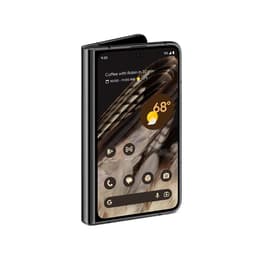


Google Pixel 9 Vs Google Pixel Fold

Google Pixel 9
Google Pixel 9
Starting at

Refurbished price:410.00

Versus €1,066.71 new

See options
Google Pixel Fold
Google Pixel Fold
Starting at

Refurbished price:534.55

Versus €1,750.29 new

See options

Ratings

The Google Pixel 9, released in August 2024, represents the latest iteration of Google's traditional smartphone line, offering a compact design with updated internal components. In contrast, the Google Pixel Fold, launched in June 2023, is Google's first foldable smartphone, featuring a unique design that transforms from a standard phone to a larger tablet-like display. Both devices operate on the Android platform, providing a consistent software experience, but their distinct form factors and hardware generations cater to different user preferences and usage scenarios.

Scores

Durability

The expected lifespan and software support differ between these two Google devices, primarily due to their respective release timelines and Google's evolving update policies.

  • Release Timeline and Age: The Pixel 9 is a newer device, released in August 2024, making it over a year newer than the Pixel Fold, which launched in June 2023. This difference in age directly impacts their remaining support windows.
  • OS Support Duration: The Pixel 9 benefits from Google's extended commitment to software updates, offering seven years of OS and security updates, expected to last until at least August 2031. The Pixel Fold, being an earlier model, receives five years of OS and security updates, with support extending until at least June 2028. This means the Pixel 9 will receive major Android version updates and security patches for a significantly longer period.
  • Repairability and Practical Lifespan: While specific repairability scores can vary, traditional slab phones like the Pixel 9 generally present fewer complexities for repairs compared to foldable devices. The Pixel Fold's intricate hinge mechanism and flexible display introduce additional points of potential wear, which could influence its practical lifespan for some users. Both devices feature robust build materials, with the Pixel 9 utilizing Gorilla Glass Victus 2 for enhanced durability, while the Pixel Fold uses Gorilla Glass Victus on its cover screen and Ultra Thin Glass for its inner display.

Year of Release

2024

2023

Compatible with latest Update

Yes

Yes

OS

Android

Android

Foldable

No

Yes

Performance

Performance capabilities are a key differentiator, with the Pixel 9 benefiting from a newer generation of Google's custom silicon, while the Pixel Fold offers a robust experience for its form factor.

  • Processor Capabilities: The Pixel 9 is equipped with a newer generation processor, the Google Tensor G4, which provides enhanced processing power and improved efficiency for everyday tasks, demanding applications, and advanced AI features. The Pixel Fold utilizes the Google Tensor G2 processor, which was a capable chip at its release, handling multitasking and most applications smoothly. Users engaging in intensive tasks or those who prioritize the latest AI functionalities may notice a difference in responsiveness and speed with the Pixel 9.
  • RAM and Storage: Both devices come with 12GB of RAM in their base configurations, allowing for efficient multitasking and app management. The Pixel 9 offers storage options of 128GB and 256GB, while the Pixel Fold is available with 256GB or 512GB of internal storage. Neither device supports expandable storage.
  • Battery Behavior: The Pixel 9 features a 4700 mAh battery, designed to provide over 24 hours of typical use. The Pixel Fold has a larger 4821 mAh battery, but it powers two displays, including a large foldable screen. While the Pixel Fold's battery capacity is greater, its real-world battery life can vary depending on the usage of its inner and outer displays. The Pixel 9 supports 27W wired charging and 15W wireless charging, while the Pixel Fold supports 30W wired charging.

Memory (GB)

12 GB

12 GB

Screen quality

The display experience is a primary distinction, with the Pixel 9 offering a single, high-quality traditional screen and the Pixel Fold providing a versatile dual-screen foldable design.

  • Display Technology and Size: The Pixel 9 features a 6.3-inch OLED Actua display, known for its vibrant colors and deep blacks. The Pixel Fold, on the other hand, offers a unique dual-screen setup: a 5.8-inch OLED cover display and a larger 7.6-inch P-OLED inner foldable display when unfolded. The Pixel Fold's design allows for a significantly larger viewing area for content consumption and multitasking.
  • Resolution and Clarity: The Pixel 9's display has a resolution of 2400x1080 pixels, resulting in a pixel density of 418 PPI, offering clear and sharp visuals. The Pixel Fold's cover display has a resolution of 2092x1080 pixels (408 PPI), and its inner display features a resolution of 2208x1840 pixels (378 PPI). Both devices provide a high level of detail suitable for various media.
  • Brightness and Refresh Rate: The Pixel 9's Actua display can reach up to 2700 nits peak brightness, ensuring excellent visibility even in bright outdoor conditions. It also features a smooth 120Hz refresh rate. The Pixel Fold's displays offer up to 1550 nits peak brightness for the cover screen and 1450 nits for the inner screen, both supporting a 120Hz refresh rate for fluid scrolling and animations. The Pixel 9's higher peak brightness provides a more comfortable viewing experience in direct sunlight.

Resolution

1080 x 2424

1840 x 2208

Screen type

OLED

Foldable OLED

Audiovisual

Both the Pixel 9 and Pixel Fold leverage Google's computational photography strengths, but they feature different camera hardware configurations.

  • Rear Camera Systems: The Pixel 9 is equipped with a dual-camera system on the rear, featuring a 50MP main sensor and a 48MP ultrawide lens with a 123-degree field of view. The Pixel Fold offers a triple-camera setup, including a 48MP main sensor, a 10.8MP ultrawide lens, and a 10.8MP telephoto lens capable of 5x optical zoom. This telephoto lens provides the Pixel Fold with greater versatility for zoomed-in shots compared to the base Pixel 9.
  • Photography Performance: Both devices benefit from Google's advanced image processing, delivering strong performance in various lighting conditions, including low-light photography with features like Night Sight. The Pixel 9's newer processor may offer subtle improvements in processing speed and AI-driven enhancements for photos. User reports suggest that while the Pixel Fold's camera system is capable, the Pixel 9's newer hardware and software optimizations may lead to slightly improved detail and color accuracy in some scenarios.
  • Video Recording and Front Cameras: Both phones are capable of recording 4K video at various frame rates. For selfies and video calls, the Pixel 9 has a 10.5MP front camera. The Pixel Fold features a 9.5MP camera on its cover screen and an 8MP camera on its inner display, offering flexibility for video calls and selfies whether the device is folded or unfolded.

Main camera

50 megapixels

48 megapixels

Front camera

10.5 megapixels

8 megapixels

Miscellaneous

Beyond core specifications, several practical elements contribute to the overall user experience and differentiate the Pixel 9 from the Pixel Fold.

  • Connectivity Options: Both devices support 5G connectivity, ensuring access to high-speed mobile networks. The Pixel 9 features Wi-Fi 7 and Bluetooth 5.3, offering the latest standards for wireless communication. The Pixel Fold supports Wi-Fi 6E and Bluetooth 5.2. The newer standards on the Pixel 9 provide potential benefits in terms of speed and efficiency with compatible networks and accessories.
  • Port Types and Sensors: Both the Pixel 9 and Pixel Fold utilize a USB-C port for charging and data transfer. The Pixel 9 incorporates an in-display fingerprint sensor for secure unlocking, while the Pixel Fold features a side-mounted fingerprint sensor. Both devices also include essential sensors like accelerometers, gyroscopes, and proximity sensors. The Pixel 9 also features satellite connectivity for emergency services.
  • Weight, Dimensions, and Build Materials: The Pixel 9 is a traditional smartphone with dimensions of 152.8 x 72.0 x 8.5mm and a weight of 198g, making it comfortable for one-handed use. The Pixel Fold, due to its foldable design, is significantly heavier at 283g and thicker when folded (139.7 x 79.5 x 12.1mm). When unfolded, it measures 139.7 x 158.7 x 5.8mm. The Pixel 9 features Gorilla Glass Victus 2 on both its front and back, along with an IP68 rating for dust and water resistance. The Pixel Fold has Gorilla Glass Victus on its cover screen and an IPX8 rating for water resistance.

Weight

198 g

283 g

Screen size (in)

6.3

7.6

Network

5G

5G

SIM card

Physical SIM + eSIM

Physical SIM + eSIM

Carrier compatibility

Unlocked

Unlocked

Connector

USB-C

USB-C

User sentiment for the Google Pixel 9 often highlights its refined design, the advancements in its camera system, and the extended software support, positioning it as a strong contender in the traditional smartphone market. Common praise points include its consistent performance for daily tasks and the integration of Google's latest AI features. Some users, however, might note the absence of a dedicated telephoto lens on the base model as a point of consideration.

The Google Pixel Fold receives commendation for its innovative foldable form factor, offering a unique blend of smartphone portability and tablet-like screen real estate. Users appreciate the versatility of having a larger display for media consumption and multitasking. Criticisms sometimes revolve around its weight and thickness when folded, and the durability of the inner display and hinge, though Google has made strides in improving these aspects with subsequent foldable models. The Pixel Fold's battery life, while adequate for many, can be a point of discussion for heavy users due to the power demands of its dual screens.

Users prioritizing a compact, durable device with the longest possible software support and the latest processing power will find the Pixel 9 well-suited to their needs. Its traditional form factor offers a straightforward and reliable experience. Conversely, individuals who value a large, immersive display for productivity and entertainment, and are willing to embrace the unique characteristics of a foldable device, may lean toward the Pixel Fold. Its ability to transform from a phone to a small tablet offers a distinct advantage for specific use cases. Both devices offer a quality-assured refurbished option, providing an eco-friendly alternative for consumers seeking either a cutting-edge traditional smartphone or an innovative foldable experience.




