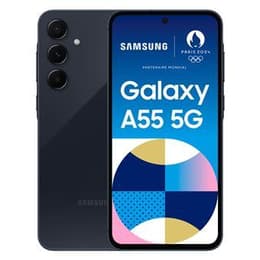


Galaxy A55 Vs Google Pixel 9

Galaxy A55
Galaxy A55
Starting at

Refurbished price:229.00

Versus €513.35 new

See options
Google Pixel 9
Google Pixel 9
Starting at

Refurbished price:386.00

Versus €1,066.71 new

See options

Ratings

The Samsung Galaxy A55, released in March 2024, and the Google Pixel 9, anticipated in Fall 2024, represent distinct approaches to the modern smartphone experience. While both devices operate on the Android platform, they cater to different user priorities through their design philosophies, software ecosystems, and hardware capabilities. The Galaxy A55 focuses on a balanced feature set within Samsung's One UI, offering a large display and robust build. In contrast, the Pixel 9 is expected to emphasize Google's pure Android experience, advanced computational photography, and deep integration of artificial intelligence features.

Scores

Durability

The longevity of a smartphone is influenced by its physical durability and the duration of software support it receives. These two devices offer differing timelines for updates and physical resilience.

  • Software Support: The Samsung Galaxy A55 launched with Android 14 and is promised four major OS updates and five years of security patches, extending its software life significantly. The Google Pixel 9, launching with Android 14, is expected to offer an extended support period of seven years for OS, security, and Pixel Drop updates, providing a longer window for receiving the latest features and security enhancements.
  • Physical Durability: The Galaxy A55 features Gorilla Glass Victus+ on its front and an aluminum frame, contributing to its resilience against everyday wear and tear, alongside an IP67 rating for dust and water resistance. The Pixel 9 is anticipated to come with Gorilla Glass Victus 2 on both its front and back, coupled with an IP68 rating, suggesting a slightly higher degree of protection against dust and water immersion.
  • Repairability: The Galaxy A55 has demonstrated a high repairability score of 8.5 out of 10, indicating that its design facilitates easier component replacement and maintenance. While specific scores for the Pixel 9 are not yet available, Google's recent efforts suggest a focus on improving device repairability.

Year of Release

2024

2024

Compatible with latest Update

Yes

Yes

OS

Android

Android

Foldable

No

No

Performance

Evaluating smartphone performance involves looking beyond raw specifications to understand how devices handle daily tasks, demanding applications, and power consumption.

  • Processing Power: The Galaxy A55 is equipped with a processor that capably handles everyday applications and moderate gaming, providing a smooth user experience for most activities. Users generally report good responsiveness, though some have noted occasional minor delays upon initial startup or after prolonged use without a restart. The Pixel 9 is expected to feature a newer generation processor designed to deliver robust performance, particularly excelling in artificial intelligence tasks and maintaining overall system fluidity for demanding applications and multitasking.
  • Battery Behavior: The Galaxy A55 includes a 5000 mAh battery, which typically provides ample power for over a day of mixed usage, with some users reporting significant screen-on time. The Pixel 9 is anticipated to house a 4700 mAh battery, and Google's software optimizations are expected to ensure efficient power management, contributing to reliable daily endurance.
  • Storage and Multitasking: Both devices offer various storage configurations, with the Galaxy A55 supporting expandable storage via a microSD card, providing flexibility for users who require additional space. The Pixel 9 is expected to offer generous internal storage options, and its anticipated RAM configurations are designed to support seamless multitasking and efficient handling of numerous open applications.

Memory (GB)

8 GB

12 GB

Screen quality

The visual experience on a smartphone is largely defined by its display, encompassing technology, resolution, brightness, and refresh rate.

  • Display Technology and Clarity: The Samsung Galaxy A55 features a 6.6-inch Super AMOLED display, known for its deep blacks and vibrant color reproduction, offering a Full HD+ resolution that provides clear and detailed visuals for media consumption and daily use. The Google Pixel 9 is expected to come with a 6.3-inch OLED display, also offering Full HD+ resolution, which is anticipated to deliver excellent contrast and color accuracy.
  • Brightness and Outdoor Visibility: The Galaxy A55's display can reach a high brightness mode of 1000 nits, ensuring good visibility in various lighting conditions, including outdoors. The Pixel 9 is rumored to achieve even higher brightness levels, with an expected 1800 nits in high brightness mode and a peak brightness of 2700 nits, which would enhance readability under direct sunlight.
  • Refresh Rate and Smoothness: Both smartphones feature a 120Hz refresh rate, contributing to smoother scrolling, more fluid animations, and a more responsive feel during interactions and gaming.

Resolution

1080 x 2340

1080 x 2424

Screen type

Super AMOLED

OLED

Audiovisual

The camera systems on these devices offer distinct strengths, with one focusing on versatile hardware and the other on computational photography.

  • Rear Camera Capabilities: The Galaxy A55 is equipped with a triple-camera setup, including a 50-megapixel main sensor with optical image stabilization, a 12-megapixel ultrawide lens, and a 5-megapixel macro lens. It performs well in daylight, capturing detailed images, and offers decent low-light performance for its main sensor. The Pixel 9 is expected to feature a dual-camera system, likely comprising a 50-megapixel main sensor and a 48-megapixel ultrawide lens. Google's Pixel line is renowned for its computational photography, which enhances image quality, particularly in challenging lighting conditions, and is expected to include a new ultrawide sensor for improved low-light performance.
  • Video Recording and Front Camera: Both devices support 4K video recording at 30 frames per second. The Galaxy A55 includes electronic image stabilization for video. The Pixel 9 is rumored to support 8K video recording at 30 frames per second and is expected to feature an autofocus-enabled front-facing camera, which would enhance clarity for selfies and video calls. The Galaxy A55 has a 32-megapixel front camera.
  • User Experience: While the Galaxy A55's camera system is versatile, some users have noted that the camera app can experience slight delays when switching modes. The Pixel 9's camera experience is typically characterized by its ease of use and consistent results, leveraging Google's software processing.

Main camera

50 megapixels

50 megapixels

Front camera

32 megapixels

10.5 megapixels

Miscellaneous

Beyond the core features, several practical elements contribute to the overall user experience and daily functionality of a smartphone.

  • Connectivity and Ports: The Galaxy A55 supports 5G, Wi-Fi 6, and Bluetooth 5.3, and includes a USB Type-C 2.0 port. It also offers expandable storage via a microSD card slot. The Pixel 9 is expected to feature more advanced connectivity, including Wi-Fi 7 and Bluetooth 5.3 or 5.4, along with a faster USB-C 3.2 port.
  • Biometrics and Sensors: Both phones incorporate an in-display fingerprint scanner for secure unlocking. The Pixel 9 is also expected to offer Face Unlock and a suite of sensors including an accelerometer, ambient light sensor, barometer, gyroscope, and magnetometer, along with satellite SOS capabilities for emergency situations. The Galaxy A55 includes an accelerometer, compass, gyroscope, and a virtual proximity sensor.
  • Design and Handling: The Galaxy A55 features a glass front and back with an aluminum frame, weighing 213 grams and measuring 161.1 x 77.4 x 8.2 mm. The Pixel 9 is anticipated to have a similar premium build with Gorilla Glass Victus 2 on both sides and a metal frame, weighing 198 grams and measuring 152.8 x 72.0 x 8.5 mm, making it slightly more compact and lighter.

Weight

213 g

198 g

Screen size (in)

6.6

6.3

Network

5G

5G

SIM card

Physical SIM

Physical SIM + eSIM

Carrier compatibility

Unlocked

Unlocked

Connector

USB-C

USB-C

The Samsung Galaxy A55 and Google Pixel 9 present compelling options for different user needs. Users of the Galaxy A55 often praise its premium build quality, vibrant display, and reliable battery life, noting its capability to handle daily tasks smoothly. Some common criticisms include occasional software lag, particularly on initial startup, and the camera app's speed. The Pixel 9, while not yet released, is anticipated to be lauded for its exceptional computational photography, seamless Android experience, and advanced AI features, building on Google's reputation for software innovation. Potential concerns might revolve around battery life compared to some larger devices, though Google's optimization efforts are expected to mitigate this.

Users prioritizing a larger, vibrant display, expandable storage, and a high repairability score may find the Galaxy A55 well-suited to their needs. It offers a robust and balanced experience within Samsung's One UI ecosystem. Conversely, users who value cutting-edge camera performance, a pure Android interface with extensive AI integration, and a longer software update commitment will likely lean towards the Google Pixel 9. Both devices offer a quality-assured refurbished option, providing an eco-friendly alternative for consumers seeking to make informed and sustainable choices.


See all articles

Our recent comparisons