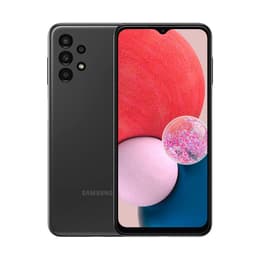
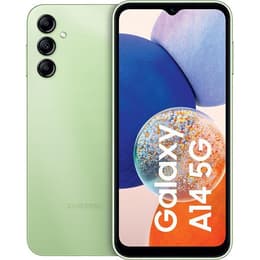


Galaxy A13 Vs Galaxy A14 5G

Galaxy A13
Galaxy A13
Starting at

Refurbished price:97.00

Versus €249.00 new

See options
Galaxy A14 5G
Galaxy A14 5G
Starting at

Refurbished price:102.00

Versus €289.00 new

See options

Ratings

The Samsung Galaxy A13 and the Samsung Galaxy A14 5G are both entry-level smartphones designed to offer essential features for everyday use. Released in March 2022, the Galaxy A13 provides a solid foundation for basic smartphone tasks, while the Galaxy A14 5G, launched in January 2023, introduces 5G connectivity and an enhanced display refresh rate as its primary advancements. Both devices operate on the Android platform with Samsung's One UI interface, aiming for a user-friendly experience.

Scores

Durability

When considering the longevity of these devices, several factors come into play, including their release dates and Samsung's software support policies.

  • Release Timeline: The Galaxy A13 was released in March 2022, making it an older model compared to the Galaxy A14 5G, which launched in January 2023. This difference in release date directly impacts their potential software support lifespan.
  • Software Support: Samsung typically provides multiple years of Android operating system updates and security patches for its A-series devices. The Galaxy A14 5G, being newer and launching with Android 13, is expected to receive a longer period of major Android updates and security support compared to the Galaxy A13, which launched with Android 12.
  • Build and Practical Lifespan: Both phones feature plastic constructions, which are common for devices in this category. While durable for daily use, they are not designed for extreme conditions and lack official water or dust resistance ratings. Users generally report that with careful handling, these devices can offer a practical lifespan of several years, especially when considering a quality-assured refurbished option.

Year of Release

2022

2023

Compatible with latest Update

No

Yes

OS

Android

Android

Foldable

No

No

Performance

The performance of a smartphone is crucial for daily interactions, from launching applications to multitasking. Both the Galaxy A13 and A14 5G are built for essential tasks, but they offer different levels of responsiveness.

  • Everyday Responsiveness: The Galaxy A13 is powered by a processor that users have sometimes described as sluggish, particularly when handling multiple applications or more demanding tasks. This can lead to noticeable delays in app loading and general navigation. In contrast, the Galaxy A14 5G features an updated processor that provides a more consistent experience for everyday use, though it may still exhibit some minor stutters with intensive multitasking or gaming.
  • Multitasking and Storage: Both devices offer various RAM configurations, typically ranging from 3GB to 6GB for the A13 and 4GB to 8GB for the A14 5G, which influences how many apps can run smoothly in the background. Both also support expandable storage via microSD cards, allowing users to increase their storage capacity beyond the internal 32GB, 64GB, or 128GB options.
  • Battery Behavior: Both phones are equipped with a 5000mAh battery, which generally provides ample power for a full day of use. The Galaxy A14 5G, despite its potentially more capable processor and higher refresh rate screen, is frequently praised for its excellent battery life, often extending to two days for moderate users. The Galaxy A13 also offers good battery endurance, though some users have reported faster drain depending on usage patterns.

Memory (GB)

4 GB

4 GB

Screen quality

The display is a primary interface for any smartphone, and while both models feature large screens, there are notable differences in their visual experience.

  • Display Technology and Resolution: Both the Galaxy A13 and Galaxy A14 5G utilize PLS LCD panels, which offer good color reproduction and viewing angles for their class. They both feature a 6.6-inch screen with a Full HD+ resolution (1080x2408 pixels), providing clear and detailed visuals for browsing, videos, and photos.
  • Refresh Rate and Smoothness: A key distinction lies in the refresh rate. The Galaxy A13 has a standard 60Hz refresh rate, meaning the screen updates 60 times per second. The Galaxy A14 5G, however, upgrades to a 90Hz refresh rate, which results in smoother scrolling and a more fluid visual experience, particularly noticeable during navigation and in supported applications.
  • Brightness and Outdoor Visibility: While both displays offer decent brightness for indoor use, some users have noted that neither phone excels in very bright outdoor conditions, where visibility can be challenging. The Galaxy A13's maximum brightness is around 483 nits, while the A14 5G can reach about 500-520 nits, which is a slight improvement but still can be dim in direct sunlight.

Resolution

1080 x 2408

1080 x 2408

Screen type

PLS LCD

PLS LCD

Audiovisual

For many users, the camera system is a significant consideration. Both the Galaxy A13 and A14 5G offer multi-camera setups, but with some variations in their capabilities.

  • Rear Camera Systems: The Galaxy A13 features a quad-camera setup with a 50-megapixel main sensor, a 5-megapixel ultrawide lens, and two 2-megapixel sensors for macro and depth. The Galaxy A14 5G simplifies this with a triple-camera array, also featuring a 50-megapixel main sensor, but it omits the ultrawide lens, instead including only 2-megapixel macro and depth sensors.
  • Photography Performance: Both phones' 50-megapixel main cameras are capable of capturing detailed and colorful photos in good lighting conditions. However, low-light performance is generally average for both, with images showing more noise and less detail. The absence of an ultrawide camera on the A14 5G means less versatility for capturing wider scenes compared to the A13.
  • Front Camera and Video: The Galaxy A13 typically includes an 8-megapixel front-facing camera, while the Galaxy A14 5G upgrades this to a 13-megapixel sensor, potentially offering more detailed selfies and clearer video calls. Both devices support video recording up to 1080p at 30 frames per second from both front and rear cameras, without advanced stabilization features.

Main camera

50 megapixels

50 megapixels

Front camera

8 megapixels

13 megapixels

Miscellaneous

Beyond the core features, several other elements contribute to the overall user experience and practical utility of these smartphones.

  • Connectivity and Ports: A primary differentiator is network support; the Galaxy A14 5G offers 5G connectivity, enabling faster mobile data speeds where available, while the Galaxy A13 is limited to 4G LTE. Both devices include Wi-Fi 5, Bluetooth (5.0 for A13, 5.2 for A14 5G), NFC for contactless payments (region-dependent), a 3.5mm headphone jack, and a USB-C 2.0 port for charging and data transfer.
  • Biometrics and Design: Both phones feature side-mounted fingerprint sensors integrated into the power button, offering a convenient and responsive method for unlocking the device. In terms of physical design, both have plastic bodies and similar dimensions, though the A14 5G is slightly heavier at around 202-204g compared to the A13's 195g.
  • User Interface and Sensors: Both run on Samsung's One UI over Android, providing a consistent software experience with various customization options. They include standard sensors like an accelerometer, ambient light sensor, and proximity sensor.

Weight

195 g

201 g

Screen size (in)

6.6

6.6

Network

4G

5G

SIM card

Dual Physical SIM

Dual Physical SIM

Carrier compatibility

Unlocked

Unlocked

The Samsung Galaxy A13 and Galaxy A14 5G cater to users seeking functional smartphones for everyday tasks, with the A14 5G offering some key upgrades. User feedback for the Galaxy A13 often highlights its decent screen and good battery life as praise points, especially considering its positioning. However, common criticisms include its sometimes sluggish performance and the limitations of its ultrawide camera.

For the Galaxy A14 5G, users frequently commend its improved display with a 90Hz refresh rate, reliable 5G connectivity, and excellent battery life that can often last up to two days. Criticisms tend to focus on its performance, which, while better than its predecessor, can still feel slow for demanding users, and the absence of an ultrawide camera.

Users prioritizing a more fluid visual experience and access to faster 5G networks will find the Galaxy A14 5G well-suited to their needs. Its updated processor also provides a slightly more responsive overall experience. Conversely, users who primarily need a device for basic communication, web browsing, and media consumption, and who value having an ultrawide camera, might consider the Galaxy A13. Both models represent practical choices for those seeking essential smartphone functionality without advanced features.

For individuals looking for a more sustainable choice, both the Galaxy A13 and Galaxy A14 5G are available as quality-assured refurbished options, providing an eco-friendly alternative to purchasing new devices.


See all articles

Our recent comparisons