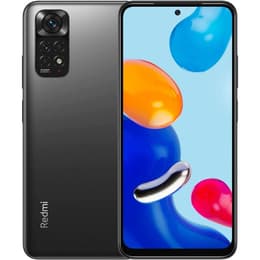
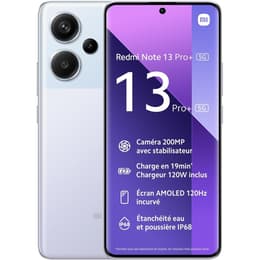


Xiaomi Redmi Note 11 Vs Xiaomi Redmi Note 13 Pro+

Xiaomi Redmi Note 11
Starting at

Refurbished price:108.00

Versus €249.99 new

See options
Xiaomi Redmi Note 13 Pro+
Starting at

Refurbished price:198.00

Versus €449.00 new

See options

Ratings

The Xiaomi Redmi Note 11, released in January 2022, and the Xiaomi Redmi Note 13 Pro+, launched in September 2023, represent different generations within Xiaomi's popular Note series. While both operate on the Android platform, the Note 13 Pro+ introduces significant advancements in display technology, camera capabilities, and overall performance. This comparison will explore the practical differences between these two devices to help users determine which model best suits their needs.

Scores

Durability

The lifespan of a smartphone is influenced by its release date, software support, and physical resilience. The Redmi Note 11 and Redmi Note 13 Pro+ offer distinct profiles in these areas.

  • Release Timeline and Software Support: The Redmi Note 11, released in early 2022, has reached its end-of-life for software and security updates as of early 2025, typically receiving 2-3 years of Android updates and 3-4 years of security updates. In contrast, the Redmi Note 13 Pro+, launched in late 2023, is committed to receiving three major Android OS updates (up to Android 16) and four years of security updates, extending its support until 2028.
  • Physical Durability: The Redmi Note 11 features Gorilla Glass 3 for screen protection and an IP53 rating, offering basic splash and dust resistance. The Redmi Note 13 Pro+ elevates durability with Gorilla Glass Victus on its display and an IP68 rating, providing more robust protection against dust and water immersion.
  • Expected Practical Lifespan: Users prioritizing long-term software support and enhanced physical resilience will find the Redmi Note 13 Pro+ offers a longer practical lifespan due to its newer release and extended update policy, alongside superior ingress protection.

Year of Release

2022

2023

Compatible with latest Update

No

Yes

OS

Android

Android

Foldable

No

No

Performance

Performance differences between these two models are notable, impacting daily responsiveness and handling of demanding applications.

  • Everyday Responsiveness: The Redmi Note 11, powered by a 6nm processor, handles typical daily tasks and light multitasking smoothly. The Redmi Note 13 Pro+, featuring a more advanced 4nm processor, delivers a noticeably snappier experience, allowing for quicker app loading and more fluid navigation, even with multiple applications running simultaneously.
  • Multitasking and Storage: The Redmi Note 11 typically comes with 4GB or 6GB of RAM and UFS 2.2 storage, which is suitable for average use. The Redmi Note 13 Pro+ offers higher RAM configurations, starting from 8GB and going up to 16GB, coupled with faster LPDDR5 RAM and UFS 3.1 storage, providing superior multitasking capabilities and quicker data access for users who frequently switch between apps or handle larger files.
  • Gaming and Demanding Apps: While the Redmi Note 11 can manage casual games and standard applications, the Redmi Note 13 Pro+ is better equipped for more graphically intensive games and demanding software, offering smoother frame rates and a more consistent experience without significant slowdowns.

Memory (GB)

4 GB

12 GB

Screen quality

The visual experience is a key differentiator, with the Redmi Note 13 Pro+ offering significant upgrades in display technology.

  • Display Technology and Clarity: Both devices feature AMOLED displays, known for vibrant colors and deep blacks. The Redmi Note 11 has a 6.43-inch display with a Full HD+ resolution. The Redmi Note 13 Pro+ boasts a larger 6.67-inch curved AMOLED display with a higher 1.5K resolution, resulting in sharper text and more detailed images.
  • Brightness and Smoothness: The Redmi Note 11 offers a 90Hz refresh rate for smoother scrolling and a peak brightness of 1000 nits, providing good visibility in most conditions. The Redmi Note 13 Pro+ steps up with a 120Hz refresh rate for even more fluid motion and an impressive peak brightness of 1800 nits, ensuring excellent outdoor visibility even under direct sunlight.
  • Viewing Experience: Users will find the Redmi Note 13 Pro+'s larger, higher-resolution, and brighter display, combined with its curved edges, offers a more immersive and premium viewing experience for media consumption and general use.

Resolution

1080 x 2400

1220 x 2712

Screen type

AMOLED

AMOLED

Audiovisual

Camera capabilities see a substantial leap forward with the newer model, particularly in main sensor resolution and features.

  • Main Camera System: The Redmi Note 11 features a 50MP main camera, capable of capturing decent photos in good lighting conditions. The Redmi Note 13 Pro+ is equipped with a 200MP main camera that includes Optical Image Stabilization (OIS), allowing for significantly more detailed images, improved low-light performance, and better stability for both photos and videos.
  • Ultrawide and Macro Photography: Both phones include an 8MP ultrawide camera and a 2MP macro camera. While these auxiliary lenses offer similar functionality across both models, the overall image processing on the Redmi Note 13 Pro+ benefits from its more powerful internal components, potentially leading to slightly better results even from these secondary sensors.
  • Video Recording and Selfies: The Redmi Note 11 records video at 1080p at 30 frames per second and has a 13MP front camera. The Redmi Note 13 Pro+ supports 4K video recording at 30 frames per second with its main camera and features a 16MP front camera, offering higher resolution and more detail for video content and selfies.

Main camera

50 megapixels

200 megapixels

Front camera

13 megapixels

16 megapixels

Miscellaneous

Beyond core specifications, several practical elements contribute to the overall user experience of these smartphones.

  • Connectivity and Ports: The Redmi Note 11 supports 4G LTE and Wi-Fi 5, along with a 3.5mm headphone jack and USB-C for charging. The Redmi Note 13 Pro+ offers more advanced connectivity with 5G support and Wi-Fi 6, providing faster mobile data and wireless internet speeds. It also uses USB-C but omits the 3.5mm headphone jack.
  • Charging Speed and Biometrics: Both devices house a 5000 mAh battery. However, the Redmi Note 11 supports 33W fast charging, while the Redmi Note 13 Pro+ features significantly faster 120W charging, capable of fully charging the device in a much shorter time. For security, the Redmi Note 11 uses a side-mounted fingerprint sensor, whereas the Redmi Note 13 Pro+ integrates an in-display fingerprint sensor.
  • Build and Handling: The Redmi Note 11 has a plastic back and frame, weighing around 179g. The Redmi Note 13 Pro+ features a more premium build with a glass front and back (or silicone polymer back option) and an aluminum frame, resulting in a slightly heavier device at approximately 199-204.5g, but also offering a more robust and refined feel.

Weight

179 g

204 g

Screen size (in)

6.43

6.67

Network

4G

5G

SIM card

Dual Physical SIM

Dual Physical SIM

Carrier compatibility

Unlocked

Unlocked

The Xiaomi Redmi Note 11 and Redmi Note 13 Pro+ cater to different user expectations, largely due to the generational gap between their releases. Users generally praise the Redmi Note 11 for its excellent battery life and vibrant AMOLED display, especially considering its positioning. However, common criticisms often point to its average camera performance in challenging conditions and the lack of 5G connectivity. The Redmi Note 13 Pro+, on the other hand, receives acclaim for its stunning display, rapid charging capabilities, and a significantly improved main camera system. Some users note that while the main camera is strong, the auxiliary lenses are less impressive, and the software experience can sometimes be inconsistent.

Users prioritizing a device with a longer software support window, enhanced durability, and superior performance for demanding applications and photography will find the Redmi Note 13 Pro+ to be a more suitable choice. Its advanced display and faster charging also contribute to a more modern user experience. Conversely, individuals seeking a reliable device for essential tasks, with strong battery endurance and a good display for media, and who do not require the latest connectivity or camera features, may find the Redmi Note 11 still meets their needs. Both models are available as quality-assured refurbished options, providing an eco-friendly alternative for consumers.


See all articles

Our recent comparisons







