

iPad Pro (2021, M1 series) Vs iPad Pro (2024, M4 series)

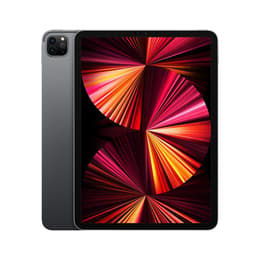
iPad Pro (2021, M1 series)
Starting at

Refurbished price:452.00

Versus €909.00 new

See options
iPad Pro (2024, M4 series)
Starting at

Refurbished price:767.00

Versus €1,229.00 new

See options

Ratings

The iPad Pro 2021 M1 Series and the iPad Pro 2024 M4 Series represent distinct generations of Apple's high-performance tablets, released in 2021 and 2024, respectively. While both devices operate on iPadOS and offer a premium tablet experience, the M4 model introduces significant advancements in display technology, a more efficient processor, and a refined design. These differences cater to varying user priorities, from visual fidelity to raw processing power and portability.

Scores

Durability

The longevity of a tablet is influenced by its release timeline, software support, and physical durability. The M1 and M4 iPad Pro models offer different expectations in these areas.

  • Release Timeline and Age: The iPad Pro M1 series was released in 2021, making it a few years older than the M4 series, which launched in May 2024. This age difference directly impacts the remaining period of official software support.
  • OS Support Duration: Apple typically provides 5-7 years of major iPadOS updates for its devices, with security updates often extending beyond that. The M1 iPad Pro, released in 2021, is expected to receive major iPadOS updates until at least 2028 or 2029, with security updates potentially continuing longer. The M4 iPad Pro, being newer, will naturally benefit from a longer period of guaranteed software support, extending its functional lifespan further into the future.
  • Repairability: The M4 iPad Pro introduces improvements in repairability, particularly concerning battery replacement, which is now more accessible compared to previous generations. However, its ultra-thin design can make other internal repairs challenging due to tightly integrated and glued components, and the display remains a delicate part during servicing. The M1 series generally presents a more complex repair process for various components.
  • Expected Practical Lifespan: Both models are built with high-quality materials and robust software. While the M1 remains highly capable for most tasks, the M4's newer processor and extended software support window suggest it will maintain optimal performance for demanding applications for a longer duration. Users of the M1 iPad Pro frequently report that it continues to perform exceptionally well for daily tasks and creative work even years after its release.

Year of Release

2021

2024

Compatible with latest Update

Yes

Yes

OS

iPadOS

iPadOS

Maximum Operating System supported

iPadOS 18

iPadOS 18

Performance

The core performance of these iPad Pro models is driven by their respective processors, influencing everything from app responsiveness to handling intensive creative workflows.

  • Processor Capabilities: The M4 iPad Pro features a significantly more advanced processor compared to the M1. This newer chip offers substantial improvements in both central processing unit (CPU) and graphics processing unit (GPU) performance, alongside enhanced power efficiency. The M4 also incorporates hardware-accelerated ray tracing, which can provide more realistic lighting and reflections in compatible applications and games.
  • Real-World Usage: While synthetic benchmarks show a considerable gap between the two, in everyday use, such as browsing, multitasking with multiple applications, and running many popular creative apps, the M1 iPad Pro still delivers a very fluid and responsive experience. The performance advantages of the M4 become most apparent in highly demanding professional workflows, such as exporting large video files, complex 3D rendering, or working with large datasets in specialized software.
  • RAM and Storage: Both generations offer similar RAM configurations: 8GB for models with 128GB, 256GB, or 512GB of storage, and 16GB for 1TB and 2TB storage options. The M1 series starts with 128GB storage, while the M4 series begins at 256GB, with both offering configurations up to 2TB.
  • Battery Behavior: The M4 chip's improved power efficiency contributes to its battery performance. Although the 13-inch M4 model has a slightly smaller battery capacity than the 12.9-inch M1, its efficiency often results in comparable or even slightly better real-world battery endurance for typical usage. Both models are generally designed to provide a full day of use on a single charge.

Memory (GB)

8 GB

8 GB

Processor

Apple M1

Apple M4

Screen quality

The display is a central feature of any tablet, and both iPad Pro generations offer high-quality viewing experiences, though with notable differences in technology.

  • Display Technology: The 12.9-inch M1 iPad Pro features a Liquid Retina XDR display with Mini-LED technology, offering excellent contrast and brightness. The 11-inch M1 model uses a Liquid Retina display with traditional LCD technology. The M4 iPad Pro, in both its 11-inch and 13-inch sizes, introduces the Ultra Retina XDR display, which utilizes Tandem OLED technology.
  • Practical Benefits: The Tandem OLED display on the M4 models provides superior contrast ratios, true blacks, and vibrant colors, enhancing the visual experience, especially for HDR content and in dark environments. While the Mini-LED on the 12.9-inch M1 also delivers impressive HDR, the M4's OLED offers a more consistent and deeper black level across the entire screen.
  • Brightness Levels: The 12.9-inch M1 iPad Pro achieves up to 1000 nits of typical brightness and 1600 nits peak brightness for HDR content. The 11-inch M1 model offers up to 600 nits. The M4 models significantly boost full-screen SDR brightness to 1000 nits and maintain 1600 nits peak for HDR, making them noticeably brighter and more legible in well-lit environments or outdoors.
  • Resolution and Refresh Rate: Both generations feature high-resolution displays with a pixel density of 264 pixels per inch (PPI), ensuring sharp text and detailed images. Both also incorporate ProMotion technology, providing an adaptive refresh rate that can dynamically adjust from 10Hz to 120Hz for smooth scrolling, responsive touch input, and efficient power usage.

Resolution

2388 x 1668

2420 x 1668

True Tone

Yes

Yes

Pro-Motion

Yes

Yes

Screen type

Liquid Retina display

Ultra Retina XDR display

Pixel density

264ppp

264ppp

Brightness

600 nits brightness max

1000 nits brightness max

Sound quality

Speakers

Four speaker audio

Four speaker audio

Audiovisual

While tablets are not typically primary photography devices, the iPad Pro models offer capable camera systems for various uses, including document scanning, video calls, and augmented reality.

  • Rear Camera System: The M1 iPad Pro features a dual-camera setup on the rear, consisting of a 12-megapixel Wide lens and a 10-megapixel Ultra Wide lens, complemented by a LiDAR scanner for enhanced depth sensing. The M4 iPad Pro streamlines this to a single 12-megapixel Wide camera and retains the LiDAR scanner, removing the Ultra Wide lens. A notable addition to the M4 is an Adaptive True Tone flash, designed to improve document scanning by reducing shadows.
  • Front Camera and Video Calls: Both generations are equipped with a 12-megapixel Ultra Wide front camera that supports Center Stage, a feature that keeps users automatically framed during video calls. A key design change in the M4 iPad Pro is the repositioning of the front camera to the landscape edge, which provides a more natural eye line during video conferences when the tablet is used with a keyboard.
  • Video Recording Quality: Both the M1 and M4 iPad Pro models are capable of recording 4K video. The M4 further enhances video capabilities with support for ProRes 4K video recording at 60 frames per second.
  • Audio Experience: Both iPad Pro series feature a four-speaker audio system that delivers rich stereo sound and supports Dolby Atmos for an immersive media consumption experience. For audio input, the M1 models include five studio-quality microphones, while the M4 models come with four. User comparisons suggest that the overall microphone quality remains high across both generations, with minimal discernible difference in typical use.

Miscellaneous

Beyond the core performance and display, several practical elements contribute to the overall user experience and differentiate the M1 and M4 iPad Pro models.

  • Connectivity Options: The M1 iPad Pro supports Wi-Fi 6 and Bluetooth 5.0 for wireless connections. The M4 iPad Pro upgrades to Wi-Fi 6E and Bluetooth 5.3, offering potentially faster and more stable wireless performance with compatible networks and accessories. Both generations are available with optional 5G cellular connectivity for on-the-go internet access.
  • Port Types: Both models feature a versatile USB-C port that supports Thunderbolt and USB 4, enabling high-speed data transfer, external display connectivity, and a wide range of accessories.
  • Sensors and Authentication: Both iPad Pro series include Face ID for secure facial recognition and authentication, along with a LiDAR scanner that enhances augmented reality (AR) experiences and improves depth perception for photography.
  • Weight and Dimensions: The M4 iPad Pro models are notably thinner and lighter than their M1 predecessors. For instance, the 13-inch M4 model measures 5.1mm thin and weighs 579g, making it significantly more portable than the 12.9-inch M1, which is 6.4mm thin and weighs 682g. The 11-inch M4 is also thinner (5.3mm) than the 11-inch M1 (5.9mm). This reduction in size and weight enhances handling and portability, especially for extended use.
  • Accessories: The M4 iPad Pro introduces compatibility with the new Apple Pencil Pro, which offers advanced features like a squeeze gesture and barrel roll, and a redesigned Magic Keyboard with an aluminum palm rest and a function row. These new accessories are exclusively compatible with the M4 models.

Weight

466 g

444 g

Width

17.85 cm

17.7 cm

Height

24.76 cm

24.9 cm

Depth

0.59 cm

0.5 cm

Screen size (in)

11

11

Network

Wi-Fi

Wi-Fi

Carrier compatibility

Without SIM Port

Without SIM Port

Wi-Fi technology

Wi-Fi 6 802.11ax

Wi-Fi 6E 802.11ax

Bluetooth Version

Bluetooth 5.0

Bluetooth 5.3

Face ID

Yes

Yes

Touch ID

No

No

Connector

USB Type-C

USB Type-C

The iPad Pro M1 and M4 series both offer powerful tablet experiences, but they cater to slightly different user needs and priorities. User sentiment for the M1 iPad Pro often highlights its enduring performance, excellent display (especially the 12.9-inch Mini-LED), and overall capability for a wide range of creative and productivity tasks, even years after its release. Some common criticisms for the M1 revolve around potential battery degradation over time, as with any older device.

For the M4 iPad Pro, users frequently praise its stunning Tandem OLED display, which offers deeper blacks and higher brightness, particularly noticeable in side-by-side comparisons. The significantly thinner and lighter design of the M4 is also a frequent point of appreciation, improving portability and handling. Criticisms for the M4 sometimes include the removal of the rear ultra-wide camera, though this is generally not a major concern for most tablet users. Some users have also reported varied experiences with battery life under heavy loads, despite the M4's improved efficiency, possibly due to the thinner chassis.

Users prioritizing a highly capable and still very powerful tablet for general productivity, creative work, and media consumption, who may not require the absolute latest display technology or the thinnest design, will find the M1 series well-suited to their needs. It remains a strong performer for most applications and offers substantial value.

Conversely, users who demand the most advanced display technology for color-critical work or immersive viewing, the absolute highest performance for professional-grade creative applications like advanced video editing or 3D rendering, and who prioritize the thinnest and lightest design for maximum portability, will lean toward the M4 series. The enhanced capabilities of the new Apple Pencil Pro and Magic Keyboard also make the M4 a compelling choice for those seeking the cutting edge in tablet technology.

For those considering either model, exploring quality-assured refurbished options can provide an eco-friendly alternative to access these powerful devices.


See all articles

Our recent comparisons