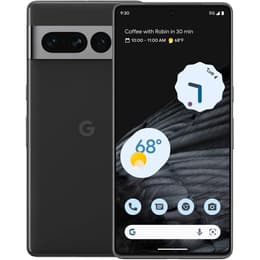



Google Pixel 7 Pro Vs Google Pixel 8

Google Pixel 7 Pro
Google Pixel 7 Pro
Starting at

Refurbished price:201.00

Versus €640.98 new

See options
Google Pixel 8
Google Pixel 8
Starting at

Refurbished price:235.00

Versus €999.00 new

See options

Ratings

The Google Pixel 7 Pro, released in October 2022, and the Google Pixel 8, launched in October 2023, represent different approaches within Google's smartphone lineup. While both devices offer a pure Android experience and emphasize computational photography, the Pixel 7 Pro is a larger, more premium device with a dedicated telephoto camera, whereas the Pixel 8 is a more compact model featuring a newer processor and an extended software support commitment.

Scores

Durability

When considering the long-term usability of a smartphone, software support and physical durability are key factors. The Pixel 7 Pro and Pixel 8 offer different timelines for updates and similar levels of physical resilience.

  • Release Timeline: The Pixel 7 Pro was released in October 2022, making it a year older than the Pixel 8, which launched in October 2023. This difference in age directly impacts their respective support windows.
  • OS Support Duration: The Pixel 8 stands out with an impressive commitment of seven years of OS, security, and Feature Drop updates, extending its support until at least October 2030. The Pixel 7 Pro, being an earlier model, typically receives fewer major OS updates, generally around three, along with five years of security updates.
  • Physical Durability: Both devices feature an IP68 rating for dust and water resistance, indicating protection against immersion in up to 1.5 meters of water for 30 minutes. The Pixel 7 Pro uses Gorilla Glass for its display and back, while the Pixel 8 upgrades to Gorilla Glass Victus for enhanced scratch and drop resistance on its display.

Year of Release

2022

2023

Compatible with latest Update

Yes

Yes

OS

Android

Android

Foldable

No

No

Performance

The performance of a smartphone is largely dictated by its internal components, influencing everything from app responsiveness to multitasking capabilities and battery efficiency. Both the Pixel 7 Pro and Pixel 8 are designed for smooth daily operation, but they differ in their underlying hardware.

  • Processor Capabilities: The Pixel 7 Pro is powered by the Google Tensor G2, which capably handles everyday applications, moderate gaming, and Google's advanced AI features. The Pixel 8 features the newer Google Tensor G3, offering improved efficiency, faster processing for demanding tasks, and enhanced AI capabilities, leading to a more responsive overall experience.
  • Multitasking and Storage: The Pixel 7 Pro comes with 12 GB of RAM, providing ample capacity for extensive multitasking and keeping many applications open in the background without slowdowns. The Pixel 8 includes 8 GB of RAM, which is sufficient for most users' daily needs and multitasking. Both devices offer storage options up to 256 GB, with the Pixel 7 Pro also having a 512 GB option, utilizing UFS 3.1 storage for quick app loading and data transfer.
  • Battery Behavior: The Pixel 7 Pro is equipped with a 5000 mAh battery, generally providing a full day of use for many users. The Pixel 8 has a slightly smaller 4575 mAh battery. While the Pixel 8's newer, more efficient processor can help optimize battery life, heavy users might notice a difference in endurance compared to the larger capacity of the Pixel 7 Pro.

Memory (GB)

12 GB

8 GB

Screen quality

The display is a primary interface for any smartphone, and both Pixel models offer vibrant and clear viewing experiences, though with distinct characteristics in size, resolution, and brightness.

  • Display Technology and Size: The Pixel 7 Pro features a larger 6.7-inch LTPO AMOLED display with a curved design, offering an expansive viewing area. The Pixel 8 has a more compact 6.2-inch OLED display, which is flat. Both displays provide deep blacks and vibrant colors characteristic of OLED technology.
  • Resolution and Clarity: The Pixel 7 Pro boasts a QHD+ resolution (1440 x 3120 pixels), resulting in a very sharp image with high pixel density, ideal for detailed content. The Pixel 8 features an FHD+ resolution (1080 x 2400 pixels), which still provides clear visuals for everyday use, though with a slightly lower pixel density due to its smaller size.
  • Brightness and Smoothness: Both phones offer a 120 Hz refresh rate for smooth scrolling and responsive interactions. The Pixel 7 Pro's display reaches high brightness levels, while the Pixel 8's display, referred to as 'Actua display,' offers even higher peak brightness, making it more visible in bright outdoor conditions.

Resolution

1440 x 3120

1080 x 2400

Screen type

LTPO AMOLED

OLED

Audiovisual

Google Pixel phones are renowned for their camera capabilities, often leveraging computational photography to deliver impressive results. Both the Pixel 7 Pro and Pixel 8 continue this tradition, but the Pro model offers a more versatile hardware setup.

  • Rear Camera Systems: The Pixel 7 Pro features a triple-camera system, including a 50 MP main sensor, a 12 MP ultrawide lens with autofocus and Macro Focus, and a 48 MP telephoto lens capable of 5x optical zoom and up to 30x Super Res Zoom. The Pixel 8 has a dual-camera setup, comprising an upgraded 50 MP main sensor with improved light sensitivity and a 12 MP ultrawide lens that also includes autofocus and Macro Focus. The Pixel 8 relies on digital zoom for magnification, lacking a dedicated telephoto lens.
  • Photography Performance: Both devices excel in everyday photography, producing images with natural colors and excellent detail. The Pixel 8's main sensor offers enhanced light sensitivity, which can translate to better low-light performance compared to the Pixel 7 Pro. The Pixel 7 Pro's dedicated telephoto lens provides superior quality for zoomed-in shots. Both benefit from Google's software processing for features like Night Sight and Photo Unblur.
  • Video Recording and Audio: Both phones support 4K video recording at 30 or 60 frames per second, with features like Cinematic Blur and enhanced stabilization. The Pixel 8 introduces new video capabilities, including 'Video Boost' for improved low-light video and 'Audio Eraser' for reducing background noise. The microphone quality on both is generally clear for calls and recordings, and they offer stereo speaker output for media consumption.

Main camera

50 megapixels

50 megapixels

Front camera

10.8 megapixels

10.5 megapixels

Miscellaneous

Beyond core performance and camera, several practical elements contribute to the overall user experience, including connectivity, physical design, and security features.

  • Connectivity and Ports: Both the Pixel 7 Pro and Pixel 8 support 5G connectivity for fast mobile data. The Pixel 7 Pro features Wi-Fi 6 (ax) and Bluetooth 5.2, while the Pixel 8 upgrades to Wi-Fi 7 (be) and Bluetooth 5.3, offering potentially faster and more stable wireless connections. Both devices utilize a USB Type-C port for charging and data transfer, with neither including a 3.5mm headphone jack.
  • Sensors and Security: Both phones incorporate an in-display optical fingerprint sensor for secure unlocking and support face unlock. They also include Google's Titan M2 security module for enhanced data protection. The Pixel 7 Pro has an ultrawideband (UWB) chip, which is also present in the Pixel 8 Pro but not explicitly mentioned for the standard Pixel 8 in the provided snippets.
  • Dimensions and Build: The Pixel 7 Pro is a larger and heavier device, measuring 162.9 x 76.6 x 8.9 mm and weighing 212 g. The Pixel 8 is more compact and lighter at 150.5 x 70.8 x 8.9 mm and 187 g, making it easier for one-handed use. Both feature a glass back and aluminum frame, with the Pixel 8 having a matte aluminum frame and glossy back glass, while the Pixel 7 Pro has an aluminum finish.

Weight

212 g

187 g

Screen size (in)

6.7

6,2

Network

5G

5G

SIM card

Physical SIM + eSIM

Physical SIM + eSIM

Carrier compatibility

Unlocked

Unlocked

The Google Pixel 7 Pro and Pixel 8 each offer compelling features, catering to slightly different user preferences. User feedback often praises the Pixel 7 Pro for its expansive, high-resolution display and the versatility of its triple camera system, particularly the dedicated telephoto lens. Some users, however, found its size to be substantial for one-handed operation. The Pixel 8, on the other hand, is frequently lauded for its more manageable size, improved main camera sensor, and the significant commitment to seven years of software updates, which is a major draw for those seeking long-term device support. Criticisms for the Pixel 8 sometimes point to the absence of a telephoto lens and its slightly smaller battery compared to the Pro models.

Users prioritizing a larger, higher-resolution display and a dedicated telephoto camera for optical zoom will find the Pixel 7 Pro well-suited to their needs. Its robust performance remains capable for most tasks. Conversely, users who prefer a more compact device, value the absolute latest processor for enhanced AI features, and prioritize an extended software support lifespan will likely lean towards the Pixel 8. Both devices offer a strong Android experience with Google's signature computational photography. For those considering a sustainable choice, both models are available as quality-assured refurbished options, providing an eco-friendly alternative to purchasing new.


See all articles

Our recent comparisons






