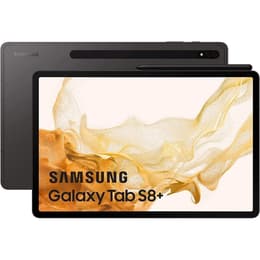


Galaxy Tab S8+ (12.4", 2022) Vs iPad Pro (2024, M4 series)

Galaxy Tab S8+ (12.4", 2022)
Starting at

Refurbished price:479.00

Versus €999.00 new

See options
iPad Pro (2024, M4 series)
Starting at

Refurbished price:767.00

Versus €1,229.00 new

See options

Ratings

The Samsung Galaxy Tab S8 Plus, released in February 2022, and the Apple iPad Pro M4 Series, launched in May 2024, represent distinct approaches to high-end tablet computing. While both offer expansive displays and robust performance, they cater to different ecosystems and user priorities. The primary differentiators lie in their operating systems—Android for the Tab S8 Plus and iPadOS for the iPad Pro M4—and the significant generational leap in processing power and display technology seen in the newer iPad model.

Scores

Durability

The longevity of a tablet is influenced by its release timeline, software support, and physical durability. The iPad Pro M4 Series, being a much newer device, naturally benefits from a longer expected support window.

  • Software Updates: The Galaxy Tab S8 Plus, released in early 2022, was promised four Android OS upgrades and five years of security updates, with major OS updates expected until 2026 and security patches until 2027. The iPad Pro M4 Series, released in May 2024, is anticipated to receive system software and security updates for five to seven years from its initial release. This suggests the iPad Pro M4 will have a considerably longer period of official software support.
  • Build Quality: Both tablets feature premium build materials designed for durability. The Galaxy Tab S8 Plus utilizes an Armor Aluminum frame. The iPad Pro M4 Series also features an aluminum enclosure. Both are designed to withstand daily use, though the iPad Pro M4 is notably thinner and lighter.
  • Practical Lifespan: Users often find that Apple devices maintain strong performance and receive updates for an extended period, contributing to a longer practical lifespan. While the Galaxy Tab S8 Plus remains a capable device, the iPad Pro M4's newer hardware and longer software commitment position it for extended relevance, particularly for demanding tasks.

Year of Release

2022

2024

Compatible with latest Update

Yes

Yes

OS

Android

iPadOS

Performance

Performance is a key area where these two tablets diverge, largely due to their different release dates and underlying architectures. The iPad Pro M4 Series benefits from a significant technological advancement.

  • Processing Power: The Galaxy Tab S8 Plus is powered by a processor capable of handling demanding applications and multitasking efficiently. It provides a smooth experience for everyday tasks, gaming, and creative work. The iPad Pro M4 Series, however, features a current-generation processor that offers a substantial increase in speed and efficiency. This translates to faster app loading, smoother multitasking, and superior performance in professional-grade applications like video editing and 3D rendering.
  • Multitasking and Responsiveness: Both tablets are designed for multitasking. The Galaxy Tab S8 Plus, with its available RAM configurations, handles multiple apps simultaneously without significant slowdowns. The iPad Pro M4, especially with its higher RAM options, provides even greater headroom for intensive workflows and complex projects, ensuring sustained responsiveness even under heavy load.
  • Battery Behavior: The Galaxy Tab S8 Plus features a large battery, with users reporting it can last a full day or two of use depending on activity, and around 9-12 hours of active screen time. The iPad Pro M4 Series also aims for all-day battery life, with some users experiencing excellent standby time and around 8 hours of screen-on time for streaming and browsing. However, some tests suggest that for continuous video streaming, its battery life might be comparable to or slightly less than previous iPad Pro models, though it excels in demanding tasks like gaming.

Memory (GB)

8 GB

8 GB

Screen quality

Both tablets offer high-quality displays, but they employ different technologies and specifications that impact the visual experience.

  • Display Technology and Clarity: The Galaxy Tab S8 Plus features a 12.4-inch Super AMOLED display with a resolution of 2800x1752 pixels, providing vibrant colors and deep blacks. The iPad Pro M4 Series introduces a Tandem OLED (Ultra Retina XDR) display, which uses two stacked OLED panels. This advanced technology delivers exceptional contrast, true blacks, and enhanced color accuracy, setting a new standard for tablet displays.
  • Brightness and Refresh Rate: Both devices offer a smooth 120Hz refresh rate for fluid scrolling and responsive interactions. The Galaxy Tab S8 Plus provides ample brightness for indoor and typical outdoor use. The iPad Pro M4 Series, with its Tandem OLED, achieves higher peak brightness levels, especially for HDR content (up to 1600 nits), and a full-screen SDR brightness of 1000 nits, making it particularly well-suited for bright environments and professional content creation.
  • Screen Size and Viewing Experience: The Galaxy Tab S8 Plus has a 12.4-inch screen, offering an expansive canvas for media consumption and productivity. The iPad Pro M4 Series is available in 11-inch and 13-inch models. The 13-inch model provides a slightly larger viewing area than the Tab S8 Plus, while the 11-inch offers a more compact form factor.

Resolution

1752 x 2800

2420 x 1668

Screen type

Super AMOLED

Ultra Retina XDR display

Pixel density

270ppp

264ppp

Audiovisual

While tablets are not typically primary photography devices, their cameras are important for video calls, document scanning, and occasional captures. Both tablets offer capable camera systems for these purposes.

  • Rear Camera System: The Galaxy Tab S8 Plus features a dual rear camera setup with a 13MP main lens and a 6MP ultrawide lens, capable of decent shots in good lighting and suitable for document scanning. The iPad Pro M4 Series has a 12MP wide rear camera with an improved sensor and sophisticated image processing, along with a LiDAR Scanner for enhanced depth sensing and AR applications. It can also capture 4K ProRes video.
  • Front Camera and Video Calls: The Galaxy Tab S8 Plus includes a 12MP ultrawide front camera, which is suitable for video calls. The iPad Pro M4 Series also features a 12MP ultrawide front-facing camera, but it has been strategically moved to the landscape edge, which is more practical for video conferencing and offers features like Center Stage for keeping subjects in frame.
  • Audio Quality: Both tablets are equipped with multi-speaker systems for an immersive audio experience. The Galaxy Tab S8 Plus has quad stereo speakers with Dolby Atmos. The iPad Pro M4 Series also features a four-speaker sound system and studio-quality microphones, enhancing the experience for media consumption and video calls.

Miscellaneous

Beyond core performance and display, several other features contribute to the overall user experience and utility of these tablets.

  • Connectivity: Both tablets support modern wireless standards. The Galaxy Tab S8 Plus offers Wi-Fi 6E and Bluetooth 5.2, with optional 5G connectivity. The iPad Pro M4 Series also includes Wi-Fi 6E and Bluetooth 5.3, with optional 5G.
  • Ports and Accessories: Both devices utilize a USB-C port for charging and data transfer. The iPad Pro M4's USB-C port supports Thunderbolt/USB 4, offering faster data transfer speeds and broader peripheral compatibility. The Galaxy Tab S8 Plus includes an S Pen in the box, which charges magnetically on the back of the tablet. The Apple Pencil Pro and other Apple Pencil models are sold separately for the iPad Pro M4.
  • Biometrics and Design: The Galaxy Tab S8 Plus features an in-display fingerprint reader for secure unlocking. The iPad Pro M4 Series uses Face ID for facial recognition. The iPad Pro M4 is notably thinner and lighter than the Galaxy Tab S8 Plus, with the 13-inch model being particularly slim.

Weight

567 g

444 g

Screen size (in)

12.4

11

Network

Wi-Fi

Wi-Fi

Carrier compatibility

Without SIM Port

Without SIM Port

The Samsung Galaxy Tab S8 Plus and the iPad Pro M4 Series cater to users with distinct preferences and needs. The Galaxy Tab S8 Plus is often praised for its vibrant Super AMOLED display, the inclusion of the S Pen, and its robust performance for general productivity and media consumption within the Android ecosystem. Users appreciate its multitasking capabilities and the flexibility offered by Android. Some common criticisms, however, point to the Android tablet software experience not always being as optimized as iPadOS for certain tasks, and its camera performance, while adequate, not matching smartphone standards.

The iPad Pro M4 Series receives significant acclaim for its groundbreaking Tandem OLED display, its exceptionally powerful processor, and its remarkably thin and light design. Users highlight its suitability for professional creative work, demanding applications, and its seamless integration within the Apple ecosystem. While its cameras are capable for video calls, some users note that the image quality for photography might not be a primary selling point compared to dedicated cameras or smartphones. The cost of accessories like the Apple Pencil and Magic Keyboard is also a consideration for some users.

Users prioritizing an integrated Android experience, an included stylus, and a high-quality AMOLED screen for media and general productivity may find the Galaxy Tab S8 Plus well-suited to their needs. Those who require top-tier performance for professional creative applications, a cutting-edge display, and a longer software support window, particularly within the Apple ecosystem, will likely lean towards the iPad Pro M4 Series. Both devices offer compelling experiences, and choosing between them often comes down to operating system preference and specific workflow requirements. For those considering a more sustainable choice, quality-assured refurbished options for both models can provide an eco-friendly alternative.


See all articles

Our recent comparisons







