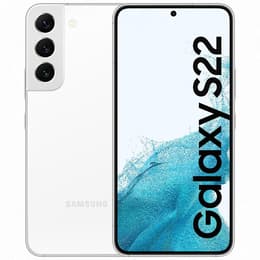
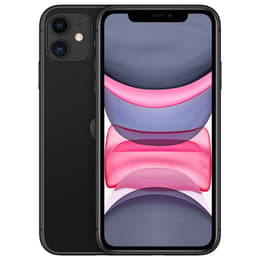


Galaxy S22 5G Vs iPhone 11

Galaxy S22 5G
Galaxy S22 5G
Starting at

Refurbished price:174.00

Versus €851.00 new

See options
iPhone 11
iPhone 11
Starting at

Refurbished price:150.08

Versus €589.00 new

See options

Ratings

The Samsung Galaxy S22 5G, released in February 2022, and the Apple iPhone 11, launched in September 2019, represent two distinct approaches to smartphone design and functionality from different generations. While both offer a compact form factor, the Galaxy S22 5G introduces a more advanced display and camera system, alongside 5G connectivity, whereas the iPhone 11 focuses on a robust user experience with its established iOS ecosystem.

Scores

Durability

Evaluating the practical lifespan of these devices involves considering their release timelines, operating system support, and ease of repair.

  • Software Longevity: The iPhone 11, released in 2019, is expected to receive major iOS updates until approximately Fall 2026, with security updates continuing for an additional one to two years. The Galaxy S22 5G, launched in 2022, has received major Android OS updates up to Android 16 (One UI 8) and is projected to receive security updates until early 2027. This means the iPhone 11 is nearing the end of its major software update cycle, while the Galaxy S22 5G has recently concluded its major OS updates.
  • Repairability: The iPhone 11 generally has a moderate repairability score, rated around 6 out of 10 by iFixit, indicating that some components like the display can be replaced with reasonable effort. In contrast, the Galaxy S22 5G received a lower repairability score of 3 out of 10 from iFixit, primarily due to the extensive use of strong adhesive for the back cover and battery, making repairs more challenging.
  • Expected Practical Lifespan: Users prioritizing extended major software feature updates might find the Galaxy S22 5G to have a slightly longer functional lifespan for new features, though both devices will continue to receive security patches for some time. The iPhone 11, despite its age, remains a capable device for everyday tasks, especially for users who do not require the very latest software features.

Year of Release

2022

2019

Compatible with latest Update

Yes

Yes

OS

Android

iOS

Foldable

No

No

Performance

Performance differences between these two smartphones are notable, reflecting the generational gap in their underlying hardware and software optimization.

  • Everyday Responsiveness: The Galaxy S22 5G, with its more recent processor, handles demanding applications and multitasking with a high degree of fluidity. Users will experience quick app loading times and smooth transitions between tasks. The iPhone 11, powered by an older generation chip, still offers a responsive experience for most daily activities, but may show some slowdown with very intensive applications or heavy multitasking compared to newer devices.
  • Battery Behavior: The Galaxy S22 5G features a 3700 mAh battery. However, user reports often indicate that its battery life can be less impressive, particularly for heavy users, sometimes requiring more frequent charging throughout the day. The iPhone 11, with a 3110 mAh battery, is frequently praised by users for its ability to last through a full day of typical use.
  • Storage and Multitasking: Both devices offer various internal storage options, typically ranging from 64GB to 256GB for the iPhone 11 and 128GB to 256GB for the Galaxy S22 5G. The Galaxy S22 5G generally includes more RAM, which contributes to its ability to keep more applications open in the background without needing to reload them.

Memory (GB)

8 GB

4 GB

Screen quality

The display technologies employed in the Galaxy S22 5G and iPhone 11 offer distinct visual experiences, impacting clarity, color, and smoothness.

  • Display Technology and Clarity: The Galaxy S22 5G features a 6.1-inch Dynamic AMOLED 2X display, providing vibrant colors, deep blacks, and excellent contrast. The iPhone 11 utilizes a 6.1-inch Liquid Retina HD LCD display, which offers good color accuracy and brightness, though it cannot achieve the same depth of black or contrast as an OLED panel.
  • Brightness and Outdoor Visibility: The Galaxy S22 5G boasts a peak brightness of up to 1300 nits, ensuring strong visibility even in bright outdoor conditions. The iPhone 11 has a typical maximum brightness of 625 nits, which is sufficient for most indoor and outdoor use but may struggle more in direct sunlight.
  • Refresh Rate and Smoothness: A key difference is the refresh rate. The Galaxy S22 5G offers an adaptive refresh rate that can scale between 48Hz and 120Hz, resulting in noticeably smoother scrolling and more fluid animations. The iPhone 11 has a standard 60Hz refresh rate, which provides a consistent experience but lacks the enhanced smoothness of a higher refresh rate display.

Resolution

1080 x 2340

828 x 1792

Screen type

Dynamic AMOLED 2X

Liquid Retina IPS LCD

Audiovisual

Both smartphones offer capable camera systems, but they differ in their hardware configurations and photographic capabilities, particularly in specialized modes.

  • Rear Camera System: The Galaxy S22 5G features a versatile triple-camera setup, including a 50MP wide-angle lens, a 12MP ultra-wide lens, and a 10MP telephoto lens with 3x optical zoom. This allows for greater flexibility in framing shots, including distant subjects. The iPhone 11 comes with a dual-camera system, comprising a 12MP wide-angle lens and a 12MP ultra-wide lens, offering 0.5x and 1x optical zoom capabilities.
  • Photography Performance: The Galaxy S22 5G excels in various lighting conditions, with its larger main sensor contributing to improved low-light performance and detailed images. Its 'Nightography' features enhance night shots. The iPhone 11 also delivers strong photo quality in good lighting and introduced a capable Night mode for improved low-light photography.
  • Video Recording and Audio: The Galaxy S22 5G supports video recording up to 8K at 24fps, along with 4K at 30/60fps. The iPhone 11 records 4K video at up to 60fps. Both devices offer good microphone quality for calls and video recording, and provide stereo speaker output for media consumption.

Main camera

50 megapixels

12 megapixels

Front camera

10 megapixels

12 megapixels

Miscellaneous

Beyond core features, several practical elements differentiate the user experience and connectivity options of these two devices.

  • Connectivity: A significant distinction is network capability. The Galaxy S22 5G supports 5G connectivity, offering faster download and upload speeds in areas with 5G coverage. The iPhone 11 is limited to 4G LTE networks. Both devices support modern Wi-Fi standards and Bluetooth for wireless connections.
  • Ports and Biometrics: The Galaxy S22 5G uses a USB-C port for charging and data transfer, while the iPhone 11 features Apple's proprietary Lightning port. Neither device includes a traditional 3.5mm headphone jack. For security, the Galaxy S22 5G employs an in-display fingerprint sensor, whereas the iPhone 11 relies on Face ID for biometric authentication.
  • Design and Handling: The Galaxy S22 5G has dimensions of 146 x 70.6 x 7.6 mm and weighs 167 grams, featuring an aluminum frame and Gorilla Glass Victus+ on both the front and back for enhanced durability. The iPhone 11 measures 150.9 x 75.7 x 8.3 mm and weighs 194 grams, with an aluminum frame and glass construction. Both devices carry an IP68 rating for dust and water resistance, though the Galaxy S22 5G is rated for 1.5 meters for 30 minutes, while the iPhone 11 is rated for 2 meters for 30 minutes.

Weight

195 g

194 g

Screen size (in)

6.1

6.1

Network

5G

4G

SIM card

Physical SIM + eSIM

Physical SIM + eSIM

Carrier compatibility

Unlocked

Unlocked

Connector

USB-C + Jack 3.5mm

Lightning

User sentiment for the iPhone 11 often highlights its reliable camera performance, particularly its Night mode, and its consistent all-day battery life for typical usage. Common criticisms include the absence of 5G connectivity and its LCD display, which, while good, doesn't offer the deep blacks and contrast of OLED screens found in newer devices. Users appreciate its enduring performance for everyday tasks, even several years after its release.

For the Galaxy S22 5G, users frequently praise its vibrant AMOLED display with a smooth 120Hz refresh rate and its versatile camera system, including the optical zoom capabilities. However, a recurring concern among users is its battery life, which many find to be less than ideal for heavy use, often requiring mid-day recharges. Its repairability score is also a point of criticism for those who value ease of maintenance.

Users prioritizing a highly fluid display, advanced camera features including optical zoom, and future-proof 5G connectivity will find the Galaxy S22 5G well-suited to their needs. Conversely, individuals who value a proven, long-lasting battery for daily use, a robust software ecosystem, and a slightly more repairable design may lean towards the iPhone 11. Both devices offer a quality smartphone experience, and choosing between them often comes down to these specific priorities. For those seeking a more sustainable and budget-conscious option, considering a quality-assured refurbished version of either model can be an excellent eco-friendly alternative.

See all articles

Our recent comparisons







