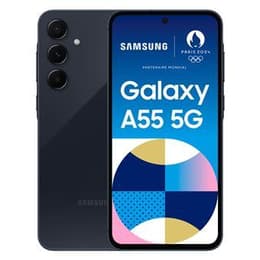



Galaxy A55 Vs Xiaomi 12T Pro

Galaxy A55
Galaxy A55
Starting at

Refurbished price:230.00

Versus €513.35 new

See options
Xiaomi 12T Pro
Xiaomi 12T Pro
Starting at

Refurbished price:201.00

Versus €1,199.00 new

See options

Ratings

The Samsung Galaxy A55, released in March 2024, and the Xiaomi 12T Pro, launched in October 2022, are both Android-based smartphones that offer distinct experiences. While the Galaxy A55 focuses on a balanced mid-range offering with a premium build, the Xiaomi 12T Pro, an older device, aimed for flagship-level performance and camera capabilities at its release. Both devices run on the Android operating system, with Samsung's One UI and Xiaomi's MIUI (or HyperOS) providing different user interfaces and feature sets.

Scores

Durability

When considering the longevity of these devices, several factors come into play, including their release dates and software support policies.

  • Release Timeline: The Samsung Galaxy A55 was released in March 2024, making it a newer device compared to the Xiaomi 12T Pro, which launched in October 2022. This difference in release date directly impacts their expected software support lifespan.
  • Software Support: Samsung promises four major Android OS upgrades and five years of security updates for the Galaxy A55. This means it will receive updates up to Android 18. The Xiaomi 12T Pro, on the other hand, was promised three major Android OS updates and four years of security patches from its launch, with Android 15 being its final major OS update.
  • Practical Lifespan: Users seeking the longest possible software support and access to the latest Android features will find the Galaxy A55 to be a more future-proof option due to its newer release and longer update commitment. The Galaxy A55 also features a more robust build with Gorilla Glass Victus+ on the front and Gorilla Glass on the back, along with an aluminum frame and IP67 dust/water resistance, suggesting better physical durability over time compared to the Xiaomi 12T Pro's Gorilla Glass 5 front and plastic back.

Year of Release

2024

2022

Compatible with latest Update

Yes

Yes

OS

Android

Android

Foldable

No

No

Performance

The performance of these two smartphones is influenced by their respective processors and memory configurations, impacting daily usage and demanding applications.

  • Processor Capabilities: The Xiaomi 12T Pro is equipped with a processor that, at its release, was considered a flagship-tier chipset, offering robust performance for demanding applications and gaming. The Galaxy A55 features a newer, in-house processor designed for efficient mid-range performance. While the Galaxy A55 handles everyday tasks smoothly and can manage casual gaming, the Xiaomi 12T Pro generally provides a more powerful experience for intensive gaming and heavy multitasking.
  • Storage and RAM: Both devices offer multiple configurations, typically starting with 8GB of RAM and 128GB or 256GB of internal storage. The Galaxy A55 also supports expandable storage via a microSD card, which is not available on the Xiaomi 12T Pro.
  • Battery Behavior: Both phones come with a 5000 mAh battery capacity. The Galaxy A55 generally offers reliable battery life, often lasting a full day with average use. The Xiaomi 12T Pro also provides solid battery endurance, with some users reporting over a day of use. A significant difference lies in charging speed, with the Xiaomi 12T Pro supporting 120W wired charging for rapid power replenishment, while the Galaxy A55 supports 25W wired charging.

Memory (GB)

8 GB

8 GB

Screen quality

The visual experience on both devices is delivered through high-quality displays, though with some distinctions in their specifications and characteristics.

  • Display Technology and Clarity: Both the Galaxy A55 and the Xiaomi 12T Pro feature AMOLED displays, known for their vibrant colors and deep blacks. The Galaxy A55 has a 6.6-inch Super AMOLED display with a resolution of 1080 x 2340 pixels, while the Xiaomi 12T Pro offers a slightly larger 6.67-inch AMOLED display with a higher resolution of 1220 x 2712 pixels, resulting in a slightly sharper image.
  • Brightness and Refresh Rate: Both screens support a 120Hz refresh rate for smooth scrolling and animations. The Galaxy A55 can reach a peak brightness of 1000 nits, offering good visibility outdoors. The Xiaomi 12T Pro has a typical brightness of 500 nits and a High Brightness Mode (HBM) of 900 nits.
  • Viewing Experience: The Galaxy A55's display is protected by Corning Gorilla Glass Victus+, while the Xiaomi 12T Pro uses Gorilla Glass 5. Both provide a clear and immersive viewing experience for media consumption and daily tasks, with the Xiaomi 12T Pro offering a marginally sharper display and the Galaxy A55 potentially offering better outdoor visibility.

Resolution

1080 x 2340

1220 x 2712

Screen type

Super AMOLED

AMOLED

Audiovisual

Both smartphones offer capable camera systems, designed to capture a variety of moments, though they approach photography with different sensor configurations and processing.

  • Rear Camera Systems: The Samsung Galaxy A55 features a triple rear camera setup with a 50 MP main sensor with optical image stabilization (OIS), a 12 MP ultrawide lens, and a 5 MP macro camera. The Xiaomi 12T Pro boasts a high-resolution 200 MP main camera with OIS, complemented by an 8 MP ultrawide and a 2 MP macro lens.
  • Photography Performance: The Galaxy A55's main camera is noted for capturing sharp, detailed shots with vibrant colors in good lighting, and it performs commendably in low-light conditions, partly due to its AI Image Signal Processing. The Xiaomi 12T Pro's 200 MP main sensor can capture highly detailed images, especially in well-lit environments, and offers strong night photography capabilities. However, some users have noted that the Xiaomi's secondary cameras (ultrawide and macro) are less impressive, and its main camera photos can sometimes appear over-sharpened.
  • Video Recording and Front Camera: Both devices are capable of recording video in 4K resolution at 30 frames per second. The Galaxy A55 has a 32 MP front-facing camera, while the Xiaomi 12T Pro features a 20 MP front camera. Both provide good quality for selfies and video calls.

Main camera

50 megapixels

200 megapixels

Front camera

32 megapixels

20 megapixels

Miscellaneous

Beyond the core features, several other aspects contribute to the overall user experience and practical utility of these smartphones.

  • Connectivity and Ports: Both devices support 5G connectivity, Wi-Fi 6, and Bluetooth 5.3. They both utilize a USB-C 2.0 port for charging and data transfer. Neither phone includes a traditional 3.5mm headphone jack.
  • Security and Biometrics: Both the Galaxy A55 and the Xiaomi 12T Pro feature an in-display optical fingerprint sensor for secure unlocking. They also offer face recognition capabilities.
  • Design and Build Materials: The Galaxy A55 features a more premium build with a glass front (Gorilla Glass Victus+), a glass back, and an aluminum frame, along with an IP67 rating for dust and water resistance. The Xiaomi 12T Pro has a Gorilla Glass 5 front, a plastic back, and an aluminum frame, with an IP53 rating for splash resistance. The Galaxy A55 weighs 213g, while the Xiaomi 12T Pro weighs 205g.

Weight

213 g

204 g

Screen size (in)

6.6

6.67

Network

5G

5G

SIM card

Physical SIM

Dual Physical SIM

Carrier compatibility

Unlocked

Unlocked

The Samsung Galaxy A55 and Xiaomi 12T Pro cater to slightly different user priorities, reflecting their respective market positions and release timelines. User feedback for the Galaxy A55 often praises its premium design, solid build quality, and reliable everyday performance. Many appreciate its vibrant display and the promise of extended software support. Some common criticisms include its battery life not always meeting expectations for heavy users and the camera performance, while good, not being exceptional in all scenarios.

The Xiaomi 12T Pro, on the other hand, is frequently lauded for its powerful processor, incredibly fast 120W charging, and the high-resolution 200 MP main camera. Users often highlight its smooth display and strong overall performance for demanding tasks. Criticisms sometimes point to its less robust build quality compared to some competitors, the performance of its secondary cameras, and a shorter software update commitment.

Users prioritizing a device with a more modern design, superior build quality, and a longer software support lifespan may find the Samsung Galaxy A55 to be a more suitable choice. Its balanced performance and reliable camera system make it a strong contender for general daily use. Conversely, individuals who value raw processing power for gaming or intensive applications, coupled with exceptionally fast charging capabilities, might lean towards the Xiaomi 12T Pro. Its high-megapixel main camera also appeals to those seeking detailed photography, provided they are aware of the limitations of its secondary lenses. Both devices are available as quality-assured refurbished options, offering an eco-friendly alternative for consumers.


See all articles

Our recent comparisons