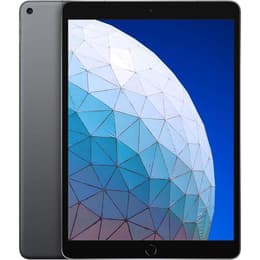
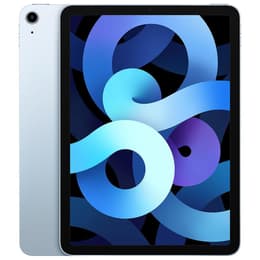


iPad Air 3 (2019, A12 series) Vs iPad Air 4 (2020, A14 series)

iPad Air 3 (2019, A12 series)
Starting at

Refurbished price:185.00

Versus €559.00 new

See options
iPad Air 4 (2020, A14 series)
Starting at

Refurbished price:273.00

Versus €679.00 new

See options

Ratings

The iPad Air (3rd generation), released in March 2019, and the iPad Air (4th generation), launched in October 2020, represent two distinct iterations of Apple's mid-range tablet line. While both devices operate on Apple's iPadOS, the 2020 model introduced a significant design overhaul and a more powerful internal processor, alongside updated connectivity and accessory support. These changes aim to cater to different user preferences and performance needs.

Scores

Durability

The longevity of a tablet is influenced by its release timeline, software support, and physical design. The iPad Air 2019 and 2020 models offer different expectations in these areas.

  • Release Timeline and Software Support: The iPad Air (3rd generation) was released in March 2019 and was discontinued in September 2020. The iPad Air (4th generation) was released in October 2020 and was discontinued in March 2022. This later release and discontinuation date for the 2020 model generally translates to an extended period of software updates and support from the manufacturer, offering a longer practical lifespan for users prioritizing the latest iPadOS features and security patches.
  • Build Quality: Both models feature an aluminum unibody design, contributing to their overall durability. The iPad Air (4th generation) introduced a more modern, flat-edged design, aligning it with the aesthetic of more recent Apple devices.
  • Practical Lifespan: While both devices are built to last, the newer processor and design of the iPad Air (4th generation) may offer a slightly longer period of optimal performance with future software and application demands.

Year of Release

2019

2020

Compatible with latest Update

Yes

Yes

OS

iPadOS

iPadOS

Maximum Operating System supported

iPadOS 18

iPadOS 18

Performance

Performance is a key differentiator between these two iPad Air models, primarily due to their respective processors and RAM configurations.

  • Processor Capabilities: The iPad Air (3rd generation) is equipped with the A12 Bionic chip, while the iPad Air (4th generation) features the A14 Bionic chip. The A14 Bionic offers a notable increase in processing power, with up to 40% faster CPU performance and 30% faster graphics compared to the A12 Bionic. This translates to a more responsive experience for demanding applications, complex multitasking, and graphically intensive games on the 2020 model.
  • System Responsiveness and Multitasking: The iPad Air (3rd generation) comes with 3GB of RAM, whereas the iPad Air (4th generation) includes 4GB of RAM. This additional memory in the 2020 model enhances its ability to handle multiple applications simultaneously and switch between them more smoothly, benefiting users who frequently multitask.
  • Battery Behavior: Both iPad Air models are designed to provide comparable battery life, typically offering up to 10 hours of web browsing on Wi-Fi. Real-world usage may vary, but both are generally capable of lasting through a full day of moderate use.

Memory (GB)

3 GB

4 GB

Processor

Apple A12 Bionic

Apple A14 Bionic

Screen quality

The visual experience on both iPad Air models is delivered through high-quality displays, though there are differences in size and design integration.

  • Display Technology and Size: The iPad Air (3rd generation) features a 10.5-inch Liquid Retina display, while the iPad Air (4th generation) boasts a slightly larger 10.9-inch Liquid Retina display. Both displays offer a resolution of 264 pixels per inch (2224 x 1668 for the 2019 model and 2360 x 1640 for the 2020 model), ensuring sharp and clear visuals. The larger screen on the 2020 model is achieved by reducing the display bezels and removing the physical Home button.
  • Color and Brightness: Both tablets feature True Tone technology, which adjusts the display's color temperature to match ambient lighting, and support the P3 wide color gamut for vibrant and accurate colors. They also offer a peak brightness of around 500 nits, providing good visibility in various lighting conditions, including outdoors.
  • Refresh Rate: Neither the iPad Air (3rd generation) nor the iPad Air (4th generation) includes ProMotion technology, meaning both have a standard 60Hz refresh rate. While smooth for most tasks, users accustomed to higher refresh rate displays might notice the difference.

Resolution

2224 x 1668

2360 x 1640

True Tone

Yes

Yes

Pro-Motion

No

No

Screen type

Retina display

Liquid Retina display

Pixel density

264ppp

264ppp

Brightness

500 nits brightness

500 nits brightness

Sound quality

Speakers

Stereo speakers

Stereo speakers

Audiovisual

The camera systems on these iPad Air models are suitable for everyday tasks, with the newer model offering enhancements for photography and video recording.

  • Rear Camera Capabilities: The iPad Air (3rd generation) is equipped with an 8-megapixel rear camera with an f/2.4 aperture, capable of recording 1080p HD video. The iPad Air (4th generation) features an upgraded 12-megapixel wide rear camera with an f/1.8 aperture, which supports 4K video recording at up to 60 frames per second and offers improved low-light performance.
  • Front Camera Performance: Both models include a 7-megapixel front-facing camera with an f/2.2 aperture, capable of 1080p HD video recording at 30 frames per second. These cameras are well-suited for video calls and casual selfies.
  • Audio Experience: The iPad Air (3rd generation) features dual speakers located on one side, which can limit stereo separation. The iPad Air (4th generation) improves upon this with stereo speakers that provide a more immersive audio experience, especially when holding the device in landscape orientation for media consumption. The 2019 model retains a 3.5mm headphone jack, which is absent on the 2020 model.

Miscellaneous

Beyond core performance and display, several practical features and design elements differentiate the iPad Air 2019 and 2020 models.

  • Connectivity and Ports: The iPad Air (3rd generation) utilizes a Lightning port for charging and accessories, and supports Wi-Fi 5 (802.11ac). The iPad Air (4th generation) transitions to a more versatile USB-C port, enabling broader compatibility with external accessories and faster data transfer, and supports the newer Wi-Fi 6 (802.11ax) standard. Both models support Bluetooth 5.0.
  • Biometric Authentication and Accessories: The 2019 model features Touch ID integrated into the traditional Home button. The 2020 model adopts a more modern design without a Home button, relocating Touch ID to the power button on the top edge. The iPad Air (3rd generation) is compatible with the 1st generation Apple Pencil and the Smart Keyboard, while the iPad Air (4th generation) supports the more advanced 2nd generation Apple Pencil, which charges magnetically, and the Magic Keyboard.
  • Design and Dimensions: The iPad Air (3rd generation) has dimensions of 250.6 x 174.1 x 6.1 mm and weighs around 456-464 grams. The iPad Air (4th generation) has slightly different dimensions at 247.6 x 178.5 x 6.1 mm and weighs approximately 458-460 grams. The 2020 model's design features flatter edges and a more uniform bezel around the display, giving it a more contemporary appearance.

Weight

456 g

460 g

Width

17.41 cm

17.85 cm

Height

25.06 cm

24.76 cm

Depth

0.61 cm

0.61 cm

Screen size (in)

10.5

10.9

Network

Wi-Fi

Wi-Fi + 4G

Carrier compatibility

Without SIM Port

Unlocked

Wi-Fi technology

Wi-Fi 6 802.11a/b/g/n/ac

Wi-Fi 6 802.11ax

Bluetooth Version

Bluetooth 5.0

Bluetooth 5.0

Face ID

No

No

Touch ID

Yes

Yes

Connector

Lightning connector

USB Type-C

User feedback often highlights the iPad Air (3rd generation) as a highly capable and reliable tablet for general use, praised for its solid performance and the inclusion of a headphone jack. Some users, however, noted its more traditional design and the Lightning port as areas where it showed its age compared to newer devices.

The iPad Air (4th generation) generally receives acclaim for its significant design refresh, powerful processor, and enhanced accessory support. Users appreciate the modern, all-screen aesthetic and the versatility offered by the USB-C port and compatibility with the 2nd generation Apple Pencil and Magic Keyboard. Common observations include the absence of a headphone jack and Face ID, with Touch ID being integrated into the power button instead.

Users prioritizing a capable and dependable tablet for everyday tasks, media consumption, and light productivity, who also value the presence of a traditional Home button and a headphone jack, may find the iPad Air (3rd generation) well-suited to their needs. Conversely, those seeking a more future-proof device with higher performance for demanding applications, a modern design, and compatibility with the latest accessories will likely lean towards the iPad Air (4th generation). Both models offer a quality-assured refurbished option, providing an eco-friendly alternative for consumers.


See all articles

Our recent comparisons