
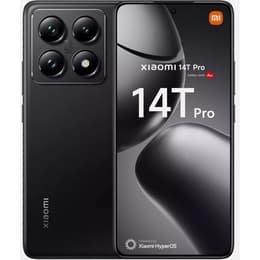


Google Pixel 7 Pro Vs Xiaomi 14T Pro

Google Pixel 7 Pro
Google Pixel 7 Pro
Starting at

Refurbished price:201.00

Versus €640.98 new

See options
Xiaomi 14T Pro
Xiaomi 14T Pro
Starting at

Refurbished price:394.00

Versus €900.00 new

See options

Ratings

The Google Pixel 7 Pro, released in October 2022, and the Xiaomi 14T Pro, launched in September 2024, are both advanced smartphones offering distinct user experiences. While the Pixel 7 Pro emphasizes computational photography and a streamlined Android experience, the Xiaomi 14T Pro focuses on high-performance hardware and rapid charging capabilities. Both devices operate on the Android platform, with the Pixel running Google's stock Android and the Xiaomi featuring its HyperOS overlay, each bringing a unique interface and feature set.

Scores

Durability

When considering the long-term usability of these devices, their release timelines and software support policies are key factors.

  • Software Longevity: The Google Pixel 7 Pro, released in October 2022, is guaranteed to receive five years of OS and security updates, extending its support until at least October 2027 for security and potentially Android 17 or 18 for OS updates. [19, 36, 38] The Xiaomi 14T Pro, launched in September 2024, ships with Android 14 and Xiaomi's HyperOS. While Xiaomi typically provides several years of software support for its flagship devices, specific long-term update commitments for the 14T Pro were not detailed in available information.
  • Physical Durability: Both devices feature an IP68 rating for dust and water resistance, indicating a high level of protection against environmental elements. [7, 15] The Pixel 7 Pro incorporates Corning Gorilla Glass Victus for screen protection. [7] The Xiaomi 14T Pro also features robust build quality, including a metal frame. [11]
  • Expected Lifespan: Users can expect a practical lifespan of several years from both phones, with the Pixel 7 Pro offering a clearly defined extended software support period from Google. The availability of quality-assured refurbished options for devices like these can further extend their lifecycle, offering a sustainable choice for consumers.

Year of Release

2022

2024

Compatible with latest Update

Yes

Yes

OS

Android

Android

Foldable

No

No

Performance

The performance of a smartphone is largely determined by its internal components and how efficiently they handle daily tasks and demanding applications.

  • Processing Power: The Google Pixel 7 Pro is powered by Google's Tensor G2 processor, designed to optimize AI and machine learning tasks, contributing to features like advanced computational photography and efficient voice processing. [8] The Xiaomi 14T Pro features the MediaTek Dimensity 9300+ processor, which is noted for its powerful performance, capable of handling intensive gaming and multitasking smoothly. [13, 29]
  • Multitasking and Storage: The Pixel 7 Pro typically comes with 12GB of RAM, ensuring smooth multitasking across various applications. [30] Storage options for the Pixel 7 Pro include 128GB, 256GB, or 512GB. [30] The Xiaomi 14T Pro is often available with 12GB of RAM and 512GB of internal storage, providing ample space and capability for demanding users. [5, 15, 25]
  • Battery Behavior: The Pixel 7 Pro is equipped with a 5000 mAh battery. [3, 30] Real-world battery performance can vary, with some users reporting around 1.5 days of moderate use, though heavy usage, especially with high screen brightness, can lead to more frequent charging. [18, 20, 32] The Xiaomi 14T Pro also houses a 5000 mAh battery, [29] and supports 120W wired fast charging and 50W wireless charging, allowing for very rapid power replenishment. [5, 15, 28, 29]

Memory (GB)

12 GB

16 GB

Screen quality

The display is a primary interface for smartphone interaction, and both devices offer high-quality viewing experiences with distinct characteristics.

  • Display Technology and Resolution: The Google Pixel 7 Pro features a 6.7-inch LTPO OLED display with a QHD+ resolution of 1440 x 3120 pixels, resulting in sharp and detailed visuals. [7, 12, 17] The Xiaomi 14T Pro comes with a 6.67-inch AMOLED display, offering a 1.5K resolution of 2712 x 1220 pixels. [5, 10, 25, 34]
  • Brightness and Clarity: The Pixel 7 Pro's screen can reach a peak brightness of 1500 nits, with some measurements showing up to 1620 nits, ensuring good visibility in various lighting conditions. [3, 8, 33] The Xiaomi 14T Pro boasts an impressive peak brightness of 4000 nits, which significantly enhances outdoor readability and HDR content viewing. [5, 10, 25, 34]
  • Refresh Rate and Smoothness: Both phones offer high refresh rates for fluid scrolling and responsive interactions. The Pixel 7 Pro has a 120Hz adaptive refresh rate. [7, 12, 35] The Xiaomi 14T Pro features an even higher 144Hz refresh rate, which can provide an exceptionally smooth visual experience, particularly beneficial for mobile gaming and fast-paced content. [5, 10, 25, 34]

Resolution

1440 x 3120

1220 x 2712

Screen type

LTPO AMOLED

AMOLED

Audiovisual

Both the Google Pixel 7 Pro and the Xiaomi 14T Pro are designed with advanced camera systems, each with its own strengths in photography and videography.

  • Rear Camera Systems: The Pixel 7 Pro features a versatile triple camera setup, including a 50MP main wide lens, a 48MP telephoto lens with 5x optical zoom and up to 30x Super Res Zoom, and a 12MP ultrawide lens. [3, 6, 35] It is highly praised for its computational photography, delivering excellent detail, vibrant colors, and strong low-light performance. [1, 2, 6, 9] The Xiaomi 14T Pro sports a Leica-tuned triple camera system, comprising a 50MP Light Fusion 900 primary sensor, a 50MP telephoto lens with 2.6x optical zoom, and a 12MP ultrawide lens. [5, 10, 25, 29]
  • Photography Features: The Pixel 7 Pro includes features like Macro Focus, Real Tone for accurate skin representation, and Cinematic Blur for videos. [35] Its low-light and astrophotography modes are particularly effective. [6, 9] The Xiaomi 14T Pro offers Leica photographic styles, a movie mode with cinematic blur effects, 10-bit video recording, UltraHDR, and a Master Portrait mode for enhanced depth and bokeh. [29]
  • Front Camera and Video Quality: The Pixel 7 Pro has a 10.8MP front camera capable of 4K video recording. [7, 35] The Xiaomi 14T Pro features a higher resolution 32MP front camera. [5, 15, 25] Both devices offer strong video recording capabilities, with the Pixel 7 Pro supporting up to 4K at 60 frames per second. [6]

Main camera

50 megapixels

50 megapixels

Front camera

10.8 megapixels

32 megapixels

Miscellaneous

Beyond core specifications, several practical elements contribute to the overall user experience and daily functionality of these smartphones.

  • Connectivity and Ports: The Google Pixel 7 Pro supports 5G connectivity and features dual SIM capabilities with a Nano-SIM and eSIM. [3] It uses a USB-C port for charging and data transfer. The Xiaomi 14T Pro is tipped to support advanced Wi-Fi 7, Bluetooth 5.4, 5G, and 4G LTE, along with NFC for contactless payments. [15, 24] It also utilizes a USB-C port.
  • Biometric Security: Both devices offer modern biometric authentication methods. The Pixel 7 Pro includes an under-display optical fingerprint sensor and Face Unlock. [3, 35] While specific details for the Xiaomi 14T Pro were not extensively detailed, it is expected to feature an in-display fingerprint sensor.
  • Design and Handling: The Pixel 7 Pro measures 162.9 mm in height, 76.6 mm in width, and 8.9 mm in thickness, weighing 212 grams. [3, 30] It features a design with curved display edges. [12] The Xiaomi 14T Pro is slightly more compact at 160.4 mm in height, 75.1 mm in width, and 8.39 mm in thickness, weighing 209 grams. [10] It boasts a metal frame and a 3D curved back for ergonomic handling. [11, 34]

Weight

212 g

209 g

Screen size (in)

6.7

6.67

Network

5G

5G

SIM card

Physical SIM + eSIM

Dual Physical SIM

Carrier compatibility

Unlocked

Unlocked

The Google Pixel 7 Pro and the Xiaomi 14T Pro cater to different priorities within the premium smartphone segment. User sentiment for the Pixel 7 Pro often praises its exceptional camera capabilities, particularly its computational photography, low-light performance, and long-term software support from Google. [2, 6, 9, 38] Some users have noted that while its processor is efficient for AI tasks, its raw performance might not always match the very latest chipsets, and battery life can be inconsistent with heavy use. [20, 39]

For the Xiaomi 14T Pro, common praise points revolve around its powerful processor, extremely bright and high refresh rate display, and very fast charging speeds. [10, 25, 28, 34] The Leica-tuned camera system is also a significant draw, though some user discussions suggest that while photos are excellent, video quality might still be an area where Pixel devices hold an edge. [41] Concerns sometimes arise regarding Xiaomi's software update longevity compared to Google's extended commitments. [41]

Users prioritizing a consistently excellent and intelligent camera system, coupled with a clean Android experience and guaranteed long-term software updates, may find the Google Pixel 7 Pro well-suited to their needs. Conversely, those who prioritize raw processing power for demanding applications, an exceptionally bright and fluid display, and industry-leading fast charging capabilities might lean towards the Xiaomi 14T Pro. Both devices offer robust build quality and modern features, making them strong contenders depending on individual user preferences. Exploring quality-assured refurbished options for either model can provide an eco-friendly alternative for acquiring these advanced smartphones.


See all articles

Our recent comparisons