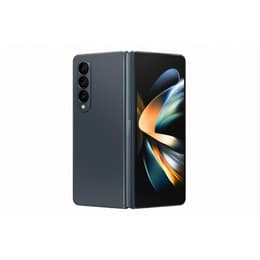
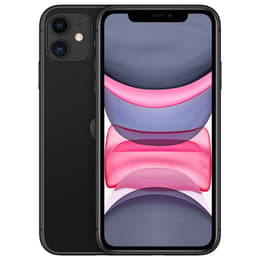


Galaxy Z Fold4 Vs iPhone 11

Galaxy Z Fold4
Galaxy Z Fold4
Starting at

Refurbished price:470.00

Versus €1,799.00 new

See options
iPhone 11
iPhone 11
Starting at

Refurbished price:153.79

Versus €639.00 new

See options

Ratings

The Samsung Galaxy Z Fold4 (2022) and the Apple iPhone 11 (2019) represent distinct approaches to smartphone design and functionality. While the Z Fold4 offers a unique foldable form factor with a large internal display for enhanced productivity, the iPhone 11 provides a more traditional, streamlined smartphone experience. Both devices operate on different ecosystems, with the Z Fold4 running Android and the iPhone 11 running iOS, leading to fundamental differences in user interface and app availability.

Scores

Durability

The expected practical lifespan of a smartphone is influenced by its initial release date and the manufacturer's software support policies.

  • Release Timeline: The iPhone 11 was released in September 2019, making it an older device compared to the Galaxy Z Fold4, which launched in August 2022.
  • Software Longevity: The Galaxy Z Fold4 is expected to receive four major Android OS updates and five years of security updates, potentially extending its support until 2027. The iPhone 11, having launched with iOS 13, is anticipated to receive major iOS updates until around 2026, with security patches continuing for an additional year or two. This suggests the Z Fold4 may offer a slightly longer period of active software support from its release date.
  • Durability Considerations: The Z Fold4 features an Armor Aluminum frame and IPX8 water resistance, offering protection against submersion. Its outer screen is protected by Gorilla Glass Victus+, while the inner foldable screen is inherently softer and more susceptible to scratches. The iPhone 11 features an aerospace-grade aluminum frame and durable glass, along with IP68 water and dust resistance, providing robust protection for a traditional smartphone.

Year of Release

2022

2019

Compatible with latest Update

Yes

Yes

OS

Android

iOS

Foldable

Yes

No

Performance

Performance in both devices is driven by their respective processors, influencing how smoothly applications run and how efficiently tasks are handled.

  • Processing Power: The Galaxy Z Fold4 is equipped with a processor designed for demanding tasks, allowing it to handle intensive applications, complex multitasking, and graphic-heavy gaming with fluidity. The iPhone 11, powered by its A13 Bionic chip, also delivers robust performance for everyday use, seamless multitasking, and gaming, maintaining its capability with modern applications.
  • Multitasking Capabilities: With 12GB of RAM, the Z Fold4 is well-suited for extensive multitasking, enabling users to run multiple applications simultaneously on its large internal display without significant slowdowns. The iPhone 11, with 4GB of RAM, is optimized by its operating system to manage applications efficiently, providing a smooth experience for typical smartphone usage and app switching.
  • Storage Options: The Galaxy Z Fold4 offers storage configurations up to 1TB, catering to users who require substantial space for files, media, and applications. The iPhone 11 is available with up to 256GB of internal storage, which is sufficient for many users but may be a consideration for those with large media libraries or numerous applications.
  • Battery Behavior: The Z Fold4 houses a 4400 mAh battery, which, combined with its efficient processor, contributes to improved battery life, often lasting a full day for many users. The iPhone 11, with a 3110 mAh battery, also provides good battery life for a full day of use, though its capacity may show more degradation over time due to its earlier release.

Memory (GB)

12 GB

4 GB

Screen quality

The display experience is a primary differentiator, with the Z Fold4 offering a unique adaptable screen and the iPhone 11 providing a consistent, high-quality traditional display.

  • Display Technology and Size: The Galaxy Z Fold4 features two Dynamic AMOLED 2X displays: a 6.2-inch cover screen and a large 7.6-inch foldable inner screen. These OLED panels deliver deep blacks, vibrant colors, and high contrast. The iPhone 11 utilizes a 6.1-inch Liquid Retina HD LCD display, known for its color accuracy and clarity.
  • Resolution and Clarity: The Z Fold4's main display boasts a resolution of 2176x1812 pixels, offering a sharp and expansive viewing area, while its cover screen has a resolution of 2316x904 pixels. The iPhone 11's display has a resolution of 1792x828 pixels, providing clear visuals for its size.
  • Refresh Rate and Smoothness: Both screens on the Z Fold4 support an adaptive refresh rate of up to 120Hz, resulting in smooth scrolling and responsive interactions. The iPhone 11 features a standard 60Hz refresh rate, which provides a consistent visual experience for most content.
  • Brightness and Outdoor Visibility: The Z Fold4's AMOLED displays offer high brightness levels, making them suitable for outdoor use. The iPhone 11's LCD panel also provides good brightness, enhanced by True Tone technology for adaptive white balance.

Resolution

1812 x 2176

828 x 1792

Screen type

Foldable Dynamic AMOLED 2X

Liquid Retina IPS LCD

Audiovisual

Both devices offer capable camera systems, though they differ in their configurations and photographic strengths.

  • Rear Camera System: The Galaxy Z Fold4 features a versatile triple-camera setup on the rear, including a 50MP wide-angle lens with optical image stabilization (OIS), a 12MP ultrawide lens, and a 10MP telephoto lens with 3x optical zoom and OIS. This system is noted for producing good images in various conditions, including low light. The iPhone 11 has a dual-camera system with a 12MP wide-angle lens (with OIS) and a 12MP ultrawide lens. It lacks a dedicated telephoto lens, relying on digital zoom.
  • Photography Performance: The Z Fold4's camera system, similar to other premium devices from its manufacturer, delivers detailed and vibrant photos, with strong low-light performance and effective night mode. The iPhone 11 is praised for its consistent image quality, excellent color reproduction, and a highly effective Night mode that significantly improves low-light photography.
  • Video Recording: The Galaxy Z Fold4 supports video recording up to 8K at 24 frames per second, and 4K at 60 frames per second, with good stabilization. The iPhone 11 records 4K video at up to 60 frames per second, offering strong video stabilization suitable for various uses.
  • Front-Facing Cameras: The Z Fold4 includes a 10MP camera on its cover screen and a 4MP under-display camera on the main screen, with the cover camera generally preferred for selfies. The iPhone 11 features a 12MP front-facing camera capable of capturing detailed selfies and supporting high-quality video calls.

Main camera

50 megapixels

12 megapixels

Front camera

4 megapixels

12 megapixels

Miscellaneous

Beyond core performance and display, several practical features contribute to the overall user experience of these devices.

  • Connectivity Standards: The Galaxy Z Fold4 supports 5G connectivity, offering faster mobile data speeds where available, along with Wi-Fi 6E and Bluetooth 5.2. The iPhone 11 supports 4G LTE, Wi-Fi 6, and Bluetooth 5.0, providing reliable wireless connections, though it does not include 5G capabilities.
  • Physical Design and Handling: The Z Fold4 has a unique foldable design, measuring 155.1 x 67.1 x 14.2-15.8 mm when folded and 155.1 x 130.1 x 6.3 mm when unfolded, with a weight of 263g. Its larger size and weight, especially when folded, can make one-handed use challenging for some. The iPhone 11, with dimensions of 150.9 x 75.7 x 8.3 mm and a weight of 194g, offers a more conventional and easily manageable form factor for single-handed operation.
  • Ports and Biometrics: The Z Fold4 features a USB-C 3.2 port and a side-mounted fingerprint scanner for secure unlocking. The iPhone 11 uses a Lightning connector for charging and data transfer, and relies on Face ID for biometric authentication.
  • Additional Features: The Galaxy Z Fold4 supports S Pen input, enhancing its utility for note-taking and drawing on its large internal display, though the stylus is sold separately. Its multitasking features, such as multi-window mode, are optimized for its foldable screen.

Weight

263 g

194 g

Screen size (in)

7.6

6.1

Network

5G

4G

SIM card

Dual Physical SIM + eSIM

Physical SIM + eSIM

Carrier compatibility

Unlocked

Unlocked

Connector

USB-C

Lightning

The Samsung Galaxy Z Fold4 and iPhone 11 cater to different user preferences, each excelling in distinct areas. Users often praise the Z Fold4 for its innovative foldable design, which transforms a compact smartphone into a large tablet-like display, making it ideal for multitasking and media consumption. Its powerful performance and versatile camera system also receive positive feedback. However, some users note the visible crease on the inner display and its relatively heavier, thicker build compared to traditional smartphones.

The iPhone 11 is frequently lauded for its consistent performance, reliable camera capabilities, and long-term software support. Its user-friendly iOS ecosystem and robust build quality are also common points of appreciation. Criticisms sometimes include the lack of a telephoto lens and its LCD display, which, while high-quality, does not offer the deep blacks and contrast of OLED panels.

Users prioritizing a large, adaptable screen for productivity, extensive multitasking, and a cutting-edge form factor may find the Galaxy Z Fold4 better suited to their needs. Conversely, users who value a straightforward, dependable smartphone experience with a strong camera, consistent performance, and a familiar operating system will likely lean towards the iPhone 11. Both devices offer compelling features for their respective audiences, and considering a quality-assured refurbished option for either model can be an eco-friendly alternative.

See all articles

Our recent comparisons







