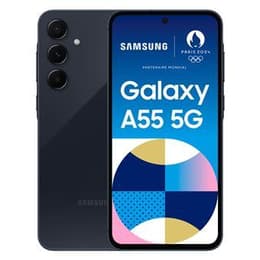
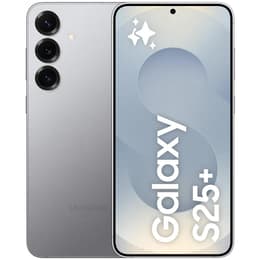


Galaxy A55 Vs Galaxy S25+

Galaxy A55
Galaxy A55
Starting at

Refurbished price:230.00

Versus €513.35 new

See options
Galaxy S25+
Galaxy S25+
Starting at

Refurbished price:624.00

Versus €1,401.57 new

See options

Ratings

The Samsung Galaxy A55 (released in March 2024) and the Samsung Galaxy S25 Plus (released in February 2025) represent different tiers within Samsung's smartphone lineup. While both operate on the Android platform with Samsung's One UI, the S25 Plus, as a flagship model, introduces more advanced hardware and extended software support compared to the A55's capable mid-range offerings. This comparison will highlight the practical distinctions between these two devices to help users determine which best suits their needs.

Scores

Durability

When considering the longevity of these devices, both offer substantial software support, though with notable differences.

  • Software Support: The Galaxy A55 is slated to receive four major Android OS upgrades and five years of security updates from its release. In contrast, the Galaxy S25 Plus benefits from Samsung's extended commitment, offering seven generations of Android OS upgrades and seven years of security updates, ensuring a longer period of up-to-date software and security.
  • Build Durability: The Galaxy A55 features a glass front with Gorilla Glass Victus+ and a glass back, encased in an aluminum frame, providing an IP67 rating for dust and water resistance. The Galaxy S25 Plus elevates this with Gorilla Glass Victus 2 on both the front and back, an aluminum frame, and a higher IP68 rating, offering enhanced protection against environmental elements.
  • Practical Lifespan: Users prioritizing the longest possible software longevity and robust physical durability will find the Galaxy S25 Plus better equipped for extended use. The A55 still offers a respectable lifespan for a mid-range device, suitable for users who typically upgrade within a few years.

Year of Release

2024

2025

Compatible with latest Update

Yes

Yes

OS

Android

Android

Foldable

No

No

Performance

The performance capabilities of the Galaxy A55 and Galaxy S25 Plus cater to different user demands, primarily due to their internal processing power and memory configurations.

  • Processing Power: The Galaxy A55 is powered by a capable octa-core processor that handles everyday tasks, multitasking, and casual gaming smoothly. Users report fast app opening and closing times, making it suitable for general daily usage. The Galaxy S25 Plus, featuring a current-generation flagship processor, delivers significantly more power, ensuring exceptionally smooth performance across demanding applications, intensive multitasking, and high-fidelity gaming without noticeable slowdowns.
  • Multitasking and Storage: The A55 is available with 8GB or 12GB of RAM and up to 256GB of internal storage, with expandable storage via microSD. This configuration supports efficient multitasking for most users. The S25 Plus comes standard with 12GB of RAM and offers internal storage options of 256GB or 512GB, providing ample space and superior fluidity for heavy users and those who manage many applications simultaneously.
  • Battery Behavior: Both devices feature large batteries. The Galaxy A55's 5000 mAh battery is noted by users for providing good endurance, often lasting through a full day of moderate to heavy use. The Galaxy S25 Plus, with its 4900 mAh battery, combined with an efficient processor and adaptive display, is praised for its stellar battery life, often extending to 24-36 hours or even two days of usage on a single charge for many users.

Memory (GB)

8 GB

12 GB

Screen quality

The visual experience on both smartphones is a key differentiator, with each offering distinct display technologies and features.

  • Display Technology and Clarity: The Galaxy A55 features a 6.6-inch Super AMOLED display with a Full HD+ resolution (1080 x 2340 pixels), providing vibrant colors and deep blacks for everyday viewing. The Galaxy S25 Plus boasts a 6.7-inch Dynamic AMOLED 2X display with a sharper Quad HD+ resolution (1440 x 3120 pixels), offering superior clarity and detail, particularly noticeable when viewing high-resolution content.
  • Brightness and Refresh Rate: Both devices offer a 120Hz refresh rate for smooth scrolling and responsiveness. The A55 reaches a peak brightness of 1000 nits in High Brightness Mode, ensuring good visibility outdoors. The S25 Plus significantly surpasses this with a peak brightness of up to 2600 nits, making it exceptionally bright and easy to view even in direct sunlight. The S25 Plus also features an adaptive refresh rate that can scale down to 1Hz, contributing to power efficiency.
  • Viewing Experience: Users of the A55 appreciate its vibrant display for media consumption and general use. The S25 Plus provides a more immersive and detailed viewing experience, ideal for users who prioritize high-resolution content, gaming, and outdoor visibility.

Resolution

1080 x 2340

1440 x 3120 pixels

Audiovisual

The camera systems on the Galaxy A55 and Galaxy S25 Plus are designed for different levels of photographic versatility and image quality.

  • Rear Camera System: The Galaxy A55 is equipped with a triple rear camera setup, including a 50MP main sensor with optical image stabilization (OIS), a 12MP ultrawide lens, and a 5MP macro lens. It captures acceptable and sometimes quite good photos in daylight, with 4K video recording at 30fps. The Galaxy S25 Plus also features a triple rear camera system, comprising a 50MP main sensor, a 12MP ultrawide camera, and a 10MP telephoto lens with 3x optical zoom. This telephoto lens provides greater flexibility for capturing distant subjects with clarity. It supports 8K video recording at 30fps.
  • Low-Light and Everyday Photography: While the A55 performs adequately in good lighting, its low-light performance can show a loss of detail. The S25 Plus generally delivers strong performance in various lighting conditions, with good detail and dynamic range in its main camera. Its low-light photos are good, retaining detail with minimal noise, though some users note that the ultrawide and telephoto lenses may show a noticeable drop in image quality compared to the main sensor.
  • Front Camera and Video: The A55 has a 32MP front camera capable of 4K video recording, though some users have noted a yellowish tone in selfies. The S25 Plus features a 12MP front-facing camera, also capable of high-quality video, and is consistent across the S25 series.
  • Audio Output: The A55 includes dual speakers, which are generally clear but some users find them not very loud and lacking in bass. The S25 Plus offers good overall speaker quality, though some reviews mention a slight lack in the bass department.

Front camera

32 megapixels

12MP

Miscellaneous

Beyond core specifications, several practical elements contribute to the overall user experience and differentiate these two Samsung smartphones.

  • Connectivity and Ports: Both devices support 5G connectivity. The Galaxy A55 features Wi-Fi 6 and Bluetooth 5.3, with a USB-C 2.0 port. The Galaxy S25 Plus offers more advanced connectivity, likely including Wi-Fi 7 and Bluetooth 5.4, along with a faster USB-C 3.2 port, enabling quicker data transfers and more robust wireless connections.
  • Biometric Security: The A55 uses an in-display optical fingerprint scanner for secure unlocking. The S25 Plus incorporates an ultrasonic in-screen fingerprint sensor, which typically offers faster and more reliable authentication.
  • Design and Handling: The Galaxy A55 has dimensions of 161.1 x 77.4 x 8.2 mm and weighs 213g, with a design that users describe as premium-feeling due to its glass and aluminum construction. The Galaxy S25 Plus is slightly more compact and lighter at 158.4 x 75.7 x 7.3 mm and 190g, offering a comfortable in-hand feel. Its design is characterized by flat metal edges and a premium yet robust build.
  • Additional Features: The S25 Plus integrates Galaxy AI features, enhancing various aspects of the user experience, which are not present on the A55.

Weight

213 g

190 g

Screen size (in)

6.6

6.7

Network

5G

5G

SIM card

Physical SIM

Physical SIM + eSIM

Carrier compatibility

Unlocked

Unlocked

Connector

USB-C

USB-C

The Samsung Galaxy A55 and Galaxy S25 Plus cater to distinct user profiles, each offering a compelling set of features for their respective segments. The Galaxy A55 is frequently praised for its premium design, vibrant display, and solid battery life for daily use. Users appreciate its capable performance for general tasks and acceptable camera quality in well-lit conditions. Common criticisms include its low-light camera performance, potentially large bezels, and less powerful speakers compared to flagship models. Some users also find it a bit heavy or prone to heating under certain conditions.

The Galaxy S25 Plus, on the other hand, receives high marks for its exceptional performance, stunning and bright display, and outstanding battery life that often extends beyond a single day. Its software experience, with One UI 7 and integrated AI features, is also a significant highlight. While its main camera performs well, some users note that the ultrawide and telephoto lenses might not match the main sensor's quality, and its design, while robust, is sometimes described as less exciting than other flagships.

Users prioritizing a long-lasting device with top-tier performance, an exceptionally bright and sharp display, advanced camera capabilities including optical zoom, and the longest possible software support will find the Galaxy S25 Plus well-suited to their needs. This device is ideal for power users, mobile gamers, and those who demand the latest technology and a premium experience. Conversely, users who prioritize a balanced smartphone for everyday tasks, media consumption, and casual photography, with a premium feel and good battery life, may prefer the Galaxy A55. It offers a strong mid-range experience with a respectable software update policy. For those seeking an eco-friendly and quality-assured alternative, both models are available as refurbished options, providing a sustainable choice for consumers.


See all articles

Our recent comparisons