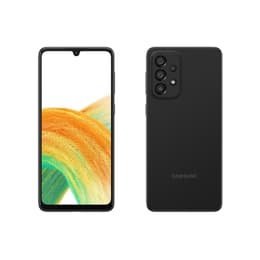

Galaxy A33 5G Vs Xiaomi Redmi Note 14 Pro

Galaxy A33 5G
Galaxy A33 5G
Starting at

Refurbished price:100.00

Versus €389.00 new

See options
Xiaomi Redmi Note 14 Pro
Starting at

Refurbished price:260.77

Versus €349.99 new

See options

Ratings

The Samsung Galaxy A33 5G, released in early 2022, and the Xiaomi Redmi Note 14 Pro, launched in late 2024, represent distinct approaches to the mid-range smartphone market. While both devices operate on the Android platform, they offer different strengths in areas such as display technology, camera capabilities, and overall performance, catering to varying user preferences.

Scores

Durability

When considering the long-term usability of these devices, their release timelines and software support policies are key factors.

  • Release Timeline: The Samsung Galaxy A33 5G was released in April 2022, making it an older model compared to the Xiaomi Redmi Note 14 Pro, which launched in late 2024. This difference in release year impacts the remaining duration of software support and the practical lifespan of each device. [2, 6, 14, 21]
  • Software Support: The Galaxy A33 5G typically receives four years of Android operating system updates and five years of security patches from its release date. [36] The Redmi Note 14 Pro, being a newer device, is expected to receive three major Android OS upgrades and four years of security updates. [24, 33] This means the Redmi Note 14 Pro will likely receive software updates for a longer period into the future due to its more recent launch.
  • Durability Features: Both phones offer a degree of protection against environmental elements. The Galaxy A33 5G features an IP67 rating for dust and water resistance, capable of withstanding submersion in up to 1 meter of freshwater for 30 minutes, and its screen is protected by Corning Gorilla Glass 5. [1, 2, 34, 35] The Redmi Note 14 Pro boasts an IP68 rating, indicating a higher level of resistance to dust and water, and features the more advanced Corning Gorilla Glass Victus 2 for enhanced screen durability. [3, 9, 11, 15, 18]

Year of Release

2022

2025

OS

Android

Android

Foldable

No

No

Performance

The performance of a smartphone is crucial for daily tasks, from app navigation to demanding applications and multitasking.

  • Processing Power: The Galaxy A33 5G is equipped with a processor designed to handle everyday applications and moderate multitasking smoothly. [2, 36] The Redmi Note 14 Pro features a more recent 4nm processor, which generally translates to improved efficiency and greater capability for handling intensive applications, complex games, and seamless multitasking. [3, 8, 14]
  • Storage and Responsiveness: Both devices offer various storage configurations, with the Galaxy A33 5G providing options up to 256GB and expandable storage via microSD. [2, 40] The Redmi Note 14 Pro also offers ample internal storage options, including up to 512GB, and supports expandable storage, ensuring sufficient space for apps and media. [3, 18, 27] The Redmi Note 14 Pro's newer processor and potentially higher RAM configurations (up to 12GB) contribute to a more responsive user experience, especially when switching between multiple applications. [3, 27]
  • Battery Endurance: The Galaxy A33 5G includes a 5000 mAh battery, which typically provides a full day of use for many users, with some reporting up to 8-10 hours of screen-on time under specific conditions. [36, 37, 40] The Redmi Note 14 Pro comes with a 5500 mAh battery, offering extended usage times, with tests indicating 7-10 hours of screen-on time even with continuous use. [10, 39, 45] Both support fast charging, with the Galaxy A33 5G at 25W and the Redmi Note 14 Pro at 45W, allowing for quicker recharges. [2, 10, 26, 39]

Memory (GB)

6 GB

8 GB

Screen quality

The display is a primary interface for smartphone interaction, and both models offer distinct visual experiences.

  • Display Technology and Size: The Samsung Galaxy A33 5G features a 6.4-inch Super AMOLED display, known for its vibrant colors and deep blacks. [1, 2, 31] The Xiaomi Redmi Note 14 Pro offers a larger 6.67-inch AMOLED display, which also provides rich colors and contrast. [3, 14, 27] The Redmi Note 14 Pro's display is often curved, contributing to a more immersive viewing experience. [3, 15]
  • Resolution and Clarity: The Galaxy A33 5G has an FHD+ resolution of 1080 x 2400 pixels, resulting in a pixel density of approximately 411 PPI, offering clear visuals for everyday content. [1, 2, 28] The Redmi Note 14 Pro features a higher 1.5K resolution (1220 x 2712 pixels), providing a sharper image with a higher pixel density, which can be noticeable in fine details. [3, 14, 30]
  • Brightness and Smoothness: The Galaxy A33 5G's display reaches a peak brightness of around 800 nits, ensuring good visibility in various lighting conditions. [20] The Redmi Note 14 Pro significantly surpasses this with a peak brightness of up to 3000 nits (local peak), making it exceptionally bright and highly visible even in direct sunlight. [3, 12, 14, 15] Both phones feature a 90Hz refresh rate for the Galaxy A33 5G and up to 120Hz for the Redmi Note 14 Pro, contributing to smoother scrolling and more fluid animations. [1, 3, 4, 14, 18]

Resolution

1080 x 2400

1080x2400

Audiovisual

For users who prioritize photography and videography, the camera systems of these devices present different capabilities.

  • Rear Camera Systems: The Galaxy A33 5G is equipped with a quad-camera setup, featuring a 48 MP main sensor with Optical Image Stabilization (OIS), an 8 MP ultrawide, a 5 MP macro, and a 2 MP depth sensor. [1, 2, 5] The Redmi Note 14 Pro features a triple camera system, highlighted by a 200 MP main sensor with OIS, an 8 MP ultrawide, and a 2 MP macro lens. [9, 10, 11, 18] The Redmi Note 14 Pro's higher megapixel count on the main sensor allows for greater detail and the possibility of 2x and 4x optical-grade lossless zoom. [9, 17]
  • Photography Performance: The Galaxy A33 5G's main camera performs well in good lighting conditions, producing sharp details and accurate colors, and its OIS helps stabilize video recording. [36] The Redmi Note 14 Pro's 200 MP main camera, combined with advanced AI features, aims for ultra-clear images with rich details and improved night shots. [9, 17] Both devices offer various shooting modes, with the Redmi Note 14 Pro including features like AI Erase Pro and enhanced RAW algorithms for night photography. [9, 16, 17]
  • Video and Front Camera: Both phones are capable of recording video up to 4K at 30 frames per second with their main rear cameras. [2, 11, 14] For selfies, the Galaxy A33 5G has a 13 MP front camera, while the Redmi Note 14 Pro features a 20 MP front camera, offering higher resolution for self-portraits and video calls. [2, 14, 27]

Front camera

13 megapixels

32 MP

Miscellaneous

Beyond core specifications, several practical features and design elements differentiate these smartphones.

  • Connectivity and Ports: Both devices support 5G connectivity, ensuring access to faster mobile networks. [2, 40] The Galaxy A33 5G includes Wi-Fi 802.11 a/b/g/n/ac and Bluetooth v5.1. [40] The Redmi Note 14 Pro features Wi-Fi 802.11 a/b/g/n/ac and Bluetooth 5.3, offering slightly newer Bluetooth technology. [18] Both utilize a USB-C port for charging and data transfer. [2] The Redmi Note 14 Pro may also include a 3.5mm headphone jack, which is absent on the Galaxy A33 5G. [2, 10]
  • Biometric Security and Sensors: The Galaxy A33 5G features a side-mounted fingerprint sensor, along with standard sensors like an accelerometer, gyroscope, and compass. [2, 40] The Redmi Note 14 Pro incorporates an in-screen fingerprint sensor and AI Face Unlock for security, alongside a similar array of sensors, including an IR Blaster for controlling home appliances. [10, 18]
  • Design and Handling: The Galaxy A33 5G has dimensions of 159.7 x 74 x 8.1 mm and weighs 186g, featuring a matte plastic back and Gorilla Glass 5 front. [2, 21, 35] The Redmi Note 14 Pro is slightly larger and heavier at 162.3 x 74.4 x 8.24 mm and 190g, often featuring a vegan leather finish option and Gorilla Glass Victus 2 on the front. [3, 10, 18] Both offer stereo speakers for an enhanced audio experience. [35]

Weight

186 g

180 g

Screen size (in)

6.4

6.67

Network

5G

4G

SIM card

Dual Physical SIM

Dual Physical SIM

Carrier compatibility

Unlocked

Unlocked

The Samsung Galaxy A33 5G and the Xiaomi Redmi Note 14 Pro cater to users with distinct priorities, reflecting their different release periods and design philosophies.

Users often praise the Galaxy A33 5G for its reliable performance in daily tasks, its vibrant Super AMOLED display, and Samsung's commitment to software updates, offering a solid long-term software experience for a device in its category. [36] Some users have noted that while its battery life is generally good, it can vary with heavy usage, and the absence of a charger in the box is a frequent point of discussion. [26, 37]

The Redmi Note 14 Pro, being a more recent release, is frequently lauded for its exceptionally bright and high-resolution AMOLED display, its advanced 200 MP main camera with OIS, and its robust IP68 water and dust resistance. [3, 9, 12, 14] Users appreciate its faster charging capabilities and the inclusion of a powerful processor for demanding applications. [3, 10, 14] Criticisms sometimes revolve around the consistency of its secondary cameras compared to the main sensor, and the software update policy, while good, might not match the extended duration offered by some competitors. [11, 33]

Users prioritizing a device with a proven track record of software longevity and a balanced feature set for everyday use may find the Galaxy A33 5G well-suited to their needs. Conversely, those who prioritize cutting-edge display technology, superior camera resolution, faster charging, and a higher level of water and dust resistance will likely lean toward the Redmi Note 14 Pro. Both devices, especially when considering quality-assured refurbished options, provide an eco-friendly alternative for consumers seeking capable smartphones.


See all articles

Our recent comparisons





