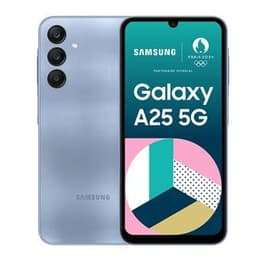



Galaxy A25 Vs Xiaomi Redmi Note 12 Pro

Galaxy A25
Galaxy A25
Starting at

Refurbished price:134.00

Versus €319.11 new

See options
Xiaomi Redmi Note 12 Pro
Starting at

Refurbished price:110.00

Versus €399.00 new

See options

Ratings

The Samsung Galaxy A25 and the Xiaomi Redmi Note 12 Pro are both smartphones designed for users seeking capable devices for daily use. The Galaxy A25, released in December 2023, operates on Android 14 with Samsung's One UI. The Redmi Note 12 Pro, launched in January 2023, initially ran on Android 12 with MIUI. While both offer robust performance for general tasks, key differences emerge in their display technology, camera capabilities, and software support.

Scores

Durability

When considering the long-term usability of these devices, their release timelines and software support policies are important factors.

  • Release Timeline: The Samsung Galaxy A25 was released in December 2023, making it a more recent device compared to the Xiaomi Redmi Note 12 Pro, which launched in January 2023. This difference in release date can influence the duration of future software support.
  • Software Support: Samsung has committed to providing four years of Android operating system updates and five years of security updates for the Galaxy A25, offering an extended period of software longevity. The Redmi Note 12 Pro typically receives 2-3 major OS updates and 3-4 years of security updates, which is a common support window for its category.
  • Practical Lifespan: Both devices are built to withstand typical daily use. The Galaxy A25 features a plastic build, which can be more resilient to drops than glass, while the Redmi Note 12 Pro includes Corning Gorilla Glass 5 on the front for display protection and an IP53 rating for splash and dust resistance. Users prioritizing extended software updates may find the Galaxy A25's policy more aligned with their needs for a longer practical lifespan.

Year of Release

2023

2022

Compatible with latest Update

Yes

No

OS

Android

Android

Foldable

No

No

Performance

Both smartphones are equipped to handle everyday applications and multitasking, though they utilize different internal components.

  • Processor Capabilities: The Galaxy A25 is powered by an octa-core processor built on a 5nm process, which allows for smooth operation in daily activities like web browsing, email, and media playback. The Redmi Note 12 Pro features an octa-core processor built on a 6nm process, providing solid performance for general use and moderate gaming.
  • Multitasking and Responsiveness: The Galaxy A25 is available with up to 8GB of RAM, contributing to responsive app switching and fluid animations within its operating system. The Redmi Note 12 Pro offers configurations with up to 12GB of RAM, enhancing its multitasking capabilities and ensuring a seamless user experience, even with multiple applications running simultaneously.
  • Storage Options: Both devices offer internal storage options of 128GB or 256GB. The Galaxy A25 provides the flexibility of expandable storage via a microSD card up to 1TB, which can be beneficial for users with large media libraries or extensive app collections. The Redmi Note 12 Pro does not offer expandable storage.

Memory (GB)

6 GB

8 GB

Screen quality

The visual experience on both devices is characterized by vibrant displays, though with some distinctions in their specifications.

  • Display Technology and Size: Both the Galaxy A25 and the Redmi Note 12 Pro feature AMOLED displays, known for deep blacks and vibrant colors. The Galaxy A25 has a 6.5-inch display, while the Redmi Note 12 Pro offers a slightly larger 6.67-inch screen, providing a more expansive viewing area.
  • Resolution and Brightness: Both phones offer a Full HD+ resolution (2340x1080 pixels for A25, 2400x1080 pixels for Note 12 Pro), resulting in clear and detailed visuals. The Galaxy A25 boasts a peak brightness of 1,000 nits, making it generally easy to view outdoors, though direct sunlight can still pose challenges. The Redmi Note 12 Pro reaches a peak brightness of 900 nits in high brightness mode, which also contributes to good outdoor visibility.
  • Refresh Rate and Smoothness: Both devices feature a 120Hz refresh rate for smoother scrolling and animations. The Galaxy A25 requires manual switching between 60Hz and 120Hz to conserve battery life. The Redmi Note 12 Pro offers an adaptive refresh rate that can switch between various frequencies (30Hz, 60Hz, 90Hz, 120Hz) depending on the content, aiming for a balance between smoothness and power efficiency. The Redmi Note 12 Pro also supports HDR10+ and Dolby Vision for enhanced content consumption.

Resolution

1080x2340

1080 x 2400

Screen type

Super AMOLED

AMOLED

Audiovisual

Both smartphones offer multi-camera setups, with their main sensors providing the most capable photography experiences.

  • Main Camera Performance: The Samsung Galaxy A25 features a 50MP main camera with optical image stabilization (OIS), which performs well in daylight conditions, capturing good detail and color. The Xiaomi Redmi Note 12 Pro also includes a 50MP main camera with OIS (Sony IMX766 sensor), delivering good results in various lighting, with strong dynamic range in daylight.
  • Ultra-wide and Macro Lenses: Both phones include an 8MP ultrawide camera and a 2MP macro lens. User feedback suggests that while the ultrawide cameras are suitable for occasional use, they may not match the quality of the main sensor, particularly in lower light. The 2MP macro lenses on both devices are generally considered to offer limited detail.
  • Video Recording and Selfies: The Galaxy A25 can record video at 4K resolution at 30 frames per second (fps) with its main camera, and 1080p at 30fps with its 13MP front camera. The Redmi Note 12 Pro also supports 4K video recording at 30fps and 1080p at up to 120fps with its main camera, and its 16MP front camera can record 1080p at 60fps.

Main camera

50 megapixels

50 megapixels

Front camera

13 megapixels

16 megapixels

Miscellaneous

Beyond core features, several practical elements differentiate these two devices in terms of connectivity, design, and user interaction.

  • Connectivity and Ports: Both smartphones support 5G connectivity, ensuring access to faster mobile networks. The Redmi Note 12 Pro supports Wi-Fi 6 and Bluetooth 5.2, offering newer wireless standards compared to the Galaxy A25. Both devices include a USB-C port for charging and data transfer, and notably, both retain a 3.5mm headphone jack.
  • Biometric Security and Build: The Galaxy A25 features a side-mounted fingerprint sensor integrated into the power button. The Redmi Note 12 Pro also has a side-mounted fingerprint sensor. The Galaxy A25 has a plastic construction, while the Redmi Note 12 Pro features a glass front with Gorilla Glass 5 protection and a plastic frame.
  • Dimensions and Weight: The Galaxy A25 measures approximately 161 x 76.5 x 8.3 mm and weighs 197 grams. The Redmi Note 12 Pro is slightly larger and lighter at 163 x 76 x 8 mm and 187 grams. The Redmi Note 12 Pro also carries an IP53 rating for splash and dust resistance.

Weight

197 g

187 g

Screen size (in)

6.5

6.67

Network

5G

5G

SIM card

Physical SIM

Dual Physical SIM

Carrier compatibility

Unlocked

Unlocked

Connector

USB-C

USB-C

The Samsung Galaxy A25 and Xiaomi Redmi Note 12 Pro each present a compelling set of features for users in the smartphone market. The Galaxy A25 is often praised for its vibrant AMOLED display, reliable everyday performance, and Samsung's commitment to long-term software updates, providing four years of OS upgrades and five years of security patches. Users appreciate its capable main camera, especially in well-lit conditions, and its extended battery life. Criticisms sometimes point to its plastic build, the performance of its secondary cameras in low light, and the lack of an adaptive refresh rate for its display.

The Xiaomi Redmi Note 12 Pro receives positive feedback for its smooth 120Hz AMOLED display with adaptive refresh rate, fast 67W wired charging (with an included charger), and generally strong performance for its category. Its main camera with OIS is also a highlight, delivering good image quality. Common concerns include the initial Android 12 operating system at launch and the less impressive performance of its ultrawide and macro cameras.

Users prioritizing extended software support and a consistent user experience within the Samsung ecosystem may find the Galaxy A25 well-suited to their needs. Those who value a slightly larger display with adaptive refresh rate, faster charging speeds, and potentially more RAM for intensive multitasking might lean towards the Redmi Note 12 Pro. Both devices offer solid performance for daily tasks, making them practical choices. For those considering these models, exploring quality-assured refurbished options can be an eco-friendly alternative to extend the life cycle of these devices.


See all articles

Our recent comparisons