
Compare models

Galaxy A25 Vs iPhone 15 Plus

  • 1-year minimum warranty
  • Free delivery on all orders
  • Free 30-day returns
Galaxy A25
Starting at

Refurbished price:173.00

Versus €319.11 new

See options
iPhone 15 Plus
Starting at

Refurbished price:435.00

Versus €979.00 new

See options

Differences at a glance

The Samsung Galaxy A25 (released December 2023) and the Apple iPhone 15 Plus (released September 2023) are contemporary smartphones offering distinct user experiences. While both devices provide robust connectivity and capable camera systems, they differ significantly in their operating systems, core performance, and display characteristics. The Galaxy A25 runs on Android, offering customization and expandable storage, whereas the iPhone 15 Plus operates on iOS, known for its integrated ecosystem and powerful processing.

Available Models

Colour

Storage (GB)

Scores

Durability

The longevity of a smartphone is influenced by its build, software support, and repairability. These two devices offer different approaches to long-term use.

  • Software Support: The iPhone 15 Plus, running iOS, typically receives major software updates for 5-7 years from its release. The Galaxy A25, an Android device, is expected to receive up to four generations of OS updates and five years of security maintenance.
  • Physical Durability: The iPhone 15 Plus features a Ceramic Shield front and a color-infused glass back with an aluminum frame, contributing to its overall resilience. The Galaxy A25 uses a glass front with a plastic back and frame.
  • Repairability: The iPhone 15 series has seen improvements in repairability with a more modular internal design. Samsung's A-series phones generally offer moderate repairability, often requiring heat for back panel removal.

Year of Release

2023

2023

Compatible with latest Update

Yes

Yes

OS

Android

iOS

Foldable

No

No

Performance

Performance is a key differentiator, impacting how smoothly applications run and how efficiently the device handles demanding tasks.

  • Processing Power: The iPhone 15 Plus is equipped with a powerful current-generation processor, enabling smooth operation for demanding applications, high-end gaming, and complex multitasking. The Galaxy A25 features a capable processor that handles everyday tasks like web browsing, email, and media playback without issues, and can run some resource-intensive games at medium settings.
  • Multitasking and Responsiveness: The iPhone 15 Plus offers consistent and fluid performance across its operating system and applications. The Galaxy A25, with its 6GB or 8GB of RAM, generally handles multiple apps simultaneously without significant lag, though some users have reported occasional stuttering with more intense multitasking.
  • Storage Options: The iPhone 15 Plus is available with 128GB, 256GB, or 512GB of internal storage. The Galaxy A25 comes with 128GB or 256GB of internal storage and includes a microSD card slot for expansion up to 1TB.

Screen quality

The display is a primary interface for users, and both devices offer vibrant viewing experiences with distinct characteristics.

  • Display Technology and Size: The iPhone 15 Plus features a 6.7-inch Super Retina XDR OLED display. The Galaxy A25 has a 6.5-inch Super AMOLED display. Both technologies provide deep blacks and rich colors.
  • Resolution and Clarity: The iPhone 15 Plus offers a resolution of 2796 x 1290 pixels at 460 pixels per inch (ppi). The Galaxy A25 provides a 2340 x 1080 pixel resolution at approximately 396 ppi. Both deliver clear visuals for typical viewing distances.
  • Brightness and Refresh Rate: The iPhone 15 Plus boasts a peak outdoor brightness of up to 2000 nits and a typical brightness of 1000 nits, with a standard 60Hz refresh rate. The Galaxy A25 offers a peak brightness of 1000 nits and a smoother 120Hz refresh rate, which can be adjusted to 60Hz to conserve battery.

Resolution

1080 x 2340

1290 x 2796

Screen type

Super AMOLED

Super Retina XDR OLED

Audiovisual

Both smartphones are equipped with capable camera systems designed to capture a variety of moments, though with different strengths.

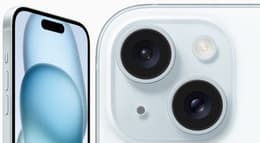
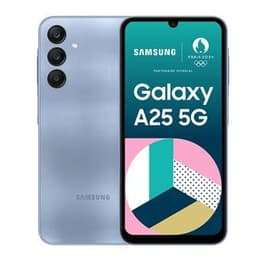
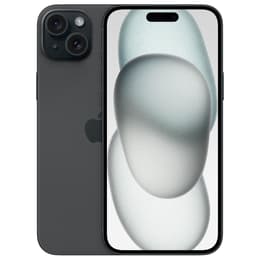
  • Rear Camera System: The iPhone 15 Plus features a dual-camera system with a 48MP main sensor and a 12MP ultrawide lens. The main camera uses a quad-pixel sensor and offers 2x optical-quality zoom by utilizing the central 12MP of the sensor. The Galaxy A25 has a triple-camera setup, including a 50MP main camera with optical image stabilization, an 8MP ultrawide camera, and a 2MP macro lens.
  • Photography Performance: The iPhone 15 Plus excels in computational photography, offering features like Photonic Engine, Deep Fusion, and Smart HDR 5, which contribute to detailed and well-exposed images in various conditions, including improved low-light performance. The Galaxy A25's 50MP main camera performs well in good lighting, producing decent images, and its pixel binning helps with less noisy night shots.
  • Video Capabilities: The iPhone 15 Plus supports 4K video recording at up to 60 frames per second (fps) with Dolby Vision HDR, and includes Cinematic mode for depth-of-field effects. The Galaxy A25 can record 4K video at 30fps, though some users note that stabilization is more effective at 1080p.

Main camera

50 megapixels

48 megapixels

Front camera

13 megapixels

12 megapixels

Miscellaneous

Beyond the core features, several practical elements contribute to the overall user experience and daily usability of these devices.

  • Connectivity: Both devices support 5G networks. The iPhone 15 Plus includes Wi-Fi 6 and Bluetooth 5.3. The Galaxy A25 supports Wi-Fi 5 and Bluetooth 5.3.
  • Ports and Biometrics: The iPhone 15 Plus has transitioned to a USB-C port for charging and data transfer, and relies on Face ID for secure authentication. The Galaxy A25 features a USB-C 2.0 port and retains a 3.5mm headphone jack, with a side-mounted fingerprint sensor for unlocking.
  • Design and Handling: The iPhone 15 Plus weighs 201 grams and has dimensions of 160.9 x 77.8 x 7.8 mm. The Galaxy A25 weighs 197 grams and measures 161 x 76.5 x 8.3 mm. The iPhone 15 Plus features a Dynamic Island for notifications and alerts.

Weight

197 g

201 g

Screen size (in)

6.5

6.7

Network

5G

5G

SIM card

Dual Physical SIM

Physical SIM + eSIM

Carrier compatibility

Unlocked

Unlocked

Connector

USB-C

USB-C

What the community thinks

User feedback for the iPhone 15 Plus frequently highlights its strong camera performance, particularly its ability to capture detailed photos and videos, and its long-lasting battery life. Users also appreciate the fluid performance and the integrated iOS ecosystem. Some common observations include its 60Hz display refresh rate, which is lower than some competitors. The Galaxy A25 is often praised for its vibrant 120Hz AMOLED display and its extensive battery life, with many users reporting it easily lasts a full day. Its inclusion of a headphone jack and expandable storage are also frequently noted as practical advantages. Some users have observed that while its processor handles daily tasks well, it may struggle with more intensive multitasking or gaming at higher settings.

Users who prioritize a highly optimized software experience, robust processing power for demanding applications, and advanced computational photography features may find the iPhone 15 Plus well-suited to their needs. Its integrated ecosystem and strong long-term software support are also key considerations. Conversely, users who value a smoother display refresh rate, expandable storage, and the flexibility of the Android operating system, along with the convenience of a headphone jack, might lean towards the Galaxy A25. Both devices offer reliable performance for their intended audiences, and choosing a quality-assured refurbished option for either model can provide an eco-friendly alternative for consumers.