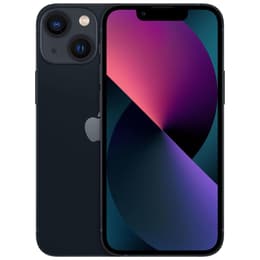
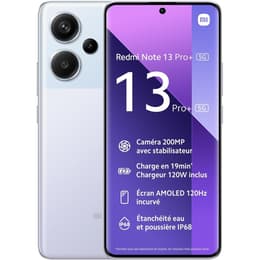


iPhone 13 mini Vs Xiaomi Redmi Note 13 Pro+

iPhone 13 mini
iPhone 13 mini
Starting at

Refurbished price:230.25

Versus €829.00 new

See options
Xiaomi Redmi Note 13 Pro+
Starting at

Refurbished price:198.00

Versus €449.00 new

See options

Ratings

The iPhone 13 Mini, released in September 2021, and the Xiaomi Redmi Note 13 Pro+, launched globally in early 2024, represent distinct approaches to smartphone design and functionality. While the iPhone 13 Mini offers a compact iOS experience, the Redmi Note 13 Pro+ provides a larger Android platform with a focus on advanced display and camera technology. These devices cater to different user preferences, primarily differing in their operating systems, physical size, and core hardware philosophies.

Scores

Durability

The longevity of a smartphone is influenced by its release timeline, software support, and physical durability. These two devices offer different expectations in these areas.

  • Release Timeline and Software Support: The iPhone 13 Mini, released in September 2021, launched with iOS 15 and is currently compatible with iOS 26, indicating a long-term commitment to software updates from Apple. The Xiaomi Redmi Note 13 Pro+, released globally in early 2024, shipped with Android 13 and MIUI 14, and is expected to receive up to three major Android OS updates, reaching Android 16, along with four years of security patches until January 2028.
  • Physical Durability and Repairability: The iPhone 13 Mini features a Ceramic Shield front cover and an IP68 rating for water and dust resistance, offering robust protection against environmental elements. Its repairability score has been noted to be around 4/10 to 6/10, with initial challenges related to Face ID repairs that were later addressed by software updates. The Redmi Note 13 Pro+ also boasts an IP68 rating for dust and water resistance and is protected by Corning Gorilla Glass Victus on its display. Its repairability score is considered average at 6.5/10, with adhesive use for the back cover and battery, but also includes pull tabs for easier battery removal.
  • Expected Practical Lifespan: Users prioritizing extended software support and a consistent ecosystem might find the iPhone 13 Mini's longer update cycle appealing. Conversely, the Redmi Note 13 Pro+ offers a solid commitment to software updates for an Android device, ensuring several years of current features and security.

Year of Release

2021

2023

Compatible with latest Update

Yes

Yes

OS

iOS

Android

Foldable

No

No

Performance

Performance in daily use, from app handling to multitasking, is a key differentiator between these two smartphones.

  • Processor Capabilities: The iPhone 13 Mini is powered by a capable processor that handles demanding applications and multitasking smoothly, providing a responsive user experience across the iOS ecosystem. The Redmi Note 13 Pro+ features a current-generation processor designed to deliver strong performance for its segment, capable of managing everyday tasks and more intensive applications effectively.
  • Storage and Multitasking: The iPhone 13 Mini is available with storage options up to 512GB, paired with 4GB of RAM, which is optimized for efficient iOS multitasking. The Redmi Note 13 Pro+ offers larger RAM configurations, typically 8GB or 12GB, and storage options up to 512GB, allowing for extensive app usage and data storage. This larger RAM can be beneficial for users who frequently switch between many applications or engage in heavy gaming.
  • Battery Behavior: The iPhone 13 Mini, due to its compact size, has a smaller battery capacity, which generally translates to a full day of moderate use, but heavy users may require more frequent charging. The Redmi Note 13 Pro+ is equipped with a larger battery, often providing around 1.5 days of use for many users, and features rapid charging technology that can significantly replenish the battery in a short time.

Memory (GB)

4 GB

12 GB

Screen quality

The visual experience is significantly shaped by the display technology, size, and refresh rate of each device.

  • Display Technology and Resolution: The iPhone 13 Mini features a 5.4-inch Super Retina XDR OLED display, offering deep blacks, vibrant colors, and a resolution of 2340x1080 pixels at 476 pixels per inch (ppi). The Redmi Note 13 Pro+ sports a larger 6.67-inch CrystalRes AMOLED display with a higher resolution of 2712x1220 pixels and a pixel density of 446 ppi, providing a sharp and immersive viewing experience.
  • Brightness and Refresh Rate: Both devices offer good brightness levels, with the iPhone 13 Mini reaching 800 nits typical and 1200 nits peak for HDR content. The Redmi Note 13 Pro+ can achieve an impressive 1800 nits peak brightness, enhancing visibility in bright outdoor conditions. A key difference lies in the refresh rate: the iPhone 13 Mini has a standard 60Hz refresh rate, while the Redmi Note 13 Pro+ features a 120Hz refresh rate, resulting in smoother scrolling and more fluid animations.
  • Screen Size and Viewing Experience: The iPhone 13 Mini's compact 5.4-inch screen is ideal for one-handed use and users who prefer a smaller form factor. The Redmi Note 13 Pro+'s larger 6.67-inch display provides a more expansive canvas for media consumption, gaming, and productivity, offering a more immersive visual experience.

Resolution

1080 x 2340

1220 x 2712

Screen type

Super Retina XDR OLED

AMOLED

Audiovisual

The camera systems on both smartphones are designed to capture moments, but they approach imaging with different specifications and features.

  • Rear Camera Systems: The iPhone 13 Mini features a dual 12MP camera system, comprising a main camera with a wide f/1.6 aperture and sensor-shift optical image stabilization (OIS), and an ultra-wide camera with a f/2.4 aperture. It excels in consistent image quality and computational photography. The Redmi Note 13 Pro+ boasts a triple rear camera setup, highlighted by a 200MP main sensor with OIS and a f/1.65 aperture, an 8MP ultrawide camera, and a 2MP macro lens. The high-resolution main sensor allows for detailed images and in-sensor zoom capabilities.
  • Photography Performance: The iPhone 13 Mini delivers strong performance in various lighting conditions, with features like Night mode, Deep Fusion, and Smart HDR 4 contributing to well-exposed and detailed photos. Its video recording capabilities include Cinematic mode and HDR video with Dolby Vision up to 4K at 60 frames per second. The Redmi Note 13 Pro+'s 200MP main camera captures highly detailed photos, particularly in good lighting, and performs well in low-light conditions with automatic night mode processing. Video recording on the Redmi Note 13 Pro+ supports 4K at 30 frames per second with electronic stabilization.
  • Front Camera and Audio: Both devices feature capable front-facing cameras for selfies and video calls. The iPhone 13 Mini has a 12MP TrueDepth camera with features like Portrait mode and Cinematic mode for video. The Redmi Note 13 Pro+ includes a 16MP front camera that produces good selfies with accurate colors. For audio, the Redmi Note 13 Pro+ offers dual speakers with Dolby Atmos support, providing an enhanced media consumption experience.

Main camera

12 megapixels

200 megapixels

Front camera

12 megapixels

16 megapixels

Miscellaneous

Beyond the core features, several practical elements contribute to the overall user experience of these smartphones.

  • Connectivity and Ports: Both the iPhone 13 Mini and the Redmi Note 13 Pro+ support 5G connectivity and modern Wi-Fi standards (Wi-Fi 6 for iPhone 13 Mini). The iPhone 13 Mini uses Apple's proprietary Lightning port for charging and data transfer. The Redmi Note 13 Pro+ features a USB-C port, a widely adopted standard.
  • Biometric Security and Sensors: The iPhone 13 Mini relies on Face ID for secure facial recognition. The Redmi Note 13 Pro+ incorporates an in-display fingerprint sensor for biometric authentication. Both devices include a range of sensors such as accelerometers, gyroscopes, and ambient light sensors for various functionalities.
  • Physical Design and Handling: The iPhone 13 Mini is notably compact and lightweight, measuring 131.5 x 64.2 x 7.65 mm and weighing 141 grams, making it highly suitable for one-handed use and pocketability. The Redmi Note 13 Pro+ is a larger device, with dimensions of 161.4 x 74.2 x 8.9 mm and a weight of 204.5 grams, offering a more substantial feel and a larger screen area. The Redmi Note 13 Pro+ also features a curved display and a premium design with a matte finish on the back.

Weight

140 g

204 g

Width

6,42 cm

7,42 cm

Height

13,15 cm

16,14 cm

Depth

0,75 cm

0,89 cm

Screen size (in)

5.4

6.67

Network

5G

5G

SIM card

Physical SIM + eSIM

Dual Physical SIM

Carrier compatibility

Unlocked

Unlocked

The iPhone 13 Mini and the Xiaomi Redmi Note 13 Pro+ cater to distinct user preferences, each offering a compelling set of features.

Users often praise the iPhone 13 Mini for its unique compact form factor, which provides a premium experience in a small package, making it ideal for one-handed use and easy portability. Its consistent camera performance and long-term software support are also frequently highlighted as strong points. Some users, however, note its smaller battery capacity compared to larger phones and the standard 60Hz display as areas where it doesn't match more recent, larger devices.

The Xiaomi Redmi Note 13 Pro+ receives commendation for its vibrant and smooth 120Hz AMOLED display, its rapid charging capabilities, and the high-resolution main camera. Its overall performance for its segment is also a common positive. Conversely, some user feedback points to the inconsistency of its secondary cameras (ultrawide and macro) and, despite a large battery, its battery life is sometimes described as average, though the fast charging often mitigates this concern. The software experience, while functional, can also be a point of discussion for some users.

Users prioritizing a highly portable device with a long software support lifespan and a streamlined operating system may find the iPhone 13 Mini well-suited to their needs. Its compact size and robust ecosystem are key advantages. On the other hand, users who value a large, high-refresh-rate display, fast charging, and a powerful main camera for detailed photography, and who prefer the Android ecosystem, may lean toward the Redmi Note 13 Pro+. Both devices offer quality-assured refurbished options, providing an eco-friendly alternative for consumers looking to make informed and sustainable choices.


See all articles

Our recent comparisons







