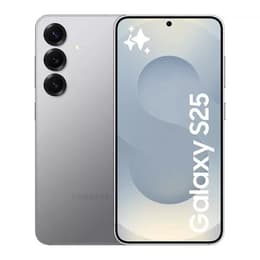



Galaxy S25 Vs Google Pixel 8 Pro

Galaxy S25
Galaxy S25
Starting at

Refurbished price:483.00

Versus €910.00 new

See options
Google Pixel 8 Pro
Google Pixel 8 Pro
Starting at

Refurbished price:293.00

Versus €1,099.00 new

See options

Ratings

The Samsung Galaxy S25, released in February 2025, and the Google Pixel 8 Pro, launched in October 2023, represent distinct approaches to the premium smartphone experience. While both devices operate on the Android platform, they offer different strengths in display technology, camera capabilities, and overall design philosophy. This comparison will explore their practical differences to help users determine which device best suits their needs.

Scores

Durability

When considering the long-term usability of a smartphone, software support and physical durability are key factors. Both the Galaxy S25 and the Pixel 8 Pro offer substantial longevity through their update policies.

  • Software Support: The Samsung Galaxy S25 is guaranteed to receive seven years of Android OS upgrades and security updates, extending its software lifespan significantly, potentially up to Android 22. Similarly, the Google Pixel 8 Pro also commits to seven years of OS upgrades, security updates, and regular Feature Drops, ensuring support until at least 2030.
  • Physical Durability: The Galaxy S25 features Gorilla Glass Victus 2 on both its front and rear panels, providing robust protection against drops and scratches. It also carries an IP68 rating for dust and water resistance. The Pixel 8 Pro, while not explicitly detailing its glass type in all sources, also offers a durable build with a flat display and rounded corners, contributing to its handling and resilience.
  • Practical Lifespan: With both devices offering extensive software support, users can expect a practical lifespan of at least seven years, making them suitable for those who prefer to keep their devices for an extended period. This commitment to long-term updates also makes them excellent candidates as quality-assured refurbished options.

Year of Release

2025

2023

Foldable

No

No

Performance

The performance of a smartphone impacts everything from app responsiveness to gaming fluidity and multitasking efficiency. Both devices are equipped with powerful components designed for demanding tasks.

  • Processing Power: The Galaxy S25 is powered by a current-generation processor, specifically optimized for the S25 series, which enables smooth handling of demanding applications and efficient multitasking. The Pixel 8 Pro features Google's Tensor G3 chip, designed to deliver robust performance for everyday use and advanced AI-driven features.
  • Multitasking and Storage: Both phones typically come with 12GB of RAM, allowing for seamless switching between multiple applications. Storage options for the Galaxy S25 include 128GB and 256GB, while the Pixel 8 Pro offers a wider range, from 128GB up to 1TB, catering to users with extensive storage needs.
  • Battery Behavior: The Galaxy S25, with its 4000 mAh battery, has shown good endurance for its size, often lasting a full day with moderate usage and performing well in battery rundown tests. The Pixel 8 Pro, equipped with a larger 5050 mAh battery, generally provides all-day power, though some users report it as average compared to other flagship devices under heavy use.

Memory (GB)

12 GB

12 GB

Screen quality

The display is a primary interface for smartphone interaction, and both the Galaxy S25 and Pixel 8 Pro offer high-quality viewing experiences with distinct characteristics.

  • Display Technology and Clarity: The Galaxy S25 features a 6.2-inch Dynamic LTPO AMOLED 2X display with a resolution of 2340x1080 pixels, providing vibrant colors and deep blacks. The Pixel 8 Pro boasts a larger 6.7-inch Super Actua LTPO OLED display with a higher resolution of 2992x1344 pixels, offering exceptional sharpness and detail.
  • Brightness and Refresh Rate: Both devices offer impressive brightness levels, with the Galaxy S25 reaching up to 2600 nits peak brightness and the Pixel 8 Pro achieving up to 2400 nits peak brightness (1600 nits for HDR content). Both phones feature adaptive refresh rates up to 120Hz, ensuring smooth scrolling and responsive visuals, with the Pixel 8 Pro capable of scaling down to 1Hz for power efficiency.
  • Viewing Experience: The Galaxy S25 provides a compact yet immersive viewing experience, suitable for one-handed use. The Pixel 8 Pro's larger screen offers more expansive real estate for media consumption and productivity, complemented by its flat display design.

Resolution

1080x2340

1344 x 2992

Screen type

Dynamic LTPO AMOLED 2X

LTPO OLED

Audiovisual

Both the Samsung Galaxy S25 and the Google Pixel 8 Pro are designed to deliver advanced photography and videography capabilities, each with its own strengths in image processing and hardware.

  • Rear Camera Systems: The Galaxy S25 is equipped with a versatile triple-camera setup, including a 50MP wide-angle main sensor, a 12MP ultra-wide camera, and a 10MP telephoto lens with 3x optical zoom. The Pixel 8 Pro also features a triple-camera system, comprising a 50MP main sensor, a 48MP ultra-wide lens, and a 48MP telephoto lens capable of 5x optical zoom.
  • Photography Features: The Pixel 8 Pro offers a dedicated Pro mode, allowing for manual control over settings like ISO and shutter speed, and supports 50MP RAW and JPEG capture. It also excels in computational photography with features like Night Sight and Magic Editor. The Galaxy S25 focuses on optimization to enhance image quality, delivering crisp details and accurate color reproduction, and supports 8K video recording at 30fps.
  • Video and Audio: The Pixel 8 Pro supports video recording up to 4K at 60fps, with improvements in video capabilities and computational audio features like Audio Eraser. The Galaxy S25 also offers advanced video features, including 8K recording and Super Steady video stabilization.

Miscellaneous

Beyond core specifications, several practical elements contribute to the overall user experience of these smartphones, from connectivity to physical design.

  • Connectivity and Ports: Both devices support modern connectivity standards, including 5G and advanced Wi-Fi. The Galaxy S25 and Pixel 8 Pro offer comprehensive wireless capabilities for fast data transfer and reliable network access. While specific port types were not detailed for the S25, Samsung typically uses USB-C. The Pixel 8 Pro uses a USB-C port.
  • Biometric Security: The Galaxy S25 includes an ultrasonic in-screen fingerprint sensor for secure and convenient unlocking. The Pixel 8 Pro also features an in-display fingerprint scanner and advanced face recognition for biometric authentication.
  • Design and Handling: The Galaxy S25 maintains a refined design, being marginally slimmer and lighter than its predecessor, making it comfortable to hold. The Pixel 8 Pro has a slightly larger form factor with rounded corners and a flat display, weighing 213 grams. Both phones utilize premium build materials, with the S25 featuring an aluminum body and glass back, and the Pixel 8 Pro offering a polished glass back and satin metal finishes.

Weight

162 g

213 g

Screen size (in)

6.2

6.7

Network

5G

5G

SIM card

Physical SIM + eSIM

Physical SIM + eSIM

Carrier compatibility

Unlocked

Unlocked

The Samsung Galaxy S25 and Google Pixel 8 Pro each present a compelling package for users seeking a high-end Android smartphone, though they cater to slightly different priorities. User feedback for the Galaxy S25 often praises its robust battery life for a device of its size and its refined design, making it a strong contender for those who value portability and endurance. Some common praise points for the Pixel 8 Pro include its exceptional camera performance, particularly its computational photography features and the Magic Editor, as well as its stunning display. However, some Pixel 8 Pro users have noted that its battery life, while all-day, can be average compared to some competitors, and occasional connectivity issues have been reported.

Users prioritizing a compact form factor with excellent battery life and a refined, modern design may find the Samsung Galaxy S25 well-suited to their needs. Its balanced camera system and long-term software support make it a reliable daily driver. Conversely, users who place a premium on advanced computational photography, a larger, highly detailed display, and a pure Android experience with Google's AI integrations will likely lean towards the Google Pixel 8 Pro. Its 5x optical zoom and manual camera controls offer more creative flexibility. Both devices offer extensive software support, ensuring a long and secure lifespan, and are available as quality-assured refurbished options, providing a sustainable choice for consumers.


See all articles

Our recent comparisons