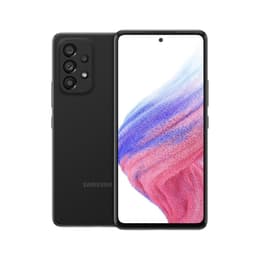
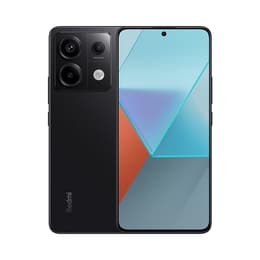


Galaxy A53 5G Vs Xiaomi Redmi Note 13 Pro

Galaxy A53 5G
Galaxy A53 5G
Starting at

Refurbished price:119.00

Versus €459.00 new

See options
Xiaomi Redmi Note 13 Pro
Starting at

Refurbished price:179.00

Versus €349.00 new

See options

Ratings

The Samsung Galaxy A53 5G and the Xiaomi Redmi Note 13 Pro are both mid-range smartphones, released in March 2022 and January 2024, respectively. While the Galaxy A53 5G runs on Samsung's One UI based on Android, the Redmi Note 13 Pro utilizes Xiaomi's MIUI, also based on Android. The primary distinctions between these two devices lie in their release timelines, display technology, camera capabilities, and processing power.

Scores

Durability

The practical lifespan of a smartphone is influenced by its release date, software support, and ease of repair.

  • Release Timeline: The Samsung Galaxy A53 5G was released in March 2022, making it an older model compared to the Xiaomi Redmi Note 13 Pro, which launched in January 2024. This difference in release year impacts their respective software support cycles.
  • Software Longevity: The Galaxy A53 5G is guaranteed to receive four Android OS upgrades, extending its support up to Android 16, along with five years of security updates until 2027. The Redmi Note 13 Pro is slated for three Android OS upgrades, also reaching Android 16, and four years of security updates, with support extending until January 2028.
  • Repairability: The Galaxy A53 5G generally receives a repairability score around 6.75 to 8.2 out of 10, indicating it is relatively repairable, though some components like the battery require adhesive removal. The Redmi Note 13 Pro (and Pro Plus, which is similar) has a repairability score of approximately 6.5 out of 10, with adhesive used for the back cover and battery, and multiple components needing disassembly for screen replacement.

Year of Release

2022

2023

Compatible with latest Update

Yes

Yes

OS

Android

Android

Foldable

No

No

Performance

Performance in daily use, including app handling and multitasking, is a key differentiator between these two devices.

  • Processing Power: The Galaxy A53 5G is equipped with a processor that offers noticeable speed improvements over its predecessor, but some users have reported it can encounter issues with demanding games and occasional interface lag. The Redmi Note 13 Pro features a newer generation processor designed to deliver outstanding performance, ensuring smooth multitasking and gaming experiences.
  • Multitasking and Responsiveness: Both devices offer multiple RAM configurations, with the Galaxy A53 5G available in 6GB or 8GB options, and the Redmi Note 13 Pro offering 8GB or 12GB of RAM. The Redmi Note 13 Pro's higher RAM options and more recent processor contribute to a highly responsive system, capable of handling numerous applications simultaneously without significant slowdowns.
  • Storage Options: The Galaxy A53 5G comes with 128GB or 256GB of internal storage and supports expandable storage via a microSD card. The Redmi Note 13 Pro offers 128GB, 256GB, or 512GB internal storage options, but does not feature expandable storage.
  • Battery Behavior: The Galaxy A53 5G has a 5000mAh battery, providing over a day of use even with a high refresh rate display. The Redmi Note 13 Pro has a slightly larger 5100mAh battery, with users reporting it can last a day and a half between charges, even with heavy use.

Memory (GB)

4 GB

8 GB

Screen quality

The visual experience is largely defined by the display technology, resolution, and brightness capabilities of each device.

  • Display Technology and Clarity: Both smartphones feature AMOLED displays, known for deep blacks and vibrant colors. The Galaxy A53 5G has a 6.5-inch Super AMOLED display with a 1080 x 2400 pixel resolution. The Redmi Note 13 Pro offers a slightly larger 6.67-inch AMOLED panel with a higher 2712 x 1220 pixel resolution, providing sharper visuals.
  • Brightness and Outdoor Visibility: The Galaxy A53 5G's display reaches a peak brightness of 800 nits, offering good visibility in most outdoor conditions. The Redmi Note 13 Pro significantly surpasses this with a peak brightness of up to 1800 nits, ensuring excellent readability even in bright sunlight.
  • Refresh Rate and Smoothness: Both devices feature a 120Hz refresh rate, contributing to a fluid user experience with smoother scrolling and animations.
  • Screen Protection: The Galaxy A53 5G is protected by Corning Gorilla Glass 5. The Redmi Note 13 Pro features the more advanced Corning Gorilla Glass Victus, offering enhanced durability against scratches and drops.

Resolution

1080 x 2400

1220 x 2712

Screen type

Super AMOLED

AMOLED

Audiovisual

The camera systems on both phones offer distinct capabilities for capturing photos and videos.

  • Rear Camera System: The Galaxy A53 5G features a quad-camera setup with a 64MP main sensor (with OIS), a 12MP ultrawide, a 5MP macro, and a 5MP depth sensor. The Redmi Note 13 Pro boasts a triple-camera system, highlighted by a 200MP main sensor (with OIS), an 8MP ultrawide, and a 2MP macro lens.
  • Photography Performance: The Galaxy A53 5G delivers good daylight photos, though low-light performance is considered average, and the ultrawide can exhibit distortion. The Redmi Note 13 Pro's 200MP main camera captures detailed and vibrant daylight images, with decent low-light capabilities, but its ultrawide and macro lenses are noted as less capable.
  • Video Recording: Both phones support video recording up to 4K at 30 frames per second. The Redmi Note 13 Pro does not offer 4K at 60 frames per second.
  • Front Camera and Audio: The Galaxy A53 5G has a 32MP front camera. The Redmi Note 13 Pro features a 16MP front camera, which is suitable for everyday selfies and video calls. Both devices include stereo speakers, with the Redmi Note 13 Pro specifically featuring Dolby Atmos support for an enhanced audio experience.

Main camera

64 megapixels

200 megapixels

Front camera

32 megapixels

16 megapixels

Miscellaneous

Beyond core features, several practical elements contribute to the overall user experience and device utility.

  • Connectivity: Both smartphones support 5G connectivity, along with Wi-Fi and Bluetooth for wireless connections. The Galaxy A53 5G uses Bluetooth 5.1, while the Redmi Note 13 Pro features the slightly newer Bluetooth 5.2.
  • Ports and Sensors: Both devices utilize a USB Type-C port for charging and data transfer. The Redmi Note 13 Pro retains a 3.5mm headphone jack, which is absent on the Galaxy A53 5G. Both phones incorporate an in-display fingerprint sensor for secure unlocking.
  • Build Materials and Durability Features: The Galaxy A53 5G features a plastic back and frame, with Corning Gorilla Glass 5 protecting the display, and carries an IP67 rating for dust and water resistance. The Redmi Note 13 Pro has a more premium feel with a glass back and Corning Gorilla Glass Victus on the front for enhanced screen protection. While the Redmi Note 13 Pro+ has an IP68 rating, the standard Redmi Note 13 Pro's water resistance is not consistently specified as IP68 across all sources.
  • Dimensions and Handling: The Galaxy A53 5G measures 159.6 x 74.8 x 8.1mm and weighs 189g. The Redmi Note 13 Pro is slightly larger and heavier at 161.15 x 74.24 x 7.98mm and 187g.

Weight

189 g

187 g

Screen size (in)

6.5

6.67

Network

5G

5G

SIM card

Physical SIM

Dual Physical SIM

Carrier compatibility

Unlocked

Unlocked

User feedback for the Samsung Galaxy A53 5G often praises its vibrant 120Hz AMOLED display, reliable main camera in good lighting, and its IP67 water resistance. Its long software support policy is also a significant positive. However, some criticisms point to occasional performance lag, especially in demanding applications, and average low-light camera performance. The absence of a charger in the box and the lack of a headphone jack are also noted by users.

The Xiaomi Redmi Note 13 Pro receives commendation for its exceptionally bright and high-resolution AMOLED display, robust battery life with fast charging, and the impressive detail captured by its 200MP main camera. Users appreciate its smooth performance for daily tasks and gaming. Common criticisms include the subpar performance of its auxiliary ultrawide and macro cameras, the lack of 4K 60fps video recording, and the presence of pre-installed software.

Users prioritizing extended software updates and a well-established brand's ecosystem may find the Samsung Galaxy A53 5G a suitable choice. Its IP67 rating also offers a good level of dust and water protection. Conversely, those who value a more modern design, a significantly brighter and sharper display, faster charging capabilities, and a higher-resolution main camera might lean towards the Xiaomi Redmi Note 13 Pro. The Redmi Note 13 Pro also offers a 3.5mm headphone jack, which can be a deciding factor for some. Both devices represent solid options in the mid-range segment, and considering a quality-assured refurbished option for either model can be an eco-friendly alternative for consumers.


See all articles

Our recent comparisons