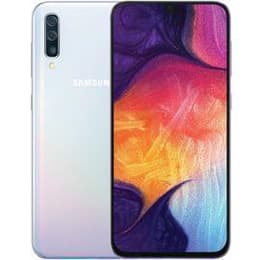
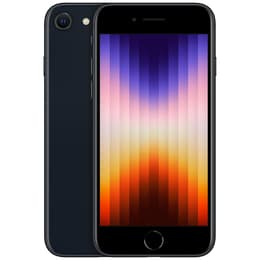


Galaxy A50 Vs iPhone SE (2022)

Galaxy A50
Galaxy A50
Starting at

Refurbished price:107.00

Versus €349.00 new

See options
iPhone SE (2022)
iPhone SE (2022)
Starting at

Refurbished price:127.00

Versus €549.00 new

See options

Ratings

The Samsung Galaxy A50, released in early 2019, and the Apple iPhone SE (2022), launched in March 2022, represent distinct approaches to smartphone design and functionality. While the Galaxy A50 operates on the Android platform with Samsung's One UI, the iPhone SE (2022) runs on Apple's iOS. These devices primarily differ in their operating systems, display technologies, and overall performance philosophies, catering to users with varied preferences.

Scores

Durability

The longevity of a smartphone is influenced by its release date, software support, and physical build.

  • Release Timeline and Software Support: The Galaxy A50, launched in 2019, originally ran Android 9 and received updates up to Android 11. It reached its end-of-life for security updates around April 2023, meaning it no longer receives regular software patches. In contrast, the iPhone SE (2022), released in 2022, shipped with iOS 15.4 and is expected to receive software updates for several years, potentially extending its usable lifespan significantly longer than the A50.
  • Repairability: The Galaxy A50 has a reported repairability score of around 7.0 out of 10, with components like the battery and screen being relatively accessible for repair. The iPhone SE (2022) has a repairability score of approximately 5.5 or 6 out of 10, with common repairs like screen and battery replacements being feasible, though some adhesive use can complicate the process.
  • Physical Durability: The Galaxy A50 features a predominantly plastic build, which can offer more resistance to drops compared to glass-backed phones. The iPhone SE (2022) incorporates tougher glass on both its front and back, along with an IP67 rating for water and dust resistance, offering protection against splashes and submersion.

Year of Release

2019

2022

Compatible with latest Update

No

Yes

OS

Android

iOS

Foldable

No

No

Performance

Performance is a key differentiator, impacting how smoothly applications run and how efficiently the device handles daily tasks.

  • Processing Power: The Galaxy A50 is equipped with a processor that handles everyday tasks like web browsing, email, and social media adequately. However, users may experience slowdowns when running multiple applications simultaneously or engaging in graphically intensive gaming. The iPhone SE (2022) features a current-generation processor, enabling it to deliver extremely responsive performance across a wide range of applications, from demanding games to complex multitasking scenarios.
  • Storage and Multitasking: The Galaxy A50 offers 4GB or 6GB of RAM and 64GB or 128GB of internal storage, with the added flexibility of expandable storage via a microSD card up to 512GB. The iPhone SE (2022) comes with 64GB, 128GB, or 256GB of internal storage, but does not offer expandable storage. While both devices can manage multiple apps, the iPhone SE (2022)'s more powerful processor generally provides a smoother multitasking experience.
  • Battery Behavior: The Galaxy A50 houses a 4,000 mAh battery, which typically provides a full day of use for moderate users, with some reports of lasting into the next day. The iPhone SE (2022) has a smaller battery capacity, and while it offers improvements over its predecessor, its battery life is often described as average for a modern smartphone, typically lasting a full day with moderate usage but requiring more frequent charging for heavy users or those on 5G networks.

Memory (GB)

4 GB

4 GB

Screen quality

The visual experience is largely defined by the display technology and its characteristics.

  • Display Technology and Clarity: The Galaxy A50 features a 6.4-inch Super AMOLED Infinity-U display with a resolution of 2340 x 1080 pixels. This technology delivers deep blacks and vibrant colors, providing an immersive viewing experience for media consumption. The iPhone SE (2022) utilizes a 4.7-inch Retina HD IPS LCD display with a resolution of 1334 x 750 pixels. While it offers good color accuracy and brightness, its LCD panel does not achieve the same contrast levels as an AMOLED display.
  • Size and Viewing Experience: The Galaxy A50's larger 6.4-inch screen provides more screen real estate, which can be beneficial for watching videos, browsing, and multitasking. The iPhone SE (2022)'s 4.7-inch display is considerably smaller, making it more suitable for one-handed use and those who prefer a compact device. However, its design includes significant bezels around the screen, which can make the viewing area feel more constrained compared to modern full-screen designs.
  • Refresh Rate and Brightness: Both devices feature a standard 60Hz refresh rate, which provides a smooth enough experience for most daily interactions. The Galaxy A50's Super AMOLED display is generally bright and offers good visibility in various lighting conditions. The iPhone SE (2022)'s LCD display is also bright, ensuring readability outdoors.

Resolution

1080 x 2340

750 x 1334

Screen type

Super AMOLED

Retina IPS LCD

Audiovisual

Camera capabilities vary significantly between these two devices, impacting photo and video quality in different scenarios.

  • Rear Camera System: The Galaxy A50 features a versatile triple-camera setup on the rear, including a 25-megapixel main sensor, an 8-megapixel ultra-wide lens, and a 5-megapixel depth sensor. This configuration allows for a range of photographic options, including wide-angle shots and portraits with background blur. The iPhone SE (2022) has a single 12-megapixel rear camera with optical image stabilization. Despite having only one lens, its advanced image processing, powered by its internal processor, enhances photo quality.
  • Photography Performance: In well-lit conditions, the Galaxy A50 captures good daylight photos, but its performance in low-light environments is less consistent, often resulting in softer images. The iPhone SE (2022) delivers consistent and detailed photos in good lighting, benefiting from its powerful image processing, though it lacks a dedicated Night Mode feature for extreme low-light situations.
  • Video and Audio: The Galaxy A50 can record video up to 1080p resolution. Its speaker output is generally considered average, with some users describing it as tinny. The iPhone SE (2022) is capable of recording high-quality video up to 4K resolution at 60 frames per second. Its audio output is generally clear, and it supports stereo sound recording for videos.

Main camera

25 megapixels

12 megapixels

Front camera

25 megapixels

7 megapixels

Miscellaneous

Beyond core features, several practical elements contribute to the overall user experience and device utility.

  • Connectivity and Ports: The Galaxy A50 includes a USB-C port for charging and data transfer, and it retains a 3.5mm headphone jack, which is convenient for wired audio accessories. It supports 4G LTE connectivity. The iPhone SE (2022) uses a Lightning port for charging and data and does not include a 3.5mm headphone jack. It offers more advanced connectivity options, including 5G cellular support, Wi-Fi 6, and Bluetooth 5.
  • Biometric Security: The Galaxy A50 features an in-display optical fingerprint sensor for biometric authentication. User feedback indicates that this sensor can sometimes be inconsistent or slow. The iPhone SE (2022) uses Touch ID, a physical fingerprint sensor integrated into the home button, which is generally regarded as fast and reliable.
  • Design and Handling: The Galaxy A50 measures 158.5 x 74.7 x 7.7 mm and weighs 166g, offering a larger form factor with a plastic build that contributes to its lighter feel. The iPhone SE (2022) is more compact at 138.4 x 67.3 x 7.3 mm and weighs 144g, making it easier for one-handed use and pocketability.

Weight

166 g

144 g

Width

7,47 cm

6 cm

Height

15,85 cm

13 cm

Depth

0,77 cm

0,73 cm

Screen size (in)

6.4

4.7

Network

4G

5G

SIM card

Dual Physical SIM

Physical SIM + eSIM

Carrier compatibility

Unlocked

Unlocked

Connector

USB-C + Jack 3.5mm

Lightning

Choosing between the Samsung Galaxy A50 and the iPhone SE (2022) depends heavily on individual priorities and preferred ecosystem. Users often praise the Galaxy A50 for its vibrant Super AMOLED display, which offers deep blacks and rich colors, making it suitable for media consumption. Its strong battery life and the inclusion of a 3.5mm headphone jack and expandable storage are also frequently highlighted as positive aspects. However, common criticisms include its less powerful processor, which can lead to slower performance with demanding applications, and an inconsistent in-display fingerprint sensor. The camera's low-light performance is also a noted area for improvement.

The iPhone SE (2022) is widely lauded for its exceptional processing power, which ensures smooth performance and longevity for demanding tasks and future software updates. Its compact size and the reliable Touch ID fingerprint sensor are also significant advantages for users who prefer a smaller device and a familiar authentication method. On the other hand, frequent criticisms revolve around its dated design with large bezels and a smaller LCD screen compared to many modern smartphones. Its battery life, while improved over previous SE models, is often considered average, especially with heavy use or 5G connectivity. The single camera, despite its capabilities, lacks features like Night Mode found in other devices.

Users prioritizing a large, vibrant display, long battery life, and the flexibility of expandable storage and a headphone jack may find the Galaxy A50 more aligned with their needs. Conversely, those who value top-tier performance, a compact form factor, extended software support, and the iOS ecosystem will likely prefer the iPhone SE (2022). Both devices offer a quality-assured refurbished option, providing an eco-friendly alternative for consumers looking to make a sustainable choice.


See all articles

Our recent comparisons




