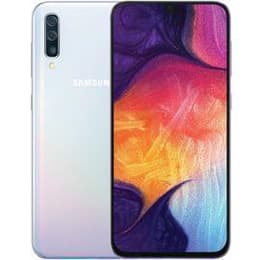
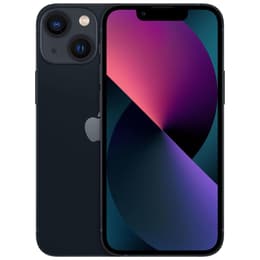


Galaxy A50 Vs iPhone 13 mini

Galaxy A50
Galaxy A50
Starting at

Refurbished price:107.00

Versus €349.00 new

See options
iPhone 13 mini
iPhone 13 mini
Starting at

Refurbished price:228.00

Versus €829.00 new

See options

Ratings

The Samsung Galaxy A50, an Android smartphone, was released in March 2019, offering a large display and a versatile camera system. In contrast, the iPhone 13 Mini, an iOS smartphone, arrived in September 2021, focusing on a compact form factor with advanced internal components and camera capabilities. These devices represent different approaches to smartphone design and user experience, primarily distinguished by their operating systems and target user preferences for size and ecosystem.

Scores

Durability

The expected practical lifespan and ongoing support differ significantly between these two smartphones due to their release timelines and operating system ecosystems.

  • Release and Software Support: The Galaxy A50, released in 2019, launched with Android 9.0 Pie and received updates up to Android 11, with software support now concluded. The iPhone 13 Mini, released in 2021, launched with iOS 15 and continues to receive regular iOS updates, extending its software longevity for several more years.
  • Physical Durability: The Galaxy A50 features a plastic back and a Gorilla Glass 3 front, offering a reasonable level of protection for everyday use. The iPhone 13 Mini incorporates a Ceramic Shield front cover, a glass back, and an aluminum frame, along with an IP68 rating for enhanced water and dust resistance, suggesting greater resilience against environmental factors.
  • Repairability: The Galaxy A50 generally has a repairability score of 7.0 out of 10, with components like the battery and screen being relatively accessible for replacement. The iPhone 13 Mini has a repairability score of 6 out of 10, which improved with software updates, though it still involves adhesive for certain parts and may require specialized tools for some repairs.

Year of Release

2019

2021

Compatible with latest Update

No

Yes

OS

Android

iOS

Foldable

No

No

Performance

Performance aspects, including storage, battery behavior, and overall system responsiveness, vary between these two devices, reflecting their different hardware and software optimizations.

  • Storage and Multitasking: The Galaxy A50 offers internal storage options of 64GB or 128GB, with the flexibility to expand storage up to 512GB using a microSD card. It comes with 4GB or 6GB of RAM, with the 4GB variant potentially showing limitations during intensive multitasking. The iPhone 13 Mini provides storage capacities of 128GB, 256GB, or 512GB, without expandable storage. Its 4GB of RAM is optimized for the iOS ecosystem, contributing to smooth multitasking.
  • Battery Behavior: Equipped with a 4000 mAh battery, the Galaxy A50 typically provides a full day of use for most users, with some reporting up to two days under moderate usage conditions. The iPhone 13 Mini has a 2406 mAh battery, which, despite its smaller capacity, offers improved battery life compared to its predecessor, often lasting a full day for many users.
  • System Responsiveness: The Galaxy A50 delivers adequate performance for daily tasks, though some users have noted occasional minor delays. It can handle gaming, but may experience warmth during extended sessions. The iPhone 13 Mini provides a highly responsive experience, handling demanding applications and multitasking with ease due to its efficient processor.

Memory (GB)

4 GB

4 GB

Screen quality

The display technologies and viewing experiences offered by the Galaxy A50 and iPhone 13 Mini present distinct characteristics for users.

  • Display Technology and Size: The Galaxy A50 features a 6.4-inch Super AMOLED display, known for its deep blacks and vibrant colors, making it suitable for media consumption. The iPhone 13 Mini comes with a more compact 5.4-inch Super Retina XDR OLED display, which also delivers rich colors and high contrast.
  • Resolution and Clarity: Both devices offer a resolution of 1080 x 2340 pixels. The Galaxy A50 has a pixel density of 403 pixels per inch (ppi), while the smaller screen of the iPhone 13 Mini results in a higher pixel density of 476 ppi, contributing to sharper image detail.
  • Brightness and Smoothness: Both phones feature a standard 60Hz refresh rate. The iPhone 13 Mini offers a typical maximum brightness of 800 nits, with a peak of 1200 nits for HDR content, providing good visibility in various lighting conditions. The Galaxy A50's Super AMOLED display also provides good brightness and vividness.

Resolution

1080 x 2340

1080 x 2340

Screen type

Super AMOLED

Super Retina XDR OLED

Audiovisual

The camera systems on the Galaxy A50 and iPhone 13 Mini are designed with different strengths, catering to varied photography and videography needs.

  • Camera System Configuration: The Galaxy A50 is equipped with a triple rear camera setup, including a 25MP wide lens, an 8MP ultrawide lens, and a 5MP depth sensor, alongside a 25MP front camera. The iPhone 13 Mini features a dual 12MP rear camera system, comprising wide and ultrawide lenses, and a 12MP front camera.
  • Photography Performance: In well-lit conditions, the Galaxy A50 captures good photos, but its performance in low-light environments is less consistent, often showing reduced detail. The iPhone 13 Mini benefits from larger sensors, Night mode, Deep Fusion, and Smart HDR 4, which contribute to improved low-light photography and overall image quality.
  • Video Capabilities and Audio: The Galaxy A50 supports video recording at 1080p. The iPhone 13 Mini offers advanced video recording, including 4K HDR video with Dolby Vision at up to 60 frames per second, and a Cinematic mode for depth-of-field effects. The iPhone 13 Mini also features stereo speakers for a more immersive audio experience, while the Galaxy A50 has a single speaker.

Main camera

25 megapixels

12 megapixels

Front camera

25 megapixels

12 megapixels

Miscellaneous

Beyond core features, connectivity, physical design, and security elements offer further distinctions between these two devices.

  • Connectivity and Ports: The Galaxy A50 supports 4G LTE, Wi-Fi, Bluetooth 5.0, and NFC, and includes a USB-C port for charging and data transfer, along with a 3.5mm headphone jack. The iPhone 13 Mini offers more advanced connectivity with 5G support, Wi-Fi 6, Bluetooth 5.0, and NFC. It uses a Lightning port and does not include a 3.5mm headphone jack.
  • Security and Biometrics: For security, the Galaxy A50 incorporates an in-display optical fingerprint sensor and supports face recognition. The iPhone 13 Mini relies on Face ID for secure facial recognition.
  • Dimensions and Build: The Galaxy A50 measures 158.5 x 74.7 x 7.7 mm and weighs 166 grams, featuring a plastic body. The iPhone 13 Mini is a more compact device at 131.5 x 64.2 x 7.65 mm and weighs 141 grams, constructed with an aluminum frame and glass back.

Weight

166 g

140 g

Width

7,47 cm

6,42 cm

Height

15,85 cm

13,15 cm

Depth

0,77 cm

0,75 cm

Screen size (in)

6.4

5.4

Network

4G

5G

SIM card

Dual Physical SIM

Physical SIM + eSIM

Carrier compatibility

Unlocked

Unlocked

Connector

USB-C + Jack 3.5mm

Lightning

User feedback for the Samsung Galaxy A50 often highlights its vibrant Super AMOLED display and solid battery life as key advantages. Many users appreciate its versatile camera system for everyday photos in good lighting conditions. However, common criticisms include its performance sometimes feeling less fluid compared to more powerful devices, and its camera struggling in low-light environments. The in-display fingerprint sensor has also been noted by some as inconsistent.

For the iPhone 13 Mini, users frequently praise its compact size, which makes it comfortable for one-handed use, and its powerful performance that handles demanding applications smoothly. Its advanced camera capabilities, including improved low-light performance and video features, are also highly regarded. While its battery life is an improvement over its predecessor, some heavy users might find its smaller capacity requires more frequent charging. The reliance on the Lightning port instead of a more universal USB-C is also a point of discussion among users.

Users prioritizing a larger screen for media consumption and expandable storage may find the Galaxy A50 well-suited to their needs. Those who value a compact form factor, robust performance for demanding tasks, and advanced camera features, along with a longer software support window, may lean toward the iPhone 13 Mini. Both devices offer distinct experiences, and considering a quality-assured refurbished option for either model can be an eco-friendly alternative for consumers.


See all articles

Our recent comparisons







