

Compare models
Galaxy A35 Vs iPhone 15 Plus
- 1-year minimum warranty
- Free delivery on all orders
- Free 30-day returns
Differences at a glance
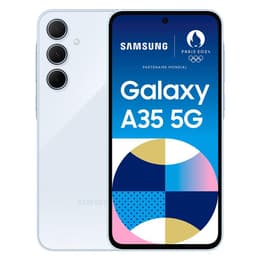
The Samsung Galaxy A35, released in March 2024, and the iPhone 15 Plus, launched in September 2023, represent distinct approaches to smartphone design and functionality. While the Galaxy A35 operates on Android with Samsung's One UI, the iPhone 15 Plus runs on Apple's iOS platform. These devices offer different user experiences, primarily distinguished by their operating systems, display technologies, and camera philosophies.
Available Models
Colour
Storage (GB)
Scores
Durability
When considering the long-term usability of these devices, both offer substantial software support and robust builds, though with differing timelines.
- Software Support: The Samsung Galaxy A35 is expected to receive four years of Android operating system updates and five years of security updates from its release. The iPhone 15 Plus, having launched with iOS 17, is compatible with later iOS versions, including iOS 18.x and iOS 26, indicating a long period of software relevance and security updates from Apple.
- Build Durability: Both devices feature strong construction. The Galaxy A35 incorporates Gorilla Glass Victus+ on both the front and back panels and carries an IP67 rating for dust and water resistance. The iPhone 15 Plus is equipped with a Ceramic Shield front and a color-infused glass back, paired with an aluminum frame, and boasts an IP68 rating for dust and water resistance.
- Practical Lifespan: Users can anticipate several years of reliable performance from either device. The iPhone 15 Plus, despite being discontinued in September 2025 following the iPhone 17 announcement, will continue to receive software support for an extended period. The Galaxy A35's commitment to four years of OS updates also ensures a prolonged functional life.
Year of Release
2024
2023
Compatible with latest Update
Yes
Yes
OS
Android
iOS
Foldable
No
No
Performance
The performance of a smartphone is crucial for daily tasks, and these two devices offer different capabilities tailored to their respective ecosystems.
- Processing Power: The Samsung Galaxy A35 is powered by an Exynos 1380 processor, which provides stable performance for everyday activities like browsing and multitasking. Users generally find it smooth for typical use, though some note occasional lag when opening heavier applications or scrolling. The iPhone 15 Plus features the A16 Bionic processor, which delivers a speedy and smooth experience across applications and demanding tasks.
- Multitasking and Storage: The Galaxy A35 is available with 6GB or 8GB of RAM and offers 128GB or 256GB of internal storage, with the added benefit of expandable storage via a microSD card up to 1TB. The iPhone 15 Plus comes with 6GB of RAM and storage options of 128GB, 256GB, or 512GB, but does not support expandable storage.
- Battery Behavior: The Galaxy A35 is equipped with a 5000mAh battery, often providing exceptional longevity, with many users reporting it lasting a full day with extensive use or even up to 1.5 days on a single charge. The iPhone 15 Plus, with its 4383mAh battery, is also noted for its strong battery life, often outlasting other iPhone models and allowing users to go through a full day of heavy use without needing a recharge.
Screen quality
The visual experience is a key differentiator, with both phones offering vibrant displays designed for clear viewing.
- Display Technology: The Samsung Galaxy A35 features a 6.6-inch Super AMOLED Infinity-O display, known for its vibrant colors and deep blacks. The iPhone 15 Plus sports a 6.7-inch Super Retina XDR OLED display, which also delivers rich colors and high contrast.
- Brightness and Clarity: The Galaxy A35 offers a maximum brightness of 1000 nits in High Brightness Mode, with Vision Booster technology to enhance outdoor visibility. The iPhone 15 Plus provides a typical brightness of 1000 nits, a peak HDR brightness of 1600 nits, and an impressive peak outdoor brightness of 2000 nits, making it highly visible even in direct sunlight. Both displays have a resolution of 2340x1080 for the A35 and 2796x1290 for the 15 Plus, resulting in sharp images.
- Refresh Rate and Smoothness: The Galaxy A35 boasts a 120Hz refresh rate, contributing to smoother scrolling and a more fluid visual experience. In contrast, the iPhone 15 Plus maintains a 60Hz refresh rate. The iPhone 15 Plus also integrates the Dynamic Island, an interactive area around the front camera that displays alerts and live activities.
Resolution
1080 x 2340
1290 x 2796
Screen type
Super AMOLED
Super Retina XDR OLED
Audiovisual
Both smartphones offer capable camera systems, designed to capture moments with clarity, though they approach photography with different strengths.
- Rear Camera Systems: The Samsung Galaxy A35 features a triple rear camera setup, including a 50MP main camera with optical image stabilization, an 8MP ultrawide lens, and a 5MP macro lens. The iPhone 15 Plus comes with a dual-camera system, comprising a 48MP main camera with optical image stabilization and a 12MP ultrawide camera. The iPhone 15 Plus also utilizes its high-resolution main sensor to offer a 2x optical-quality zoom.
- Photography Performance: The Galaxy A35 is praised for its vibrant and clean daylight photos, with colors that are vivid but not oversaturated. Its low-light performance is considered decent, especially with night mode, but can sometimes result in blurry or noisy images compared to higher-end devices. The iPhone 15 Plus delivers sharp images with good color and accurate exposure, showing significant improvements in low-light conditions over previous models.
- Video and Audio: Both devices are capable of recording video at up to 4K resolution at 30 frames per second with their main cameras. The iPhone 15 Plus can record up to 4K at 60 frames per second and offers excellent video stabilization. For audio, the Galaxy A35 includes stereo speakers, providing loud output. The iPhone 15 Plus also offers a strong media consumption experience with its speakers.
Main camera
50 megapixels
48 megapixels
Front camera
13 megapixels
12 megapixels
Miscellaneous
Beyond core features, several practical elements contribute to the overall user experience and daily convenience of these devices.
- Connectivity and Ports: Both the Galaxy A35 and iPhone 15 Plus support 5G connectivity, Wi-Fi 6, and Bluetooth 5.3. A notable difference is the port type: the Galaxy A35 uses a USB-C 2.0 port, while the iPhone 15 Plus also features a USB-C port, marking a shift from Apple's proprietary Lightning connector, though it also operates at USB 2.0 speeds. The Galaxy A35 includes expandable storage via microSD, a feature absent on the iPhone 15 Plus.
- Biometrics and Sensors: The Galaxy A35 incorporates an under-display fingerprint sensor for secure unlocking. The iPhone 15 Plus relies on Face ID for biometric authentication, utilizing 3D face recognition. Both devices include a range of sensors such as accelerometers, gyroscopes, and ambient light sensors.
- Design and Handling: The Galaxy A35 measures 161.7 x 78.0 x 8.2mm and weighs 209 grams. The iPhone 15 Plus is slightly more compact and lighter at 160.9 x 77.8 x 7.8mm and 201 grams. Both phones feature flat sides and rounded corners, contributing to a modern aesthetic.
Weight
209 g
201 g
Screen size (in)
6.6
6.7
Network
5G
5G
SIM card
Dual Physical SIM
Physical SIM + eSIM
Carrier compatibility
Unlocked
Unlocked
Connector
USB-C
USB-C
What the community thinks
Choosing between the Samsung Galaxy A35 and the iPhone 15 Plus involves weighing different priorities and ecosystem preferences. User feedback for the Galaxy A35 often highlights its vibrant display, dependable cameras in good lighting, and impressive battery life as strong points. Some users appreciate its smooth performance for daily tasks, though occasional lag with demanding apps and slower charging speeds are noted concerns. The iPhone 15 Plus receives praise for its powerful processor, excellent camera capabilities, particularly in low light, and its robust battery life that supports extended usage. The integration of the Dynamic Island and the shift to USB-C are also seen as positive updates. A common point of discussion for the iPhone 15 Plus has been its 60Hz refresh rate, which some users feel is a limitation compared to competitors.
Users prioritizing a smooth, long-lasting software experience within the Apple ecosystem, coupled with strong camera performance and a bright display, may find the iPhone 15 Plus well-suited to their needs. Its consistent performance and integration with other Apple devices are key advantages. Conversely, individuals who value a high refresh rate display, expandable storage, and the flexibility of the Android operating system, along with a strong battery life, might lean towards the Samsung Galaxy A35. Both devices offer a quality-assured refurbished option, providing an eco-friendly alternative for consumers seeking reliable technology.