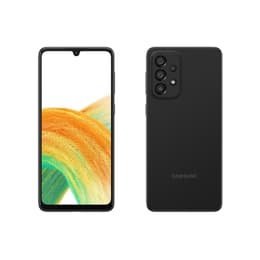
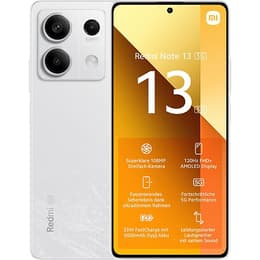


Galaxy A33 5G Vs Xiaomi Redmi Note 13

Galaxy A33 5G
Galaxy A33 5G
Starting at

Refurbished price:100.00

Versus €389.00 new

See options
Xiaomi Redmi Note 13
Starting at

Refurbished price:137.00

Versus €340.00 new

See options

Ratings

The Samsung Galaxy A33 5G, released in April 2022, and the Xiaomi Redmi Note 13, launched globally in January 2024, are both Android-based smartphones designed for a broad user base. While the Galaxy A33 5G offers a robust build and extended software support, the Redmi Note 13 counters with a more fluid display and a higher-resolution main camera. Both devices run on the Android operating system, providing access to a wide ecosystem of applications and services.

Scores

Durability

When considering the long-term usability of a smartphone, factors like software support and physical resilience are key. These two devices present different profiles in terms of their expected practical lifespan.

  • Release Timeline and Age: The Samsung Galaxy A33 5G was released in April 2022, making it an older model compared to the Xiaomi Redmi Note 13, which launched globally in January 2024. This difference in release dates means the Redmi Note 13 starts with a more recent software foundation.
  • OS Support Duration: Samsung has committed to providing the Galaxy A33 5G with four years of Android operating system upgrades and five years of security updates. The Redmi Note 13 is expected to receive three major Android OS updates and four years of security patches, with security updates extending until January 2028. This indicates the Galaxy A33 5G may offer a slightly longer period of security support.
  • Physical Durability: The Galaxy A33 5G features Corning Gorilla Glass 5 for screen protection and boasts an IP67 rating for water and dust resistance, meaning it can withstand submersion in up to 1 meter of freshwater for 30 minutes. The Redmi Note 13 uses Corning Gorilla Glass 3 for its display and does not carry an official IP rating for water and dust resistance, suggesting the Galaxy A33 5G offers greater protection against environmental elements.

Year of Release

2022

2024

Compatible with latest Update

Yes

Yes

OS

Android

Android

Foldable

No

No

Performance

The performance of a smartphone is crucial for daily operations, from launching applications to managing multiple tasks simultaneously. Both devices aim to deliver a smooth user experience, though they approach this with different internal components.

  • Processor Capabilities: The Galaxy A33 5G is powered by an Exynos 1280 processor, which is generally considered competent for everyday tasks and light gaming. The Redmi Note 13 features a Snapdragon 685 processor, which some users have noted can feel less responsive, particularly when handling more demanding applications or extensive multitasking.
  • Multitasking and Responsiveness: For typical daily usage, including browsing social media and opening apps, the Galaxy A33 5G generally provides a smooth experience without noticeable delays. The Redmi Note 13 also handles daily tasks and casual gaming adequately, but its performance for more intensive use cases like graphic-heavy games may be less robust.
  • Storage and RAM: Both devices offer configurations with 6GB or 8GB of RAM and 128GB or 256GB of internal storage. Both also support expandable storage via a microSD card, allowing users to increase their storage capacity significantly, up to 1TB.

Memory (GB)

6 GB

8 GB

Screen quality

The display is a primary interface for smartphone interaction, and both the Galaxy A33 5G and the Redmi Note 13 offer vibrant viewing experiences with distinct characteristics.

  • Display Technology and Refresh Rate: Both smartphones feature AMOLED displays, known for deep blacks and vibrant colors. The Galaxy A33 5G has a 6.4-inch Super AMOLED display with a 90Hz refresh rate, providing smooth scrolling. The Redmi Note 13 offers a slightly larger 6.67-inch AMOLED display with a higher 120Hz refresh rate, which can result in an even more fluid visual experience, especially during fast-paced content or scrolling.
  • Brightness and Clarity: The Redmi Note 13 boasts a peak brightness of 1800 nits, ensuring good visibility even in bright outdoor conditions. While the Galaxy A33 5G's peak brightness is not explicitly stated in all sources, its Super AMOLED panel generally offers good outdoor visibility. Both displays have a Full HD+ resolution (1080x2400 pixels), contributing to sharp and clear visuals.
  • Screen Protection: The Galaxy A33 5G is equipped with Corning Gorilla Glass 5 for enhanced scratch resistance. The Redmi Note 13 uses Corning Gorilla Glass 3, which offers a good level of protection but is an older generation compared to the A33 5G.

Resolution

1080 x 2400

1080 x 2400

Screen type

Super AMOLED

AMOLED

Audiovisual

For many users, the camera system is a critical component of a smartphone, and both the Galaxy A33 5G and the Redmi Note 13 offer multi-lens setups for varied photography.

  • Main Camera Capabilities: The Galaxy A33 5G features a 48MP main camera with Optical Image Stabilization (OIS), which helps in capturing sharper images and more stable videos, especially in challenging lighting. The Redmi Note 13 comes with a 108MP main camera, offering a higher megapixel count for potentially more detailed photos, though it lacks OIS.
  • Additional Lenses and Performance: Both phones include an 8MP ultrawide camera and a 2MP macro camera. The Galaxy A33 5G also adds a 2MP depth sensor. User feedback suggests that while the main camera on both can produce good results in ample lighting, the ultrawide and macro lenses on the Redmi Note 13 are less impressive, and low-light performance can be a weakness for both, with the A33 5G sometimes oversaturating colors.
  • Video Recording: The Galaxy A33 5G supports video recording up to 4K resolution at 30 frames per second. The Redmi Note 13 records videos at a maximum of 1080p at 30 frames per second, which is a lower resolution and frame rate compared to the A33 5G.

Main camera

48 megapixels

108 megapixels

Front camera

13 megapixels

16 megapixels

Miscellaneous

Beyond the core specifications, several practical features contribute to the overall user experience and differentiate these two smartphones.

  • Connectivity and Ports: Both devices support 5G connectivity, Wi-Fi 802.11 a/b/g/n/ac, Bluetooth 5.1, and NFC for contactless payments. They both utilize a USB-C 2.0 port for charging and data transfer. A notable difference is the absence of a 3.5mm headphone jack on the Galaxy A33 5G, a feature that is also missing on the Redmi Note 13. The Redmi Note 13 includes an IR blaster, allowing it to function as a universal remote control.
  • Biometric Security: The Galaxy A33 5G features an in-display fingerprint sensor for secure unlocking. The Redmi Note 13 also incorporates an in-screen fingerprint sensor, providing a convenient and modern biometric authentication method.
  • Design and Build: The Galaxy A33 5G has a plastic back and frame, with a matte finish that some users find comfortable to hold. It weighs 186 grams. The Redmi Note 13 also features a flat frame design with a glossy plastic back and weighs 188.5 grams. The Galaxy A33 5G is rated IP67 for water and dust resistance, offering a higher level of protection than the Redmi Note 13.

Weight

186 g

175 g

Screen size (in)

6.4

6.67

Network

5G

5G

SIM card

Dual Physical SIM

Dual Physical SIM

Carrier compatibility

Unlocked

Unlocked

The Samsung Galaxy A33 5G and the Xiaomi Redmi Note 13 cater to users seeking capable smartphones in the mid-range segment, each with its own set of strengths and trade-offs. User feedback for the Galaxy A33 5G often praises its robust build quality, including IP67 water and dust resistance, and its commitment to extended software updates. Some users appreciate its Super AMOLED display and reliable battery life for daily use. However, criticisms sometimes point to its performance for demanding applications and the tendency for its camera to oversaturate colors.

The Redmi Note 13, being a newer device, is frequently lauded for its vibrant 120Hz AMOLED display and its high-resolution 108MP main camera. Users also highlight its fast charging capabilities and the inclusion of a charger in the box. Conversely, common concerns revolve around its processor, which some find to be on the slower side for its category, potentially leading to a less fluid experience with intensive tasks. The quality of its ultrawide and macro cameras, as well as video recording capabilities, are also noted as areas where it could improve.

Users prioritizing a device with strong environmental protection, a longer software support window, and a generally consistent performance for everyday tasks might find the Samsung Galaxy A33 5G to be a suitable choice. Its IP67 rating and Gorilla Glass 5 offer peace of mind for those concerned about durability. On the other hand, individuals who value a more fluid display experience, faster charging, and a higher-megapixel main camera for still photography may lean towards the Xiaomi Redmi Note 13. Its newer release date also means it starts with a more current Android version. Both devices represent quality-assured refurbished options, providing an eco-friendly alternative for consumers.


See all articles

Our recent comparisons





