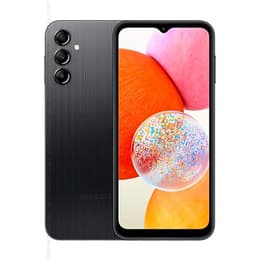



Galaxy A14 Vs Xiaomi Redmi Note 12 Pro

Galaxy A14
Galaxy A14
Starting at

Refurbished price:97.00

Versus €269.00 new

See options
Xiaomi Redmi Note 12 Pro
Starting at

Refurbished price:114.00

Versus €399.00 new

See options

Ratings

The Samsung Galaxy A14, released in early 2023, and the Xiaomi Redmi Note 12 Pro, with its 5G variant launching in late 2022 and a 4G version in early 2023, are both smartphones designed for everyday use. While both devices operate on the Android platform, they present distinct approaches to display technology, charging capabilities, and overall performance, catering to different user priorities.

Scores

Durability

When considering the long-term usability of these devices, their release timelines and software support policies are key factors.

  • Release Timeline: The Samsung Galaxy A14 5G was released in January 2023, while the Xiaomi Redmi Note 12 Pro 5G launched in October 2022, making them close in age. The Redmi Note 12 Pro also has a 4G variant released in March 2023.
  • Software Longevity: The Galaxy A14 5G is expected to receive two major Android operating system updates, bringing it up to Android 15, and four years of security updates, extending its support until 2027. The Redmi Note 12 Pro series was initially promised two major Android updates and three years of security patches, with its final major update (HyperOS 2, based on Android 15) anticipated by the end of 2025. This suggests the Galaxy A14 5G may offer a slightly longer period of security support.
  • Durability Features: The Redmi Note 12 Pro features Gorilla Glass 5 on its front for enhanced screen protection and carries an IP53 rating, indicating some resistance to dust and splashes. The Galaxy A14, while having a glass front, does not specify the type of protection and lacks an official IP rating, suggesting a more basic level of environmental resistance.

Year of Release

2023

2022

Compatible with latest Update

No

No

OS

Android

Android

Foldable

No

No

Performance

The performance of these smartphones is influenced by their internal components, affecting how smoothly they handle daily tasks and more demanding applications.

  • Processing Power: The Redmi Note 12 Pro 5G is equipped with a processor that generally offers more robust performance for multitasking and gaming compared to the Galaxy A14 5G's processor. The Redmi Note 12 Pro 4G uses a different processor, which still provides a capable experience for general use. The Galaxy A14's processor is designed for essential smartphone functions and lighter use.
  • Memory and Storage: The Redmi Note 12 Pro typically offers more RAM options, ranging from 6GB to 12GB, which can contribute to smoother multitasking and app management. The Galaxy A14 usually comes with 4GB or 6GB of RAM. Both devices offer 128GB storage options, but the Galaxy A14 includes a microSD card slot for expandable storage, a feature often absent in the Redmi Note 12 Pro 5G variant.
  • Battery Behavior: Both phones house a 5000 mAh battery, providing ample power for a full day of moderate use. However, the Redmi Note 12 Pro stands out with its 67W fast charging capability, allowing for significantly quicker recharges compared to the Galaxy A14's 15W charging. Users of the Galaxy A14 have noted its sluggish charging speed.

Memory (GB)

4 GB

8 GB

Screen quality

The visual experience on these devices differs considerably due to their display technologies and specifications.

  • Display Technology: The Redmi Note 12 Pro features a 6.67-inch AMOLED display, known for its deep blacks, high contrast, and vibrant colors. In contrast, the Galaxy A14 uses a 6.6-inch PLS LCD panel, which offers good color reproduction but does not achieve the same level of contrast or black depth as AMOLED.
  • Refresh Rate and Brightness: The Redmi Note 12 Pro provides a smoother viewing experience with a 120Hz refresh rate and can reach peak brightness levels of up to 900-1100 nits, making it more comfortable to view in bright outdoor conditions. The Galaxy A14 5G has a 90Hz refresh rate, while the 4G version is limited to 60Hz, and its display is generally less bright, which some users have noted.
  • Resolution and Clarity: Both phones offer Full HD+ resolutions (1080x2408 for A14, 1080x2400 for Redmi Note 12 Pro), providing sharp images and text for typical viewing distances. The Redmi Note 12 Pro also supports HDR10+ and Dolby Vision, enhancing the viewing quality for compatible content.

Resolution

1080 x 2408

1080 x 2400

Screen type

PLS LCD

AMOLED

Audiovisual

Both smartphones offer multi-camera setups, but their capabilities for photography and videography vary in detail and performance.

  • Main Camera Performance: The Galaxy A14 features a 50MP main camera, capable of capturing detailed everyday photos. The Redmi Note 12 Pro 5G also has a 50MP main sensor, which includes Optical Image Stabilization (OIS) for clearer shots, especially in challenging conditions. The Redmi Note 12 Pro 4G variant boasts a 108MP main camera. User feedback for the Galaxy A14's main camera is generally positive, though some note difficulties with focus and pixelation with zoom.
  • Additional Lenses and Features: The Galaxy A14 4G includes a 5MP ultrawide lens, alongside 2MP macro and depth sensors. The Galaxy A14 5G typically features only macro and depth sensors, often omitting the ultrawide. The Redmi Note 12 Pro (both 4G and 5G) includes an 8MP ultrawide camera and a 2MP macro lens, with the 4G version also having a 2MP depth sensor.
  • Video Recording and Front Camera: The Redmi Note 12 Pro offers 4K video recording at 30fps, providing higher resolution video capture. The Galaxy A14 records video at 1080p at 30fps. For selfies, the Redmi Note 12 Pro has a 16MP front camera, while the Galaxy A14 features a 13MP front camera.

Main camera

50 megapixels

50 megapixels

Front camera

13 megapixels

16 megapixels

Miscellaneous

Beyond core specifications, several practical elements contribute to the overall user experience of these devices.

  • Connectivity and Ports: The Redmi Note 12 Pro 5G supports Wi-Fi 6, offering faster and more stable wireless connections, while the 4G variant and the Galaxy A14 support Wi-Fi 5. Both phones include a 3.5mm headphone jack and a USB-C port for charging and data transfer. The Redmi Note 12 Pro also features an IR blaster, allowing it to function as a universal remote.
  • Biometric Security: Both devices incorporate a side-mounted fingerprint sensor for convenient and secure unlocking.
  • Design and Handling: The Galaxy A14 has a plastic frame and back, contributing to its overall weight and dimensions. The Redmi Note 12 Pro often features a glass back (in some regions) and a plastic frame, giving it a slightly more refined feel and generally a lighter weight. Users have noted the Galaxy A14's substantial bezels.

Weight

201 g

187 g

Screen size (in)

6.6

6.67

Network

4G

5G

SIM card

Dual Physical SIM

Dual Physical SIM

Carrier compatibility

Unlocked

Unlocked

The Samsung Galaxy A14 and Xiaomi Redmi Note 12 Pro cater to users with differing priorities, offering distinct strengths in various areas. User feedback for the Galaxy A14 often highlights its strong battery life and capable main camera as positive aspects. However, some users have expressed concerns regarding its charging speed, display quality, and occasional performance lags, with some reporting overheating and touch issues.

The Redmi Note 12 Pro generally receives praise for its vibrant AMOLED display, rapid 67W fast charging, and a main camera that often includes OIS for improved stability. Criticisms sometimes point to the presence of bloatware and ads within its MIUI software, and some users have reported microphone issues or camera artifacting with digital zoom.

Users prioritizing an immersive visual experience with a high refresh rate and quick charging will find the Redmi Note 12 Pro well-suited to their needs. Its more capable processor also benefits those who engage in more demanding applications or multitasking. Conversely, users who prioritize a slightly longer security update commitment and expandable storage may lean toward the Samsung Galaxy A14. Both devices offer a solid foundation for everyday smartphone use, and considering a quality-assured refurbished option for either model can be a sustainable choice for consumers.


See all articles

Our recent comparisons