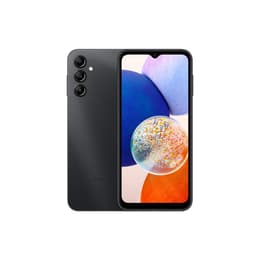
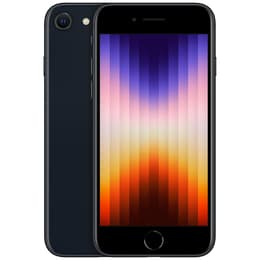


Galaxy A14 Vs iPhone SE (2022)

Galaxy A14
Galaxy A14
Starting at

Refurbished price:97.00

Versus €269.00 new

See options
iPhone SE (2022)
iPhone SE (2022)
Starting at

Refurbished price:127.00

Versus €549.00 new

See options

Ratings

The Samsung Galaxy A14 5G, released in January 2023, and the Apple iPhone SE (2022), launched in March 2022, represent distinct approaches to smartphone design and functionality. While both offer 5G connectivity, the Galaxy A14 5G provides a larger display and a multi-camera system, whereas the iPhone SE (2022) focuses on a compact form factor and a powerful internal processor. These differences cater to varying user preferences, from those seeking an expansive viewing experience to those prioritizing a highly responsive, pocket-friendly device.

Scores

Durability

When considering the longevity of these devices, several factors come into play, including their release timelines, software support, and ease of repair.

  • Release Timeline and Software Support: The iPhone SE (2022) was released in March 2022, while the Galaxy A14 5G followed in January 2023. Apple is known for providing extended software support for its devices, often exceeding five years. The iPhone SE (2022) is expected to receive software updates for approximately seven years or more, ensuring long-term access to new features and security patches. In contrast, the Galaxy A14 5G is promised two major Android OS upgrades and four years of security updates. This means the Galaxy A14 5G should receive Android 14 and Android 15, with security patches extending until 2027.
  • Repairability: The Galaxy A14 5G has a repairability score of 8 out of 10, partly due to its user-friendly design and the use of an adhesive pull tab for the battery, making replacement easier. The iPhone SE (2022) has an average repairability score of 5.5 out of 10. While common parts like the battery and screen can be replaced, it often requires specialized tools and alcohol to dissolve strong adhesives.
  • Expected Practical Lifespan: Users prioritizing the longest possible software longevity might find the iPhone SE (2022) more appealing due to Apple's extended update policy. However, the Galaxy A14 5G offers a commendable update policy for its segment and a higher repairability score, which can contribute to its practical lifespan.

Year of Release

2023

2022

Compatible with latest Update

No

Yes

OS

Android

iOS

Foldable

No

No

Performance

The performance of a smartphone is largely determined by its internal components and how efficiently they handle daily tasks and demanding applications.

  • Processor Capabilities: The iPhone SE (2022) is equipped with a powerful current-generation processor, which allows it to handle demanding applications and multitasking smoothly. This processor is capable of driving much higher-resolution screens and more complex camera systems found in other devices. The Galaxy A14 5G features a processor that provides solid everyday performance. While it handles most daily tasks adequately, some users have reported that opening and closing apps can feel less immediate, and resource-heavy 3D games may not run as smoothly.
  • System Responsiveness and Multitasking: The iPhone SE (2022) offers a highly responsive user experience, making it well-suited for users who frequently switch between applications or engage in intensive mobile gaming. The Galaxy A14 5G provides a satisfactory experience for general use, with its performance being considered solid for its category.
  • Storage Options and RAM: Both devices offer various storage configurations. The iPhone SE (2022) comes with 4GB of RAM and storage options up to 256GB. The Galaxy A14 5G is available with 4GB or 6GB of RAM and up to 128GB of internal storage, with expandable memory support via a microSD card.

Memory (GB)

4 GB

4 GB

Screen quality

The display is a primary interface for smartphone interaction, and both devices offer different visual experiences.

  • Display Technology and Resolution: The iPhone SE (2022) features a 4.7-inch Retina IPS LCD with a resolution of 1334 x 750 pixels, resulting in a pixel density of 326 ppi. This display offers good color accuracy and a wide color gamut. The Galaxy A14 5G boasts a larger 6.6-inch PLS LCD with a higher resolution of 2408 x 1080 pixels, providing a pixel density of 399 ppi. This higher resolution on a larger screen offers a sharper viewing experience.
  • Brightness and Refresh Rate: The iPhone SE (2022) has a typical maximum brightness of 625 nits, which contributes to good visibility in various lighting conditions. The Galaxy A14 5G's display peaks at 500 nits, which can make reading the phone in bright sunlight challenging for some users. The Galaxy A14 5G features a 90Hz refresh rate, contributing to smoother scrolling and a more fluid visual experience. The iPhone SE (2022) has a standard 60Hz refresh rate.
  • Screen Size and Viewing Experience: The Galaxy A14 5G's larger screen is well-suited for media consumption and browsing, offering an expansive viewing area. The iPhone SE (2022)'s compact 4.7-inch display is ideal for users who prefer a smaller device for one-handed use and portability.

Resolution

1080 x 2408

750 x 1334

Screen type

PLS LCD

Retina IPS LCD

Audiovisual

The camera systems on both smartphones cater to different photography needs and expectations.

  • Rear Camera Capabilities: The iPhone SE (2022) features a single 12-megapixel wide rear camera with an f/1.8 aperture, optical image stabilization, and computational photography features like Smart HDR 4 and Deep Fusion, which enhance image quality in good lighting. However, it lacks a dedicated Night mode, leading to darker and grainier images in low-light conditions. The Galaxy A14 5G comes with a triple-camera setup, including a 50-megapixel main sensor, a 2-megapixel macro camera, and a 2-megapixel depth sensor. The 50MP main camera performs well in good lighting, capturing decent details and vibrant colors. However, it lacks an ultrawide camera, and the macro and depth sensors offer limited utility.
  • Front Camera and Video Recording: The iPhone SE (2022) has a 7-megapixel front camera that performs adequately in good light but struggles in low-light scenarios. It can record video up to 4K at 60 frames per second. The Galaxy A14 5G features a 13-megapixel front camera that captures sharp and crisp photos in good lighting. Both front and rear cameras on the A14 5G are limited to 1080p video recording at 30 frames per second.
  • Overall Photography Experience: Users prioritizing strong performance in well-lit conditions and advanced video recording capabilities might lean towards the iPhone SE (2022). Those who prefer a higher-resolution main sensor for everyday photos and a more versatile camera array (despite the limitations of secondary lenses) might find the Galaxy A14 5G suitable.

Main camera

50 megapixels

12 megapixels

Front camera

13 megapixels

7 megapixels

Miscellaneous

Beyond core performance and display, several practical elements differentiate these two smartphones.

  • Connectivity Options: Both devices support 5G connectivity, enabling faster mobile data speeds. The iPhone SE (2022) includes Wi-Fi 6 and Bluetooth 5.0. The Galaxy A14 5G supports Wi-Fi 5 (802.11 a/b/g/n/ac) and Bluetooth 5.2.
  • Port Types and Sensors: The iPhone SE (2022) utilizes a Lightning port for charging and data transfer and features Touch ID for secure fingerprint recognition. It does not have a traditional headphone jack. The Galaxy A14 5G includes a USB-C port for charging and data, and notably retains a 3.5mm headphone jack. It also features a side-mounted fingerprint sensor for biometric authentication.
  • Weight, Dimensions, and Build Materials: The iPhone SE (2022) is a compact and lightweight device, measuring 138.4 x 67.3 x 7.3 mm and weighing 144g. It features a glass front and back with an aluminum frame and an IP67 rating for dust and water resistance. The Galaxy A14 5G is larger and heavier, with dimensions of 167.7 x 78 x 9.1 mm and a weight of 201g. It has a plastic back and frame, which contributes to a solid in-hand feel, but lacks an official IP rating for water and dust resistance.

Weight

201 g

144 g

Screen size (in)

6.6

4.7

Network

4G

5G

SIM card

Dual Physical SIM

Physical SIM + eSIM

Carrier compatibility

Unlocked

Unlocked

User feedback for the iPhone SE (2022) often praises its exceptional processing power, which ensures smooth operation for years, and its compact size, appealing to those who prefer a smaller device. Common criticisms include its dated design with large bezels, average battery life for heavy users, and the absence of a Night mode for its camera. For the Galaxy A14 5G, users frequently highlight its large, sharp display with a 90Hz refresh rate, long-lasting battery, and solid performance for its segment. Some users note that the screen can be difficult to view in bright sunlight and that the secondary camera lenses offer limited practical use.

Users prioritizing a highly responsive device with a long software support lifespan and a compact form factor may find the iPhone SE (2022) well-suited to their needs. Its powerful internal components make it capable of handling demanding tasks with ease. Conversely, individuals who value a larger display for media consumption, extended battery life, and the flexibility of a headphone jack and expandable storage might lean towards the Galaxy A14 5G. This device offers a robust experience for everyday use at a larger scale. Both models are available as quality-assured refurbished options, providing an eco-friendly alternative for consumers.


See all articles

Our recent comparisons






