

iPhone 16 Pro Max Vs Xiaomi 14T Pro

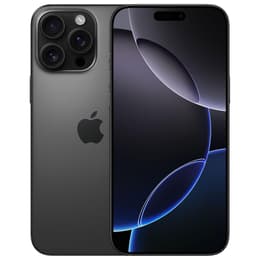
iPhone 16 Pro Max
iPhone 16 Pro Max
Starting at

Refurbished price:821.00

Versus €1,489.00 new

See options
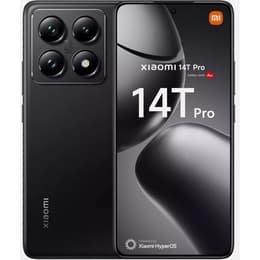
Xiaomi 14T Pro
Xiaomi 14T Pro
Starting at

Refurbished price:394.00

Versus €900.00 new

See options

Ratings

The iPhone 16 Pro Max, released in September 2024, and the Xiaomi 14T Pro, also launched in September 2024, represent two distinct approaches to high-end smartphone design and functionality. Both devices offer advanced features tailored to demanding users, yet they diverge significantly in their operating systems and specific hardware priorities. The iPhone operates on Apple's iOS, known for its integrated ecosystem, while the Xiaomi device runs on Android with Xiaomi's HyperOS overlay, offering a more customizable experience. Key differentiators lie in their camera philosophies, display characteristics, and charging technologies.

Scores

Durability

When considering the long-term usability of these devices, both the iPhone 16 Pro Max and the Xiaomi 14T Pro offer robust build quality and commitment to software updates, though their approaches differ.

  • Software Longevity: Apple typically provides major iOS updates for approximately five to seven years, with security updates extending even longer, potentially up to eight years for some models. This means the iPhone 16 Pro Max, launching with iOS 18, can expect a prolonged period of new features and security enhancements. The Xiaomi 14T Pro, running Android 14 with HyperOS, is expected to receive four years of OS updates and five years of security updates, offering a solid, though generally shorter, support window.
  • Physical Durability: The iPhone 16 Pro Max features a titanium design and a Ceramic Shield front cover, which Apple states is more resistant to drops. It also carries an IP68 rating for water and dust resistance, allowing submersion up to 6 meters for 30 minutes. The Xiaomi 14T Pro utilizes an aluminum alloy frame and Corning Gorilla Glass 5 for screen protection, alongside an IP68 rating for water and dust resistance, capable of submersion up to 2 meters for 30 minutes.
  • Repairability: While specific repairability scores can vary, both manufacturers generally design their flagship devices with certain repair considerations. Users seeking to extend the life of their device through refurbishment can find quality-assured options for both models, contributing to a more sustainable choice.

Year of Release

2024

2024

Compatible with latest Update

Yes

Yes

Foldable

No

No

Performance

Both smartphones deliver high-level performance suitable for demanding applications and multitasking, though they achieve this through different hardware architectures and software optimizations.

  • Processing Power: The iPhone 16 Pro Max is equipped with a current-generation processor that enables smooth operation across complex applications, intensive gaming, and advanced video editing tasks. Users can expect rapid app loading and seamless transitions. The Xiaomi 14T Pro features a powerful processor designed for efficiency and speed, handling demanding games and applications with ease, ensuring a responsive user experience.
  • Multitasking and Storage: The iPhone 16 Pro Max comes with 8GB of RAM, which supports efficient multitasking and keeps numerous applications active in the background. Storage options range from 256GB to 1TB. The Xiaomi 14T Pro offers 12GB or 16GB of RAM, providing ample capacity for extensive multitasking and resource-intensive applications, with storage configurations also up to 1TB.
  • Battery Behavior: The iPhone 16 Pro Max houses a 4685 mAh battery, optimized by its operating system and processor for extended usage, with Apple reporting up to 33 hours of video playback. Real-world tests indicate impressive longevity, often exceeding a full day of heavy use. The Xiaomi 14T Pro is equipped with a larger 5000 mAh battery, which, combined with its efficient processor, is designed to provide substantial power, with some users reporting up to two days of moderate use.

Memory (GB)

8 GB

16 GB

Screen quality

The visual experience on both devices is premium, featuring advanced display technologies that offer vibrant colors and sharp details, catering to media consumption and daily interactions.

  • Display Technology and Clarity: The iPhone 16 Pro Max features a 6.9-inch Super Retina XDR OLED display with a resolution of 2868 by 1320 pixels, resulting in a pixel density of 460 pixels per inch. This provides exceptional clarity and deep blacks. The Xiaomi 14T Pro sports a 6.67-inch CrystalRes AMOLED display with a 2712 by 1220 pixel resolution, offering a pixel density of 446 ppi. Both displays support HDR content for enhanced contrast and color reproduction.
  • Brightness and Refresh Rate: The iPhone 16 Pro Max's display offers a typical brightness of 1000 nits and a peak brightness of 2000 nits, ensuring good visibility in various lighting conditions. It also features ProMotion technology, providing an adaptive refresh rate up to 120Hz for smooth scrolling and responsive visuals. The Xiaomi 14T Pro boasts an impressive peak brightness of 4000 nits, making it highly readable outdoors. Its adaptive refresh rate goes up to 144Hz, contributing to a very fluid user experience, particularly in supported games and applications.
  • Viewing Experience: Both devices offer immersive viewing experiences with minimal bezels. The iPhone 16 Pro Max has slightly thinner display borders, contributing to its larger screen-to-body ratio. The Xiaomi 14T Pro also features an ultra-thin bezel design, aiming for a balanced visual effect.

Resolution

1320 x 2868

1220 x 2712

Screen type

LTPO Super Retina XDR OLED

AMOLED

Audiovisual

Both the iPhone 16 Pro Max and the Xiaomi 14T Pro are equipped with sophisticated camera systems, each offering distinct strengths in photography and videography to capture high-quality images and videos.

  • Rear Camera Systems: The iPhone 16 Pro Max features a Pro camera system with a 48MP main sensor, a 48MP ultra-wide camera, and a 12MP 5x telephoto lens, alongside a LiDAR Scanner for improved depth sensing. It emphasizes computational photography for consistent results. The Xiaomi 14T Pro integrates a Leica-tuned triple camera setup, including a 50MP main sensor with a Leica Summilux optical lens, a 50MP telephoto lens with 2.6x optical zoom, and a 12MP ultra-wide lens. This system focuses on capturing rich detail and offers specific Leica photographic styles.
  • Photography Performance: The iPhone 16 Pro Max excels in delivering consistent image quality across its lenses, with strong dynamic range and natural color reproduction, making photos ready for sharing. Its low-light performance is robust, especially with the main sensor. The Xiaomi 14T Pro, with its larger main sensor and Leica optics, is noted for its ability to capture significant detail and perform well in low-light environments, offering vibrant or authentic color profiles.
  • Video Capabilities: The iPhone 16 Pro Max supports 4K Dolby Vision video recording at up to 120 frames per second on its main camera, along with Cinematic mode and ProRes video recording options for professional workflows. The Xiaomi 14T Pro offers 8K video recording at 30 frames per second and 4K at 60 frames per second, including a 'Movie mode' for cinematic aspect ratios and effects, and Director mode for advanced controls.

Main camera

48 megapixels

50 megapixels

Front camera

12 megapixels

32 megapixels

Miscellaneous

Beyond core performance, several practical features and design elements contribute to the overall user experience of both the iPhone 16 Pro Max and the Xiaomi 14T Pro.

  • Connectivity and Ports: Both devices support 5G connectivity for fast mobile data and Wi-Fi 7 for high-speed wireless networking. The iPhone 16 Pro Max features a USB-C port for charging and data transfer. The Xiaomi 14T Pro also uses a USB-C port and includes an infrared (IR) blaster, allowing it to function as a universal remote control for various electronic devices.
  • Biometrics and Design: The iPhone 16 Pro Max relies on Face ID for secure facial recognition. It also introduces an Action Button, offering customizable shortcuts, and maintains a titanium frame with a matte finish. The Xiaomi 14T Pro incorporates an under-display fingerprint scanner for biometric security. Its design features an aluminum alloy frame and a matte glass back, available in several 'Titan' colorways.
  • Audio and Haptics: Both smartphones are equipped with stereo speakers for an enhanced audio experience during media consumption. The iPhone 16 Pro Max offers high-quality audio recording with studio-quality microphones. The Xiaomi 14T Pro also provides high-res audio support.

Weight

227 g

209 g

Screen size (in)

6.9

6.67

Network

5G

5G

SIM card

Physical SIM + eSIM

Dual Physical SIM

Carrier compatibility

Unlocked

Unlocked

The iPhone 16 Pro Max and the Xiaomi 14T Pro each present a compelling package for users seeking a high-performance smartphone, though they cater to slightly different preferences and priorities. Users frequently praise the iPhone 16 Pro Max for its exceptional battery life, consistent camera performance, and the long-term software support provided by Apple. Some users, however, might find its design evolution to be incremental. The Xiaomi 14T Pro often receives commendation for its incredibly fast charging speeds, vibrant 144Hz display, and the versatility of its Leica-tuned camera system. Criticisms sometimes point to its software update longevity being shorter than Apple's, or occasional app compatibility issues with its unique display resolution.

Users prioritizing a deeply integrated ecosystem, extended software support, and a highly optimized user experience, particularly for video recording and consistent photography, may find the iPhone 16 Pro Max well-suited to their needs. Conversely, those who value rapid charging, a higher refresh rate display, greater RAM options, and a customizable Android experience with a strong, versatile camera system co-engineered with Leica, might lean towards the Xiaomi 14T Pro. Both devices offer premium build quality and advanced features, making either a capable daily driver. For those considering a more sustainable choice, quality-assured refurbished options for both models are available, providing an eco-friendly alternative to purchasing new.


See all articles

Our recent comparisons