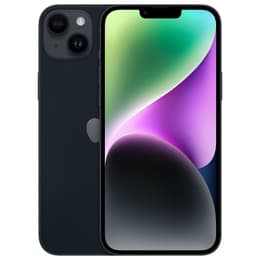
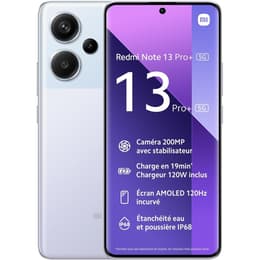


iPhone 14 Plus Vs Xiaomi Redmi Note 13 Pro+

iPhone 14 Plus
iPhone 14 Plus
Starting at

Refurbished price:317.00

Versus €879.00 new

See options
Xiaomi Redmi Note 13 Pro+
Starting at

Refurbished price:201.00

Versus €449.00 new

See options

Ratings

The iPhone 14 Plus, released in October 2022, and the Xiaomi Redmi Note 13 Pro+, launched in late 2023 and early 2024, represent distinct approaches to smartphone design and functionality. While both offer large displays and robust feature sets, they cater to different user ecosystems and prioritize varying aspects of the mobile experience. The iPhone 14 Plus operates on Apple's iOS, known for its integrated ecosystem, whereas the Redmi Note 13 Pro+ runs on Android with Xiaomi's HyperOS overlay, offering more customization.

Scores

Durability

When considering the practical lifespan of these devices, several factors come into play, including software support, physical durability, and repairability.

  • Software Longevity: The iPhone 14 Plus launched with iOS 16 and typically receives major iOS updates for approximately 5-6 years from its release. The Xiaomi Redmi Note 13 Pro+ launched with Android 13 and is expected to receive 3 major Android upgrades and 4 years of security updates. This suggests a longer software support window for the iPhone.
  • Physical Durability: Both devices feature robust build materials. The iPhone 14 Plus incorporates a Ceramic Shield front and an aluminum frame, offering IP68 water and dust resistance, allowing submersion up to 6 meters for 30 minutes. The Redmi Note 13 Pro+ also boasts an IP68 rating, protecting against dust and water immersion up to 1.5 meters for 30 minutes, and uses Corning Gorilla Glass Victus for screen protection.
  • Repairability: While specific repairability scores can vary by region and independent assessments, Apple has made efforts to improve the repairability of its recent iPhone models. Information on the Redmi Note 13 Pro+'s repairability is less widely detailed, but its design and component availability may influence the ease and cost of repairs.

Year of Release

2022

2023

Compatible with latest Update

Yes

Yes

OS

iOS

Android

Foldable

No

No

Performance

The performance of a smartphone is crucial for daily tasks, from casual browsing to demanding applications and gaming. Both devices offer capable hardware designed for smooth operation.

  • Processing Power: The iPhone 14 Plus is equipped with a powerful processor that handles demanding applications and multitasking smoothly, ensuring a responsive user experience. The Xiaomi Redmi Note 13 Pro+ features a current-generation chipset that provides very good performance for its category, feeling fast and smooth in daily use and capable for advanced tasks and gaming.
  • Multitasking and Storage: The iPhone 14 Plus comes with 6GB of RAM and offers storage options up to 512GB. The Redmi Note 13 Pro+ offers more varied RAM configurations, including 8GB, 12GB, and even 16GB, paired with storage options up to 512GB, which can be beneficial for extensive multitasking and storing large files. However, the Redmi Note 13 Pro+ does not support expandable storage.
  • Battery Behavior: The iPhone 14 Plus is noted for its excellent battery life, often lasting 1.5 to 2 days on a single charge with up to 26 hours of video playback. It supports fast wired charging and 15W wireless charging. The Redmi Note 13 Pro+ has a larger battery capacity, typically offering about 1.5 days (36 hours) of use, though some reviews suggest its active use battery life is average. A key feature of the Redmi is its 120W HyperCharge, capable of fully charging the device in under 25 minutes.

Memory (GB)

6 GB

12 GB

Screen quality

The display is a primary interface for smartphone interaction, and both devices offer large, vibrant screens designed for an immersive viewing experience.

  • Display Technology and Clarity: Both smartphones feature large OLED displays. The iPhone 14 Plus has a 6.7-inch Super Retina XDR OLED display with a resolution of 2778x1284 pixels, resulting in a pixel density of 458 ppi. The Redmi Note 13 Pro+ features a 6.67-inch CrystalRes AMOLED display with a resolution of 2712x1220 pixels and a pixel density of 446 ppi. Both offer deep blacks and vibrant colors characteristic of OLED technology.
  • Brightness and Refresh Rate: The iPhone 14 Plus offers a typical maximum brightness of 800 nits and a peak HDR brightness of 1200 nits, with a standard 60Hz refresh rate. The Redmi Note 13 Pro+ provides a higher peak brightness of 1800 nits and an adaptive refresh rate of up to 120Hz, which contributes to smoother scrolling and a more fluid visual experience.
  • Viewing Experience: The Redmi Note 13 Pro+ supports Dolby Vision and HDR10+, enhancing the dynamic range and color accuracy for compatible content. While the iPhone 14 Plus also supports HDR, its 60Hz refresh rate means that users accustomed to higher refresh rates on other devices might notice a difference in smoothness.

Resolution

1284 x 2778

1220 x 2712

Screen type

Super Retina XDR OLED

AMOLED

Audiovisual

Camera capabilities are a significant consideration for many users, and both devices offer advanced systems for capturing photos and videos.

  • Rear Camera Systems: The iPhone 14 Plus features a dual-camera system with two 12MP lenses: a main wide-angle camera with a f/1.5 aperture and sensor-shift optical image stabilization (OIS), and an ultrawide camera with a f/2.4 aperture. The Redmi Note 13 Pro+ boasts a triple-camera setup, highlighted by a 200MP main sensor with OIS and a f/1.65 aperture, an 8MP ultrawide camera, and a 2MP macro lens. The Redmi's main camera uses pixel binning technology to produce detailed 12.5MP photos.
  • Photography Performance: The iPhone 14 Plus benefits from Apple's Photonic Engine for improved low-light performance and overall image processing. While the Redmi Note 13 Pro+ offers a high-resolution main sensor, some reviews suggest its camera processing could benefit from refinement, though it is capable of good photo and video output. The iPhone 14 Plus does not include a telephoto lens, relying on digital zoom. The Redmi Note 13 Pro+ offers 2x/4x lossless zoom, which is digital.
  • Video and Audio: The iPhone 14 Plus supports 4K video recording at up to 60 frames per second and includes an Action Mode for enhanced video stabilization. Both devices offer capable video recording, and the Redmi Note 13 Pro+ features stereo speakers with Dolby Atmos support for an enhanced audio experience. The iPhone 14 Plus also has a 12MP front camera with autofocus. The Redmi Note 13 Pro+ has a 16MP front camera.

Main camera

12 megapixels

200 megapixels

Front camera

12 megapixels

16 megapixels

Miscellaneous

Beyond core performance and display, various practical features contribute to the overall user experience and device utility.

  • Connectivity and Ports: Both smartphones support 5G cellular connectivity, Wi-Fi 6, and Bluetooth 5.3. The iPhone 14 Plus utilizes a Lightning port for charging and data transfer, while the Redmi Note 13 Pro+ features a USB-C port. Notably, the iPhone 14 Plus models sold in the US exclusively use eSIM technology, without a physical SIM card tray. The Redmi Note 13 Pro+ offers dual SIM support, either with two nano SIMs or a nano SIM and an eSIM. The Redmi Note 13 Pro+ does not include a 3.5mm headphone jack.
  • Biometric Security and Sensors: The iPhone 14 Plus relies on Face ID for secure authentication. The Redmi Note 13 Pro+ incorporates an in-screen fingerprint sensor and AI Face Unlock. Both devices include a range of sensors such as accelerometers, gyroscopes, and compasses. The iPhone 14 Plus also features advanced safety capabilities like Crash Detection and Emergency SOS via satellite.
  • Design and Handling: The iPhone 14 Plus measures 160.8 x 78.1 x 7.8 mm and weighs 203 grams. The Redmi Note 13 Pro+ has dimensions of 161.4 x 74.2 x 8.9 mm and weighs around 199g to 204.5g, depending on the back material. The iPhone 14 Plus has an aluminum frame and glass back, while the Redmi Note 13 Pro+ offers options for a glass or silicone polymer (eco-leather) back.

Weight

150 g

204 g

Screen size (in)

6.7

6.67

Network

5G

5G

SIM card

eSIM

Dual Physical SIM

Carrier compatibility

Unlocked

Unlocked

User feedback for the iPhone 14 Plus often highlights its exceptional battery life and large, vibrant display as significant advantages. Users appreciate the consistent performance and the reliability of the iOS ecosystem. Common criticisms include the 60Hz refresh rate, which some find less fluid compared to devices with higher refresh rates, and the absence of a telephoto camera.

For the Xiaomi Redmi Note 13 Pro+, users frequently praise its high-resolution display with a 120Hz refresh rate, its rapid 120W charging capability, and its overall performance for a device in its category. Some users note that while the 200MP camera is impressive on paper, the image processing could be improved, and the battery life, despite the large capacity, is sometimes described as average for active use.

Users prioritizing a long-lasting battery, a large display within a familiar and integrated software ecosystem, and advanced safety features may find the iPhone 14 Plus well-suited to their needs. Conversely, users who value a high refresh rate display, extremely fast charging, and a more customizable Android experience with potentially more RAM options might lean toward the Xiaomi Redmi Note 13 Pro+. Both devices offer compelling features, and choosing between them often comes down to individual preferences regarding operating system, camera priorities, and charging speed. For those considering a more sustainable choice, both models are available as quality-assured refurbished options, extending their lifecycle and reducing electronic waste.

See all articles

Our recent comparisons