

Google Pixel 9 Pro XL Vs Xiaomi Redmi Note 13 Pro+

Google Pixel 9 Pro XL
Starting at

Refurbished price:423.00

Versus €1,298.07 new

See options
Xiaomi Redmi Note 13 Pro+
Starting at

Refurbished price:198.00

Versus €449.00 new

See options

Ratings

The Google Pixel 9 Pro XL, a flagship smartphone released in 2024, and the Xiaomi Redmi Note 13 Pro+, an upper mid-range device launched in late 2023, offer distinct experiences for users. While the Pixel 9 Pro XL emphasizes a refined software experience and advanced computational photography, the Redmi Note 13 Pro+ focuses on a feature-rich package with rapid charging and a high-resolution main camera. Both devices operate on the Android platform, though with different user interfaces and update philosophies.

Scores

Durability

When considering the long-term usability of these smartphones, their respective release timelines and software support policies are key differentiators.

  • Release Timeline: The Google Pixel 9 Pro XL, having been released in 2024, benefits from a more recent launch compared to the Xiaomi Redmi Note 13 Pro+, which debuted in late 2023. This difference in release year inherently provides the Pixel with a longer potential lifespan for receiving the latest software features and security patches.
  • Software Support: Google has committed to providing seven years of software updates, including Android OS upgrades, security updates, and regular Feature Drops, for its Pixel 8 and later series, extending support for the Pixel 9 Pro XL well into the future. In contrast, the Redmi Note 13 Pro+ is slated to receive three major Android OS updates and four years of security updates, with support ending around January 2028. This means the Pixel 9 Pro XL offers significantly extended software longevity.
  • Durability Features: Both devices incorporate robust build materials. The Pixel 9 Pro XL features Gorilla Glass Victus 2 for display protection and an IP68 rating for dust and water resistance. The Redmi Note 13 Pro+ also boasts an IP68 rating and Corning Gorilla Glass Victus protection for its display.

Year of Release

2024

2023

Compatible with latest Update

Yes

Yes

OS

Android

Android

Foldable

No

No

Performance

The performance capabilities of these two smartphones cater to different user expectations, influenced by their internal hardware and software optimization.

  • Processor Capabilities: The Google Pixel 9 Pro XL is powered by a Google Tensor G4 processor, designed to handle demanding applications and multitasking smoothly, with a focus on AI-driven features. Users report that even in 2026, the Tensor G4 in the Pixel 9 Pro XL performs well for daily use, social media, browsing, and light gaming, with overall smooth performance. The Xiaomi Redmi Note 13 Pro+ utilizes a MediaTek Dimensity 7200-Ultra processor, which delivers high-speed output for a smooth mobile gaming experience and efficient multitasking.
  • Memory and Storage: The Pixel 9 Pro XL often comes with 16GB of RAM, providing ample capacity for intensive multitasking and future AI features. The Redmi Note 13 Pro+ is available with up to 12GB of RAM and 512GB of storage, allowing for fast app execution and significant media storage.
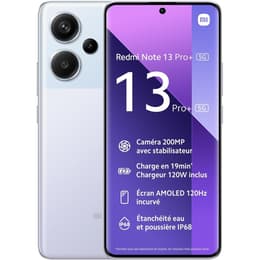
  • Battery Behavior: The Pixel 9 Pro XL is equipped with a battery capacity exceeding 5000mAh, designed to last through a full day of normal use. The Redmi Note 13 Pro+ features a 5000mAh battery, with users reporting around 1.5 days or 36 hours of use on a single charge. The Redmi also supports 120W HyperCharge, enabling very rapid charging times.

Memory (GB)

16 GB

12 GB

Screen quality

The visual experience on both devices is delivered through advanced display technologies, each offering distinct characteristics.

  • Display Technology and Size: The Google Pixel 9 Pro XL features a large 6.8-inch Super Actua LTPO OLED display, providing adaptive refresh rates and vibrant visuals. The Xiaomi Redmi Note 13 Pro+ comes with a 6.67-inch AMOLED display, also offering rich colors and deep blacks.
  • Resolution and Clarity: The Pixel 9 Pro XL's display boasts a resolution of 2992 x 1344 pixels, contributing to a sharp and detailed viewing experience. The Redmi Note 13 Pro+ offers a 2712 x 1220 pixel resolution, resulting in a pixel density of 446 PPI for clear images.
  • Brightness and Smoothness: The Pixel 9 Pro XL's screen can reach a peak brightness of up to 3000 nits, ensuring excellent visibility even in bright outdoor conditions. It also features a 1-120Hz adaptive refresh rate for smooth scrolling and responsiveness. The Redmi Note 13 Pro+ has a peak brightness of 1800 nits and a 120Hz refresh rate, providing fluid animations and good outdoor readability.

Resolution

1344 x 2992

1220 x 2712

Screen type

LTPO OLED

AMOLED

Audiovisual

Both smartphones offer capable camera systems, though with different approaches to imaging and feature sets.

  • Main Camera System: The Google Pixel 9 Pro XL is equipped with a triple camera setup, including a 50-megapixel main sensor, a 48-megapixel ultrawide unit, and a 48-megapixel telephoto lens with 5x optical zoom. The Xiaomi Redmi Note 13 Pro+ features a 200-megapixel main camera with optical image stabilization (OIS), an 8-megapixel ultrawide camera, and a 2-megapixel macro camera.
  • Photography Performance: The Pixel 9 Pro XL is known for its computational photography, delivering sharp photos with natural colors, good dynamic range, and excellent detail, particularly in portrait mode and low-light conditions. The Redmi Note 13 Pro+'s 200MP main sensor captures sharp images with rich colors and good dynamic range, performing well in good lighting and offering decent night mode results.
  • Video Recording and Audio: The Pixel 9 Pro XL supports video recording up to 8K at 30 frames per second, along with 4K and 1080p options, benefiting from OIS and EIS for stabilization. The Redmi Note 13 Pro+ can record videos in 4K at 30 frames per second, with OIS and EIS providing good stabilization. Both devices offer stereo speakers for an enhanced media consumption experience.

Main camera

50 megapixels

200 megapixels

Front camera

42 megapixels

16 megapixels

Miscellaneous

Beyond core specifications, several practical elements contribute to the overall user experience of these devices.

  • Connectivity and Ports: Both the Pixel 9 Pro XL and the Redmi Note 13 Pro+ support 5G connectivity, along with modern Wi-Fi standards and Bluetooth for wireless connections. The Pixel 9 Pro XL features a USB-C port, while the Redmi Note 13 Pro+ also uses USB-C for charging and data transfer.
  • Biometric Security: The Pixel 9 Pro XL offers an under-display ultrasonic fingerprint scanner and secure face unlock. The Redmi Note 13 Pro+ also includes an in-display fingerprint sensor for convenient unlocking.
  • Design and Handling: The Pixel 9 Pro XL has a premium build with a glass back and metal frame, weighing around 221 grams. The Redmi Note 13 Pro+ features a harmonious aesthetic, with some variants offering an eco-leather back and a curved display, weighing approximately 204.5 grams.

Weight

221 g

204 g

Screen size (in)

6.8

6.67

Network

5G

5G

SIM card

Physical SIM + eSIM

Dual Physical SIM

Carrier compatibility

Unlocked

Unlocked

The Google Pixel 9 Pro XL and the Xiaomi Redmi Note 13 Pro+ cater to different user priorities, each excelling in specific areas. Users frequently praise the Pixel 9 Pro XL for its exceptional camera capabilities, particularly its computational photography and consistent image quality across various conditions. Its long-term software support, extending for seven years, is also a significant advantage, ensuring the device remains current and secure for an extended period. Some users, however, might find its charging speed to be less rapid compared to competitors.

The Redmi Note 13 Pro+ is often lauded for its vibrant display, remarkably fast 120W charging, and a capable 200-megapixel main camera. Users appreciate its overall performance for daily tasks and light gaming. Criticisms sometimes point to the secondary cameras (ultrawide and macro) being less impressive than the main sensor, and some users have noted occasional software jankiness or battery drain issues after certain updates, though the fast charging mitigates this for many.

Users prioritizing a top-tier camera experience, a clean Android interface, and industry-leading software longevity will find the Google Pixel 9 Pro XL well-suited to their needs. Conversely, individuals who value a feature-rich device with an excellent display, extremely fast charging, and a high-resolution main camera may lean towards the Xiaomi Redmi Note 13 Pro+. Both devices offer compelling options, and considering a quality-assured refurbished option for either model can provide a sustainable choice for consumers.


See all articles

Our recent comparisons