

Google Pixel 8 Pro Vs Google Pixel Fold

Google Pixel 8 Pro
Google Pixel 8 Pro
Starting at

Refurbished price:329.00

Versus €1,099.00 new

See options
Google Pixel Fold
Google Pixel Fold
Starting at

Refurbished price:499.00

Versus €1,750.29 new

See options

Ratings

The Google Pixel 8 Pro, released in October 2023, and the Google Pixel Fold, launched in June 2023, represent distinct approaches to the modern smartphone experience. While both devices operate on the Android platform and offer Google's signature software features, their primary differentiation lies in their form factor: the Pixel 8 Pro is a traditional slab smartphone, whereas the Pixel Fold introduces a foldable design. This fundamental difference impacts everything from display usage to overall portability and user interaction.

Scores

Durability

The expected lifespan of a smartphone is significantly influenced by its software support and physical resilience. Both the Pixel 8 Pro and Pixel Fold offer robust software commitments, though with differing durations.

  • Software Updates: The Google Pixel 8 Pro is set to receive seven years of operating system and security updates, extending its software longevity until at least 2030. In contrast, the Google Pixel Fold is guaranteed five years of updates, with support continuing until at least 2028. This difference means the Pixel 8 Pro will benefit from new features and security patches for a longer period.
  • Physical Durability: The Pixel 8 Pro features Gorilla Glass Victus 2 for its display and an IP68 rating for dust and water resistance, indicating a high level of protection against environmental elements. The Pixel Fold, with its innovative design, uses Gorilla Glass Victus on its cover screen and ultra-thin glass for its internal folding display, alongside an IPX8 water resistance rating. However, the folding mechanism introduces a unique point of potential vulnerability, and some early user reports noted concerns regarding the durability of the inner screen.
  • Repairability: Repairability scores for the Pixel 8 Pro generally indicate a decent level of ease for certain repairs, with some sources giving it a score of 7 out of 10, similar to some other flagship devices. Information on the Pixel Fold's repairability is less widely detailed, but the complex folding mechanism typically suggests a more intricate repair process compared to traditional smartphones.

Performance

Both devices are powered by Google's custom-designed processors, offering smooth performance for daily tasks, though they feature different generations of this technology.

  • Processing Power: The Pixel 8 Pro is equipped with a newer generation processor, which provides enhanced capabilities for demanding applications, advanced computational photography, and overall system responsiveness. The Pixel Fold utilizes the previous generation processor, which still delivers a capable experience for multitasking and running various applications, but may not match the peak performance of the newer chip in highly intensive scenarios.
  • Multitasking and Responsiveness: Both devices come with 12GB of RAM, allowing for efficient multitasking and smooth transitions between applications. Users can expect quick app loading times and fluid navigation on both. The Pixel Fold's larger internal display, when unfolded, offers a more expansive canvas for running two applications side-by-side, enhancing productivity for certain workflows.
  • Battery Behavior: The Pixel 8 Pro houses a 5050 mAh battery, which generally provides all-day power for most users, with some reports indicating it can last through heavy use. The Pixel Fold has a 4821 mAh battery. Given its dual-screen setup and larger overall display area when unfolded, its battery life can vary more significantly depending on usage patterns, particularly how often the larger internal screen is utilized.

Memory (GB)

12 GB

12 GB

Screen quality

The display experience is a major distinguishing factor between these two Pixel devices, primarily due to the Pixel Fold's unique form factor.

  • Display Technology and Clarity: The Pixel 8 Pro features a 6.7-inch LTPO OLED display with a resolution of 1344 x 2992 pixels, offering sharp visuals and deep blacks. The Pixel Fold offers two OLED displays: a 5.8-inch cover display with a resolution of 1080 x 2092 pixels and a 7.6-inch internal folding display with a resolution of 1840 x 2208 pixels. The internal display provides a tablet-like viewing experience when unfolded.
  • Brightness and Refresh Rate: The Pixel 8 Pro's display can reach a peak brightness of up to 2400 nits, making it highly visible even in bright outdoor conditions. It also features an adaptive refresh rate that can scale from 1Hz to 120Hz for smooth scrolling and power efficiency. The Pixel Fold's cover display offers up to 1550 nits peak brightness, while its internal display reaches up to 1450 nits. Both screens support a 120Hz refresh rate, with the internal display capable of dynamically adjusting its refresh rate for battery conservation.
  • Viewing Experience: The Pixel 8 Pro provides a consistent, high-quality viewing experience on a single, expansive screen. The Pixel Fold offers versatility, allowing users to choose between a traditional smartphone experience on the cover display or an immersive, larger canvas when unfolded, which is particularly beneficial for media consumption or productivity. The internal folding screen does have a visible crease, which is more noticeable in certain lighting conditions.

Audiovisual

Both Pixel devices are known for their advanced computational photography, delivering high-quality images, but their camera hardware has some differences.

  • Camera System Configuration: The Pixel 8 Pro features a triple camera system on the rear, consisting of a 50MP main sensor, a 48MP ultrawide sensor, and a 48MP telephoto lens with 5x optical zoom. The Pixel Fold also has a triple camera setup, with a 48MP main sensor, a 10.8MP ultrawide, and a 10.8MP telephoto lens offering 5x optical zoom. The Pixel 8 Pro's ultrawide and telephoto sensors have higher megapixel counts.
  • Photography Performance: The Pixel 8 Pro's camera system benefits from a newer processor and improved sensors, leading to enhanced low-light performance, better dynamic range, and more detailed images across its lenses. It also introduces a Pro mode for more manual control. The Pixel Fold's cameras are highly praised for their balanced image quality and Google's image processing, often compared favorably to other flagship foldables, especially for its 5x optical zoom.
  • Video and Audio: Both devices are capable of recording high-quality video, with the Pixel 8 Pro offering improvements in video stabilization and overall quality. The Pixel 8 Pro's front camera also features autofocus, which can enhance selfie quality. Both devices provide a good media consumption experience with capable speakers, though the Pixel Fold's larger internal screen offers a more immersive visual for video playback.

Miscellaneous

Beyond core performance and display, several practical elements contribute to the overall user experience of these devices.

  • Connectivity and Ports: Both the Pixel 8 Pro and Pixel Fold support 5G connectivity, modern Wi-Fi standards (including Wi-Fi 6 for the Fold and Wi-Fi 7 for the 8 Pro), and Bluetooth 5.3. They both utilize a USB-C port for charging and data transfer. Neither device includes a traditional 3.5mm headphone jack.
  • Biometrics and Security: The Pixel 8 Pro features an optical in-screen fingerprint sensor for secure unlocking. The Pixel Fold incorporates a fingerprint sensor integrated into its power button. Both devices also offer face recognition for convenient access.
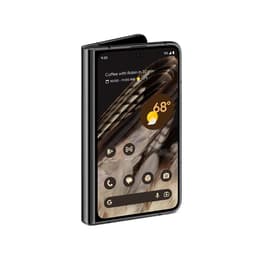
  • Physical Characteristics: The Pixel 8 Pro measures 162.6 x 76.5 x 8.8 mm and weighs 213 grams, offering a substantial yet manageable feel. The Pixel Fold, due to its folding design, has different dimensions when folded (139.7 x 79.5 x 12.1 mm) and unfolded (139.7 x 158.7 x 5.8 mm). It is heavier at 283 grams. The Pixel Fold's wider cover screen provides a more comfortable one-handed typing experience compared to some other foldables.
  • Build Materials: The Pixel 8 Pro uses a glass back (Corning Gorilla Glass Victus 2) and an aluminum frame. The Pixel Fold features Gorilla Glass Victus on its cover and back, with an ultra-thin glass cover for the internal display.

Screen size (in)

6.7

7.6

Network

5G

5G

SIM card

Physical SIM + eSIM

Physical SIM + eSIM

Carrier compatibility

Unlocked

Unlocked

User sentiment for the Google Pixel 8 Pro often highlights its exceptional camera capabilities, with many praising its ability to produce consistently high-quality photos, especially in challenging conditions. Its long software support commitment is also a significant positive. Some common criticisms include battery life being considered average compared to some competitors, and occasional connectivity issues.

For the Google Pixel Fold, users frequently commend its innovative foldable design, which offers a versatile large screen experience for multitasking and media consumption. The camera system is also generally well-received for a foldable device. However, concerns have been raised regarding the durability of the internal screen and the visible crease.

Users prioritizing a traditional smartphone experience with a top-tier camera system, extended software longevity, and robust overall performance will find the Google Pixel 8 Pro well-suited to their needs. Its consistent performance and long-term support make it a reliable choice for those who prefer a conventional form factor.

Conversely, users who value a highly versatile device that can transform from a compact smartphone to a larger tablet-like screen for enhanced productivity and immersive media will likely lean towards the Google Pixel Fold. Its unique design caters to those seeking a different kind of mobile experience, despite the trade-offs in terms of weight and potential durability concerns related to the folding screen. Both devices offer a quality-assured refurbished option, providing an eco-friendly alternative for consumers.