

Google Pixel 6A Vs iPhone SE (2020)

Google Pixel 6A
Google Pixel 6A
Starting at

Refurbished price:143.00

Versus €459.00 new

See options
iPhone SE (2020)
iPhone SE (2020)
Starting at

Refurbished price:97.00

Versus €319.00 new

See options

Ratings

The Google Pixel 6A, released in July 2022, and the iPhone SE 2020, launched in April 2020, represent distinct approaches to smartphone design and user experience. While both offer capable performance for everyday tasks, they cater to different preferences through their respective operating systems and hardware philosophies. Key differentiators include their display technologies, camera systems, and overall design aesthetics.

Scores

Durability

When considering the practical lifespan of these devices, both offer robust software support, though their timelines differ due to their release dates and manufacturer policies.

  • Release Timeline: The Google Pixel 6A was released in July 2022, making it a newer device compared to the iPhone SE 2020, which launched in April 2020. This difference in age inherently provides the Pixel 6A with a longer remaining period of official support.
  • Software Longevity: The Pixel 6A is expected to receive Android OS updates until at least July 2025 and security updates until at least July 2027. The iPhone SE 2020, running on iOS, typically receives major OS upgrades for 5 to 7 years from its release, suggesting support could extend until around 2025 to 2027.
  • Build and Protection: Both devices feature an IP67 rating for dust and water resistance, offering protection against splashes and submersion. The Pixel 6A uses Gorilla Glass 3 for its display protection, while the iPhone SE 2020 features ion-strengthened glass.

Year of Release

2022

2020

Compatible with latest Update

Yes

Yes

OS

Android

iOS

Foldable

No

No

Performance

Both smartphones deliver strong performance for daily use, but they achieve this through different hardware and software optimizations.

  • Processing Power: The Google Pixel 6A is equipped with a processor designed by Google, which handles demanding applications and multitasking smoothly. This processor is optimized for artificial intelligence tasks, enhancing features like photography and voice recognition. The iPhone SE 2020 features a powerful chip that ensures a responsive user experience, capable of running current applications and games without significant slowdowns.
  • Multitasking and Storage: The Pixel 6A comes with 6GB of RAM, contributing to efficient multitasking. It offers 128GB of internal storage, which is not expandable. The iPhone SE 2020 includes 3GB of RAM and is available with storage options of 64GB, 128GB, or 256GB, also without expandable storage.
  • Battery Behavior: The Pixel 6A houses a 4410 mAh battery, generally providing enough power to last a full day for many users under moderate usage. The iPhone SE 2020 has a smaller 1821 mAh battery, which may require more frequent charging, especially for heavy users or those who stream media extensively.

Memory (GB)

6 GB

3 GB

Screen quality

The visual experience on these two devices presents a clear distinction, primarily due to their display technologies and physical dimensions.

  • Display Technology and Size: The Google Pixel 6A features a 6.1-inch OLED display, offering vibrant colors, deep blacks, and excellent contrast. In contrast, the iPhone SE 2020 has a smaller 4.7-inch IPS LCD display, which provides good color accuracy but does not achieve the same level of contrast or black depth as an OLED panel.
  • Resolution and Clarity: The Pixel 6A's screen has a resolution of 2400 x 1080 pixels, resulting in sharp and clear visuals. The iPhone SE 2020 offers a resolution of 1334 x 750 pixels, which is still clear for its size but has a lower pixel density compared to the Pixel 6A.
  • Refresh Rate: Both devices feature a standard 60Hz refresh rate, meaning the screen updates 60 times per second. This provides a smooth experience for most everyday interactions, though it does not offer the enhanced fluidity seen on devices with higher refresh rates.

Resolution

1080 x 2400

750 x 1334

Screen type

OLED

Retina IPS LCD

Audiovisual

Both smartphones are capable of capturing quality images, but they employ different hardware and software strategies for photography and video.

  • Rear Camera System: The Google Pixel 6A features a dual-camera setup on the rear, consisting of a 12.2MP main lens and a 12MP ultrawide lens. Its strength lies in Google's computational photography, which enhances image quality, particularly in challenging lighting conditions with features like Night Sight and Magic Eraser. The iPhone SE 2020 is equipped with a single 12MP wide-angle camera. It performs well in optimal lighting and includes features like Portrait mode, but it lacks an ultrawide lens and a dedicated Night Mode.
  • Video Recording: Both devices are capable of recording 4K video at up to 60 frames per second, offering detailed and smooth video capture.
  • Front Camera: The Pixel 6A has an 8MP front-facing camera, while the iPhone SE 2020 features a 7MP front camera. Both are suitable for video calls and selfies in good lighting.

Main camera

12.2 megapixels

12 megapixels

Front camera

8 megapixels

7 megapixels

Miscellaneous

Beyond core performance and display, several practical elements differentiate these two devices in terms of daily usability and design.

  • Connectivity and Ports: The Google Pixel 6A supports 5G connectivity and features Wi-Fi 6E and Bluetooth 5.2, along with a USB-C port for charging and data transfer. The iPhone SE 2020 supports 4G LTE connectivity, Wi-Fi 6, and Bluetooth 5.0, utilizing Apple's proprietary Lightning port.
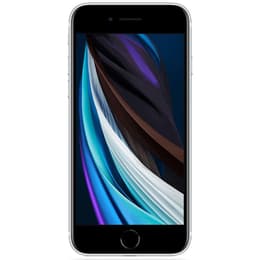
  • Biometric Authentication: The Pixel 6A incorporates an in-display fingerprint sensor for secure unlocking. The iPhone SE 2020 retains the classic home button with Touch ID, a physical fingerprint sensor.
  • Design and Handling: The Pixel 6A has a modern design with a plastic back and an aluminum frame, weighing 178g. The iPhone SE 2020 features a more traditional design with a glass front and back, an aluminum frame, and a lighter weight of 148g, making it more compact. The Pixel 6A does not include a headphone jack.

Weight

178 g

148 g

Screen size (in)

6.1

4.7

Network

5G

4G

SIM card

Physical SIM + eSIM

Physical SIM + eSIM

Carrier compatibility

Unlocked

Unlocked

Connector

USB-C

Lightning

The Google Pixel 6A and iPhone SE 2020 offer distinct experiences, each with its own set of strengths that appeal to different user priorities. Users often praise the Pixel 6A for its exceptional camera capabilities, robust performance, and vibrant OLED display. Its battery life is generally considered reliable for a full day of use. Common observations include its 60Hz display and the absence of wireless charging as areas where it differs from some other devices.

Conversely, the iPhone SE 2020 is frequently lauded for its compact form factor, the familiarity and reliability of its Touch ID sensor, and its powerful processor within a smaller design. However, users sometimes note its smaller LCD screen, which is less vibrant than OLED alternatives, and a battery life that may require more frequent charging for heavy usage. Its single camera system, while capable in good light, lacks the versatility of multi-lens setups and a dedicated Night Mode.

Users prioritizing a modern Android experience, a versatile camera system with advanced computational photography, a larger and more vibrant OLED screen, and generally longer battery life may find the Google Pixel 6A better suited to their needs. On the other hand, users who prefer a compact iOS device, appreciate the classic iPhone design with a physical home button and Touch ID, and value consistent performance for everyday tasks within a smaller footprint, may lean toward the iPhone SE 2020. Both devices represent quality-assured options, and considering a refurbished model can be an eco-friendly alternative for either choice.


See all articles

Our recent comparisons