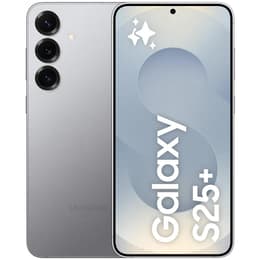
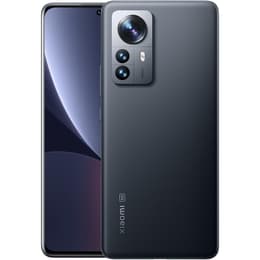


Galaxy S25+ Vs Xiaomi 12T Pro

Galaxy S25+
Galaxy S25+
Starting at

Refurbished price:624.00

Versus €1,401.57 new

See options
Xiaomi 12T Pro
Xiaomi 12T Pro
Starting at

Refurbished price:201.00

Versus €1,199.00 new

See options

Ratings

The Samsung Galaxy S25 Plus, released in February 2025, and the Xiaomi 12T Pro, launched in October 2022, are both Android smartphones designed to offer robust performance and advanced features. While the Galaxy S25 Plus represents a more recent generation of flagship technology, the Xiaomi 12T Pro aimed to deliver high-end specifications at its release. Key differentiators between these devices include their release timelines, display resolutions, and camera system configurations, influencing their long-term software support and overall user experience.

Scores

Durability

The age of a device significantly impacts its expected lifespan, particularly concerning software updates and hardware longevity. The Samsung Galaxy S25 Plus, being a newer model, benefits from an extended support window compared to the Xiaomi 12T Pro.

  • Software Support: The Galaxy S25 Plus launched with Android 15 and is promised 7 years of OS and security updates, with support extending into 2032. The Xiaomi 12T Pro, initially running Android 12, typically receives fewer major OS updates, with an expected 3 years of OS updates and security patches.
  • Hardware Durability: The Galaxy S25 Plus features Gorilla Glass Victus 2 for enhanced screen protection and an IP68 rating for significant dust and water resistance. The Xiaomi 12T Pro uses Gorilla Glass 5 on its front and has an IP53 rating, offering protection against dust and splashes.
  • Repairability: The Galaxy S25 Plus has been noted for its relatively high repairability, scoring 9/10 in some assessments, partly due to improved internal design elements like an easier-to-remove battery and the use of standard Philips screws. Information on the Xiaomi 12T Pro's repairability is less widely detailed, but its construction is generally considered standard for its release period.

Year of Release

2025

2022

Compatible with latest Update

Yes

Yes

OS

Android

Android

Foldable

No

No

Performance

Performance is a critical aspect for daily use, affecting everything from app responsiveness to demanding tasks like gaming and video editing. The difference in release dates between these two devices translates to a notable gap in their processing capabilities.

  • Processing Power: The Galaxy S25 Plus is equipped with a current-generation processor, the Snapdragon 8 Elite for Galaxy, which offers substantial improvements in CPU and GPU performance, as well as enhanced AI capabilities. The Xiaomi 12T Pro features the Snapdragon 8+ Gen 1, a powerful processor from its release year, capable of handling demanding applications and multitasking smoothly.
  • Multitasking and Storage: The Galaxy S25 Plus comes with 12GB of RAM as standard, paired with storage options of 256GB or 512GB. The Xiaomi 12T Pro offers configurations with 8GB or 12GB of RAM and 128GB or 256GB of UFS 3.1 storage.
  • Battery Behavior: The Galaxy S25 Plus houses a 4900 mAh battery, providing reliable power for a full day of typical use, with some users reporting over 14 hours of video playback. The Xiaomi 12T Pro features a larger 5000 mAh battery, which also delivers extended usage, with reports of up to 14 hours and 26 minutes of daily use.

Memory (GB)

12 GB

8 GB

Screen quality

The display is a primary interface for users, and both devices offer vibrant viewing experiences, though with differences in resolution and brightness.

  • Display Technology and Resolution: The Galaxy S25 Plus features a 6.7-inch Dynamic AMOLED 2X display with a sharp 3120 x 1440 pixel (QHD+) resolution, resulting in a high pixel density of approximately 513 ppi. The Xiaomi 12T Pro has a 6.67-inch AMOLED display with a 2712 x 1220 pixel (1.5K) resolution and a pixel density of around 446 ppi.
  • Brightness and Smoothness: The Galaxy S25 Plus boasts a peak brightness of 2600 nits, ensuring excellent visibility even in bright outdoor conditions, and an adaptive refresh rate that scales from 1Hz to 120Hz for smooth scrolling and power efficiency. The Xiaomi 12T Pro offers a peak brightness of 900 nits and a 120Hz adaptive refresh rate, providing a fluid visual experience.
  • Viewing Experience: Both phones provide vibrant colors and deep blacks characteristic of AMOLED panels. The higher resolution and peak brightness of the Galaxy S25 Plus contribute to a slightly more detailed and impactful visual experience, particularly for high-resolution content.

Resolution

1440 x 3120 pixels

1220 x 2712

Audiovisual

Both smartphones feature capable camera systems, but they approach photography with different hardware configurations and software enhancements.

  • Rear Camera Systems: The Galaxy S25 Plus includes a versatile triple camera setup: a 50 MP main sensor with optical image stabilization (OIS) and autofocus, a 12 MP ultra-wide camera, and a 10 MP telephoto lens with 3x optical zoom and OIS. The Xiaomi 12T Pro highlights a 200 MP main camera with OIS, an 8 MP ultra-wide lens, and a 2 MP macro camera.
  • Photography Performance: The Galaxy S25 Plus benefits from advanced AI processing (Pro Visual Engine) for improved object recognition, color reproduction, and low-light performance, offering consistent results across its lenses. The Xiaomi 12T Pro's 200 MP main sensor excels in capturing high detail, especially in well-lit conditions, and uses pixel-binning technology for better low-light shots.
  • Video and Audio: The Galaxy S25 Plus supports 8K video recording at 30 frames per second from its main camera, with 4K available from other lenses. The Xiaomi 12T Pro also offers 8K video recording at 24 frames per second. For audio, the Xiaomi 12T Pro features dual speakers tuned by Harman Kardon with Dolby Atmos support, providing a rich media consumption experience.

Front camera

12MP

20 megapixels

Miscellaneous

Beyond core specifications, several practical features contribute to the overall usability and convenience of these devices.

  • Connectivity and Ports: Both phones support 5G connectivity and modern Wi-Fi standards for fast internet access. The Galaxy S25 Plus features a USB-C port and supports wireless charging and reverse wireless charging. The Xiaomi 12T Pro also uses a USB-C port but lacks wireless charging capabilities.
  • Biometrics and Sensors: Both devices incorporate in-display fingerprint sensors for secure unlocking. The Galaxy S25 Plus also includes advanced facial recognition. The Xiaomi 12T Pro includes an IR blaster, a feature not commonly found on many modern smartphones, allowing it to control various home appliances.
  • Design and Handling: The Galaxy S25 Plus measures 158.4 x 75.8 x 7.3 mm and weighs 190g, offering a slim profile. The Xiaomi 12T Pro is slightly larger and heavier at 163.1 x 75.9 x 8.6 mm and 205g, featuring a glass-and-metal body with a matte finish.

Weight

190 g

204 g

Screen size (in)

6.7

6.67

Network

5G

5G

SIM card

Physical SIM + eSIM

Dual Physical SIM

Carrier compatibility

Unlocked

Unlocked

The Samsung Galaxy S25 Plus and Xiaomi 12T Pro cater to different user priorities, largely influenced by their release dates and respective design philosophies. Users frequently praise the Galaxy S25 Plus for its long software support, vibrant QHD+ display, and advanced AI features that enhance both performance and camera capabilities. Some common criticisms for the S25 Plus have included its design being similar to previous generations and the absence of a charger in the box.

The Xiaomi 12T Pro, while older, is often lauded for its exceptionally fast 120W wired charging, large battery capacity, and its high-resolution 200 MP main camera, which offers impressive detail in good lighting. User feedback sometimes points to the lack of wireless charging and a less robust IP rating as areas where it falls short compared to newer flagships.

Users prioritizing long-term software support, a higher-resolution display, and a more refined camera system with optical zoom across lenses may find the Samsung Galaxy S25 Plus well-suited to their needs. Its newer processor also provides a performance edge for future-proofing. Conversely, individuals who value rapid battery replenishment, a large battery for extended use, and a high-megapixel main camera for detailed shots might lean towards the Xiaomi 12T Pro. Both devices, especially the Xiaomi 12T Pro due to its age, are available as quality-assured refurbished options, providing an eco-friendly alternative for consumers.


See all articles

Our recent comparisons