
Galaxy A53 5G Vs Xiaomi Redmi Note 14 Pro

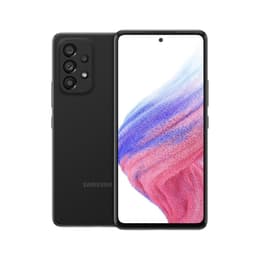
Galaxy A53 5G
Galaxy A53 5G
Starting at

Refurbished price:118.00

Versus €459.00 new

See options
Xiaomi Redmi Note 14 Pro
Starting at

Refurbished price:260.77

Versus €349.99 new

See options

Ratings

The Samsung Galaxy A53 5G, released in March 2022, and the Xiaomi Redmi Note 14 Pro, which saw a global launch in January 2025, are both smartphones designed to offer a comprehensive mobile experience. While the Galaxy A53 5G focuses on a balanced feature set with strong software support, the Redmi Note 14 Pro emphasizes advanced display technology and a high-resolution camera system. Both devices operate on the Android platform, providing users with a wide ecosystem of applications and services.

Scores

Durability

When considering the long-term usability of these devices, their release timelines and software support policies are key factors.

  • Release and Software Support: The Samsung Galaxy A53 5G, launched in March 2022, shipped with Android 12 and is guaranteed to receive four major OS upgrades and five years of security updates, extending its support until approximately March 2027. The Xiaomi Redmi Note 14 Pro, globally launched in January 2025, comes with Android 14 and is expected to receive three OS updates and four years of security updates, projecting support until January 2029. This means the Redmi Note 14 Pro offers a longer period of official software updates from its release date.
  • Repairability and Durability: The Galaxy A53 5G is considered relatively repairable, with some sources giving it a repairability score of around 6.75 to 7.5 out of 10. It features Corning Gorilla Glass 5 for screen protection and an IP67 rating for dust and water resistance, meaning it can withstand immersion in up to 1 meter of fresh water for 30 minutes. The Redmi Note 14 Pro is equipped with Corning Gorilla Glass Victus 2 for enhanced screen durability. Its dust and water resistance rating is cited as IP64 by some official specifications, indicating splash resistance, while other reviews mention IP68, suggesting more robust water immersion protection.
  • Practical Lifespan: Users prioritizing extended software longevity might find the Redmi Note 14 Pro's newer release date and subsequent update cycle appealing. However, Samsung's commitment to four OS upgrades for the A53 5G provides a substantial period of feature and security updates for a device released earlier. Both phones are built with materials and certifications aimed at providing a practical lifespan suitable for daily use over several years.

Performance

The performance of a smartphone is crucial for daily tasks, from app usage to multitasking and gaming.

  • Processing Capabilities: The Samsung Galaxy A53 5G is powered by an internal processor that handles everyday applications and general multitasking smoothly. While it offers a noticeable improvement over its predecessor, some users have reported occasional sluggishness or issues during demanding gaming sessions. The Xiaomi Redmi Note 14 Pro features a more recent processor designed for stable midrange performance, ensuring smooth operation for a variety of applications and casual gaming.
  • Storage and Multitasking: The Galaxy A53 5G is available with 128GB or 256GB of internal storage and supports expandable storage up to 1TB via a microSD card, offering flexibility for users with large media libraries. It comes with 6GB or 8GB of RAM. The Redmi Note 14 Pro offers storage options of 128GB, 256GB, or 512GB, paired with 8GB or 12GB of RAM, providing ample space and memory for efficient multitasking and storing numerous applications and files. It also supports expandable storage up to 1TB through a hybrid SIM slot.
  • Battery Behavior: Both devices are equipped with substantial battery capacities. The Galaxy A53 5G has a 5000mAh battery, which typically provides over a day of use even for heavy users. It supports 25W fast charging. The Redmi Note 14 Pro features a larger 5500mAh battery, designed to comfortably last a full day with mixed usage, aided by its efficient processor. It supports 45W turbo charging, and a compatible charger is included in the box.

Memory (GB)

4 GB

8 GB

Screen quality

The display is a primary interface for any smartphone, influencing the visual experience for all content.

  • Display Technology and Clarity: The Samsung Galaxy A53 5G features a 6.5-inch Super AMOLED display, known for its deep blacks and vibrant colors, with a Full HD+ resolution of 1080x2400 pixels. The Xiaomi Redmi Note 14 Pro boasts a slightly larger 6.67-inch AMOLED panel, offering a sharper 1.5K resolution (1220x2712 pixels) for enhanced detail.
  • Brightness and Smoothness: Both phones offer a smooth viewing experience with a 120Hz refresh rate. The Galaxy A53 5G reaches a peak brightness of 800 nits, providing good visibility in various lighting conditions. The Redmi Note 14 Pro significantly surpasses this with a peak brightness of up to 3000 nits, ensuring excellent legibility even in bright outdoor sunlight.
  • Protection and Viewing Experience: The Galaxy A53 5G's display is protected by Corning Gorilla Glass 5. The Redmi Note 14 Pro features the more advanced Corning Gorilla Glass Victus 2, offering superior scratch and drop resistance. Both displays provide a rich and immersive viewing experience, with the Redmi Note 14 Pro offering a slight edge in sharpness and outdoor visibility.

Audiovisual

For many users, the camera system is a decisive factor, capturing everyday moments and special occasions.

  • Rear Camera Systems: The Samsung Galaxy A53 5G is equipped with a versatile quad-camera setup, including a 64MP main camera with optical image stabilization (OIS), a 12MP ultrawide lens, a 5MP macro lens, and a 5MP depth sensor. The main camera uses pixel binning to produce detailed 16MP images. The Xiaomi Redmi Note 14 Pro features a triple-camera system, highlighted by a 200MP main sensor with OIS, an 8MP ultrawide camera, and a 2MP macro lens. Its main sensor utilizes 16-in-1 pixel binning to create large 2.24µm pixels for improved light capture.
  • Photography Performance: The Galaxy A53 5G's main camera performs well in bright conditions, producing vibrant and clear photos, and OIS assists in dimmer environments. The ultrawide camera is considered decent, and the macro lens is usable. The Redmi Note 14 Pro's 200MP main sensor is designed for high-detail photography, particularly benefiting from its large pixel-binned output in various lighting.
  • Video and Front Camera: Both phones support video recording up to 4K at 30 frames per second with their main rear cameras. The Galaxy A53 5G has a 32MP front-facing camera capable of 4K@30fps video. The Redmi Note 14 Pro offers a 20MP or 32MP front camera (depending on the variant) with 1080p@30fps video recording.

Miscellaneous

Beyond core specifications, several practical elements contribute to the overall user experience.

  • Connectivity and Ports: Both smartphones offer 5G connectivity for fast mobile data. The Galaxy A53 5G supports Wi-Fi 802.11 a/b/g/n/ac and Bluetooth 5.1. It features a USB Type-C 2.0 port and lacks a 3.5mm headphone jack. The Redmi Note 14 Pro supports Wi-Fi 6 (802.11ax) and Bluetooth 5.3, offering more advanced wireless standards. It also includes a USB Type-C port, and some variants may retain a 3.5mm headphone jack.
  • Sensors and Security: Both devices incorporate an in-display optical fingerprint sensor for secure unlocking. They also include standard sensors like an accelerometer, gyroscope, and compass. The Redmi Note 14 Pro additionally features an IR Blaster, which allows it to function as a universal remote control.
  • Design and Handling: The Galaxy A53 5G measures 159.6 x 74.8 x 8.1 mm and weighs 189 grams, featuring a plastic back and a Gorilla Glass 5 front. The Redmi Note 14 Pro has dimensions of approximately 162.3 x 74.4 x 8.2 mm and weighs around 180-190 grams, with a design that may include glass or vegan leather finishes and Gorilla Glass Victus 2 on the front. Both phones offer a comfortable in-hand feel, with the Redmi Note 14 Pro potentially offering a more premium tactile experience depending on the back panel material.

Screen size (in)

6.5

6.67

Network

5G

4G

SIM card

Physical SIM

Dual Physical SIM

Carrier compatibility

Unlocked

Unlocked

The Samsung Galaxy A53 5G and the Xiaomi Redmi Note 14 Pro cater to users seeking capable smartphones within the mid-range segment, each with distinct strengths. User sentiment for the Galaxy A53 5G often praises its vibrant AMOLED display, reliable battery life that can extend beyond a day, and Samsung's commitment to long-term software updates. Its camera system is generally well-regarded for producing good photos in adequate lighting, with the benefit of optical image stabilization. However, some users have noted that its processing performance can be sluggish at times, particularly with demanding applications or games.

The Xiaomi Redmi Note 14 Pro, being a more recent release, garners positive feedback for its advanced display, featuring a higher resolution and significantly brighter panel, making it excellent for media consumption and outdoor visibility. Its larger battery capacity and faster charging are also frequently highlighted as strong points, ensuring extended usage. The high-resolution main camera is appreciated for its detail capture. Potential criticisms might revolve around the regional variations in specifications, which can lead to confusion, and the presence of a 2MP macro camera, which some users find less useful than higher-resolution alternatives.

Users prioritizing a device with a proven track record of consistent software updates and a balanced, reliable performance for everyday tasks may find the Samsung Galaxy A53 5G well-suited to their needs. Its robust IP67 rating also adds a layer of reassurance for durability. Conversely, individuals who place a premium on cutting-edge display technology, superior brightness for outdoor use, a larger battery with faster charging, and a more recent camera sensor for detailed photography might lean towards the Xiaomi Redmi Note 14 Pro. Both devices represent quality-assured refurbished options, offering an eco-friendly alternative for consumers looking to make informed and sustainable choices.


See all articles

Our recent comparisons