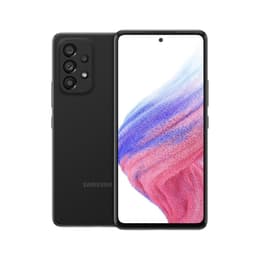



Galaxy A53 5G Vs OnePlus 10 Pro

Galaxy A53 5G
Galaxy A53 5G
Starting at

Refurbished price:119.00

Versus €459.00 new

See options
OnePlus 10 Pro
OnePlus 10 Pro
Starting at

Refurbished price:228.00

Versus €999.00 new

See options

Ratings

The Samsung Galaxy A53 5G and the OnePlus 10 Pro, both released in early 2022, represent distinct offerings within the Android smartphone market. The Galaxy A53 5G is positioned as a capable mid-range device, while the OnePlus 10 Pro offers a more premium, flagship-tier experience. Both operate on the Android platform, but they cater to different user priorities through their hardware and software approaches. Key differences emerge in their processing power, display technology, and camera systems.

Scores

Durability

The practical lifespan and software support differ between these two devices, influencing their long-term usability.

  • Software Updates: The Galaxy A53 5G benefits from Samsung's commitment to four major Android OS updates and five years of security patches, extending its software longevity up to Android 16 and security updates until 2027. The OnePlus 10 Pro typically receives three major Android OS updates and four years of security updates, with Android 16 being its last major OS update.
  • Physical Durability: The Galaxy A53 5G features a plastic back and Gorilla Glass 5 on the front, along with an IP67 rating for dust and water resistance, protecting it from immersion in up to 1 meter of water for 30 minutes. The OnePlus 10 Pro uses Gorilla Glass Victus on the front and Gorilla Glass 5 on the back, with an aluminum frame, but lacks an official IP rating for most global variants. Some durability tests have also indicated structural weaknesses in the OnePlus 10 Pro, particularly in bend tests.
  • Expected Lifespan: Users prioritizing the longest possible software support will find the Galaxy A53 5G more appealing due to its extended update policy. Both devices are built for daily use, but the A53's official water resistance provides an additional layer of protection against environmental elements.

Year of Release

2022

2022

Compatible with latest Update

Yes

Yes

OS

Android

Android

Foldable

No

No

Performance

The performance capabilities of the Galaxy A53 5G and the OnePlus 10 Pro cater to different levels of demand, impacting daily responsiveness and handling of intensive tasks.

  • Everyday Responsiveness: The OnePlus 10 Pro offers significantly faster app loading, smoother transitions, and more fluid multitasking due to its high-end processor. The Galaxy A53 5G provides a capable experience for general use and common applications, though it may exhibit slower performance with very demanding apps or graphically intensive games.
  • Storage and RAM: The Galaxy A53 5G is available with 128GB or 256GB of internal storage and supports microSD card expansion for additional space. The OnePlus 10 Pro offers larger internal storage options, including 128GB, 256GB, and 512GB, but does not support expandable storage. Both devices come with ample RAM configurations to handle typical multitasking.
  • Battery Behavior: Both phones feature a 5000mAh battery capacity. The OnePlus 10 Pro supports faster wired charging at 80W (65W in North America) and 50W wireless charging, allowing for quicker power replenishment. The Galaxy A53 5G supports 25W fast charging.

Memory (GB)

4 GB

8 GB

Screen quality

The visual experience on the Galaxy A53 5G and the OnePlus 10 Pro differs in terms of clarity, color reproduction, and overall smoothness.

  • Display Technology: The Galaxy A53 5G features a 6.5-inch Super AMOLED display, known for its vibrant colors and deep blacks. The OnePlus 10 Pro boasts a larger 6.7-inch LTPO2 Fluid AMOLED display, which offers more advanced adaptive refresh rate technology and higher peak brightness.
  • Resolution and Clarity: The OnePlus 10 Pro provides a sharper viewing experience with its higher resolution display (1440x3216 pixels), making text and images appear crisper. The Galaxy A53 5G offers a Full HD+ resolution (1080x2400 pixels), which is clear for most content consumption.
  • Brightness and Smoothness: Both devices feature a 120Hz refresh rate for smooth scrolling and animations. The OnePlus 10 Pro can reach a higher peak brightness of 1300 nits, improving visibility in bright outdoor conditions, compared to the Galaxy A53 5G's 800 nits HBM.

Resolution

1080 x 2400

1440 x 3216

Screen type

Super AMOLED

LTPO2 Fluid AMOLED

Audiovisual

The camera systems of these two smartphones offer different strengths for photography and videography.

  • Rear Camera System: The Galaxy A53 5G features a versatile quad-camera setup with a 64 MP main sensor with optical image stabilization (OIS), a 12 MP ultrawide, and dedicated 5 MP macro and 5 MP depth sensors. The OnePlus 10 Pro, co-developed with Hasselblad, offers a triple camera system with a 48 MP main sensor with OIS, a 50 MP ultrawide with a very wide field of view, and an 8 MP telephoto lens with 3.3x optical zoom.
  • Photography Performance: The OnePlus 10 Pro generally excels in detail, color accuracy, and low-light performance, particularly with its main and ultrawide sensors, and offers greater versatility with its telephoto lens. The Galaxy A53 5G performs well in daylight conditions, producing good images, but its low-light performance is considered average. Some users have noted the OnePlus 10 Pro lacks a dedicated macro mode.
  • Video and Audio: Both phones are capable of recording high-quality video. The OnePlus 10 Pro offers advanced video features and generally good microphone quality for calls and recordings. The Galaxy A53 5G also provides good video performance, though some reviews suggest it is less impressive in low light. Both devices offer stereo speakers for media consumption.

Main camera

64 megapixels

48 megapixels

Front camera

32 megapixels

32 megapixels

Miscellaneous

Beyond core specifications, several practical elements contribute to the overall user experience of these devices.

  • Connectivity and Ports: Both the Galaxy A53 5G and OnePlus 10 Pro support 5G connectivity, along with modern Wi-Fi standards and Bluetooth. The Galaxy A53 5G uses a USB-C 2.0 port, while the OnePlus 10 Pro also features a USB-C port, with some variants offering faster data transfer speeds. Neither device includes a traditional 3.5mm headphone jack.
  • Biometric Security: Both smartphones incorporate an under-display optical fingerprint sensor for secure unlocking.
  • Design and Handling: The Galaxy A53 5G is slightly lighter at 189g and has dimensions of 159.6 x 74.8 x 8.1 mm. The OnePlus 10 Pro is a bit heavier at 200.5g and measures 163 x 73.9 x 8.55 mm. The A53 5G features a flat display, while the 10 Pro has a curved screen, which some users find enhances the in-hand feel.

Weight

189 g

201 g

Screen size (in)

6.5

6.7

Network

5G

5G

SIM card

Physical SIM

Physical SIM

Carrier compatibility

Unlocked

Unlocked

Connector

USB-C

USB-C

The Samsung Galaxy A53 5G and the OnePlus 10 Pro cater to different user expectations and budgets. User feedback for the Galaxy A53 5G often praises its vibrant display, reliable battery life for casual use, and its IP67 water resistance. Criticisms sometimes point to its mid-range performance, which might not satisfy users with demanding applications or intensive gaming habits, and its average low-light camera performance.

The OnePlus 10 Pro is frequently lauded for its powerful performance, excellent display quality, and fast charging capabilities. However, some users have reported concerns regarding its long-term software stability, potential for performance degradation over time, and its notable fragility in durability tests.

Users prioritizing extended software support, official water and dust resistance, and expandable storage for a balanced everyday experience may find the Galaxy A53 5G well-suited to their needs. Conversely, users who value top-tier processing power for gaming and demanding tasks, a higher-resolution display, and very fast charging will likely lean towards the OnePlus 10 Pro. Both devices offer compelling features, and choosing between them depends on which aspects align best with individual usage patterns. For those considering a more sustainable choice, both models are available as quality-assured refurbished options, providing an eco-friendly alternative to purchasing new.


See all articles

Our recent comparisons