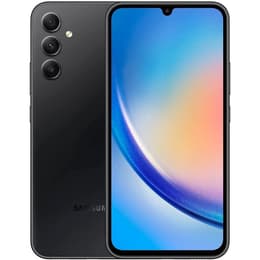


Galaxy A34 Vs Xiaomi Redmi Note 14 4G

Galaxy A34
Galaxy A34
Starting at

Refurbished price:135.00

Versus €399.00 new

See options
Xiaomi Redmi Note 14 4G
Starting at

Refurbished price:155.00

Versus €259.00 new

See options

Ratings

The Samsung Galaxy A34, released in March 2023, and the Xiaomi Redmi Note 14 4G, launched in January 2025, are both smartphones designed to offer a comprehensive user experience. While the Galaxy A34 provides 5G connectivity and a robust water resistance rating, the Redmi Note 14 4G enters the market with a newer operating system, a larger battery, and a higher-resolution main camera. Both devices run on the Android operating system, offering access to a wide ecosystem of applications and services.

Scores

Durability

When considering the long-term usability of a smartphone, factors like release date, software support, and physical durability play a significant role. The Galaxy A34 and Redmi Note 14 4G present different profiles in these areas.

  • Release Timeline: The Samsung Galaxy A34 was released in March 2023, making it a more established device. The Xiaomi Redmi Note 14 4G, launched in January 2025, benefits from being a newer model, potentially offering a longer period before its hardware feels outdated.
  • Software Longevity: The Galaxy A34 launched with Android 13 and is expected to receive several years of Android and security updates, aligning with Samsung's typical support policy for its A-series devices. The Redmi Note 14 4G launched with Android 14 and is anticipated to receive up to four major Android upgrades, suggesting a comparable or potentially longer software support window due to its later release.
  • Physical Durability: The Galaxy A34 features an IP67 rating for dust and water resistance, meaning it can withstand submersion in up to 1 meter of freshwater for 30 minutes. The Redmi Note 14 4G offers an IP54 rating, providing protection against dust and splashes from any direction, but not full submersion. Both devices utilize Corning Gorilla Glass 5 for screen protection.

Year of Release

2023

2025

OS

Android

Android

Foldable

No

No

Performance

The performance of a smartphone is crucial for daily tasks, from browsing and social media to more demanding applications and gaming. Both the Galaxy A34 and Redmi Note 14 4G are equipped to handle everyday usage, though with some distinctions in their underlying capabilities.

  • Processor Capabilities: The Galaxy A34 is powered by a processor that handles demanding apps and multitasking smoothly, providing a responsive experience for most users. The Redmi Note 14 4G features a newer generation processor designed for efficient performance in its category, ensuring smooth operation for general use and moderate gaming.
  • Storage and Multitasking: Both devices offer various configurations, typically including 6GB or 8GB of RAM and 128GB or 256GB of internal storage, with expandable storage options via microSDXC. This allows for ample space for apps and media, and sufficient RAM for effective multitasking.
  • Battery Performance: The Galaxy A34 is equipped with a 5000 mAh battery, which users often report as providing excellent battery life, lasting through a full day of typical use. It supports 25W fast charging. The Redmi Note 14 4G comes with a larger 5500 mAh battery and supports faster 33W wired charging, potentially offering extended usage times and quicker recharges.

Memory (GB)

6 GB

6 GB

Screen quality

The display is a primary interface for any smartphone, and both the Galaxy A34 and Redmi Note 14 4G offer vibrant viewing experiences with modern display technologies.

  • Display Technology and Clarity: Both smartphones feature Super AMOLED or AMOLED displays, which are known for producing deep blacks, high contrast, and vibrant colors. They both offer Full HD+ resolutions (1080 x 2340 pixels for A34, 1080 x 2400 pixels for Redmi Note 14 4G), resulting in sharp and clear visuals for text, images, and videos.
  • Refresh Rate and Smoothness: Both devices boast a 120Hz refresh rate, which contributes to smoother scrolling, fluid animations, and a more responsive feel during interactions and gaming.
  • Brightness and Size: The Galaxy A34 has a 6.6-inch display with a peak brightness of 1000 nits in high brightness mode, ensuring good visibility outdoors. The Redmi Note 14 4G features a slightly larger 6.67-inch display and offers a higher peak brightness of up to 1800 nits (some sources indicate 2100 nits), which can further enhance outdoor readability.

Resolution

1080 x 2340

1080x2400

Screen type

Super AMOLED

AMOLED

Audiovisual

Camera capabilities are a significant consideration for many users, and both the Galaxy A34 and Redmi Note 14 4G provide versatile camera systems for capturing photos and videos.

  • Rear Camera System: The Galaxy A34 features a triple rear camera setup with a 48 MP main sensor with optical image stabilization (OIS), an 8 MP ultrawide lens, and a 5 MP macro lens. The Redmi Note 14 4G also has a triple rear camera system, highlighted by a 108 MP main sensor with OIS, complemented by 2 MP macro and 2 MP depth sensors.
  • Photography Performance: The Galaxy A34's main camera delivers sharp images with good HDR performance, and its OIS helps in producing clearer shots. The Redmi Note 14 4G's high-resolution main sensor can capture detailed images in good lighting, though some user feedback suggests its additional macro and depth sensors may be less impactful.
  • Video Recording: The Galaxy A34 supports 4K video recording at 30 frames per second (fps) with its main and front cameras, and 1080p at 30/60fps. The Redmi Note 14 4G records video at a maximum of 1080p at 30/60fps for its rear camera and 1080p at 30fps for the front camera, lacking 4K capability.

Miscellaneous

Beyond the core features, several practical elements contribute to the overall user experience of these smartphones.

  • Connectivity: The Samsung Galaxy A34 offers 5G connectivity, providing access to faster mobile data speeds where available. The Xiaomi Redmi Note 14 4G is a 4G-only device, which may be a consideration for users prioritizing the latest network speeds. Both support Wi-Fi 802.11 a/b/g/n/ac and Bluetooth 5.3.
  • Ports and Sensors: The Galaxy A34 features a USB-C port for charging and data transfer and an optical in-screen fingerprint sensor for secure unlocking. The Redmi Note 14 4G also includes a USB Type-C port, a 3.5mm headphone jack, and an in-display fingerprint reader.
  • Design and Handling: The Galaxy A34 has dimensions of 161.3 x 78.1 x 8.2 mm and weighs 199 g. The Redmi Note 14 4G is slightly larger and lighter at 163.25 x 76.55 x 8.16 mm and 196.5 g. Both devices feature a plastic back and frame, with Gorilla Glass 5 protecting the display.

Weight

199 g

196 g

Screen size (in)

6.6

6.67

Network

5G

4G

SIM card

Dual Physical SIM

Physical SIM + eSIM

Carrier compatibility

Unlocked

Unlocked

The Samsung Galaxy A34 and Xiaomi Redmi Note 14 4G cater to users with slightly different priorities, reflecting their respective release timelines and design philosophies. User feedback for the Galaxy A34 often praises its excellent battery life, vibrant display, and stable software experience, with some noting its capable performance for its segment. Criticisms sometimes point to its thicker bezels and the performance of its fingerprint scanner.

For the Redmi Note 14 4G, common praise highlights its appealing OLED screen, the inclusion of a 3.5mm headphone jack, and its large battery capacity. However, some users express that the camera performance, particularly the utility of its secondary lenses and the lack of 4K video recording, could be improved.

Users prioritizing 5G connectivity, a higher water resistance rating (IP67), and a proven track record of software stability may find the Samsung Galaxy A34 a suitable choice. Conversely, those who value a newer device with a larger battery, faster charging, a brighter display, and the convenience of a 3.5mm headphone jack might lean towards the Xiaomi Redmi Note 14 4G. Both devices offer a solid Android experience, and considering a quality-assured refurbished option for either model can be an eco-friendly alternative for making an informed purchasing decision.

See all articles

Our recent comparisons