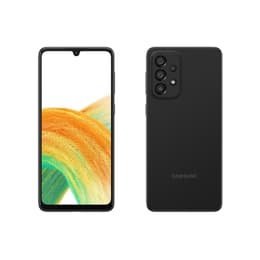
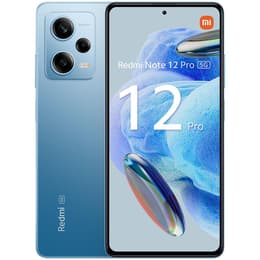


Galaxy A33 5G Vs Xiaomi Redmi Note 12 Pro

Galaxy A33 5G
Galaxy A33 5G
Starting at

Refurbished price:100.00

Versus €389.00 new

See options
Xiaomi Redmi Note 12 Pro
Starting at

Refurbished price:106.00

Versus €399.00 new

See options

Ratings

The Samsung Galaxy A33 5G, released in 2022, and the Xiaomi Redmi Note 12 Pro, launched in late 2022 and early 2023, are both smartphones designed for everyday use. While both devices offer 5G connectivity and vibrant displays, they present different approaches to software longevity, charging speeds, and camera capabilities. Both run on the Android operating system, but their respective manufacturer interfaces and update policies vary.

Scores

Durability

The expected lifespan of a smartphone is significantly influenced by its software support and physical durability. These two devices offer different commitments in terms of updates and varying levels of protection against environmental factors.

  • Software Support: The Samsung Galaxy A33 5G was launched with Android 12 and is guaranteed to receive four major Android OS updates and five years of security patches, extending its software relevance significantly. The Xiaomi Redmi Note 12 Pro also launched with Android 12 and MIUI 13, but its update policy is less extensive, with some reports indicating it will receive its final major update (HyperOS 2, based on Android 15) in late 2025, and generally offers two major OS updates and three years of security patches.
  • Physical Durability: The Galaxy A33 5G features an IP67 rating, indicating a higher level of resistance to dust and water immersion compared to the Redmi Note 12 Pro's IP53 rating, which offers protection against dust and splashes. Both devices utilize Corning Gorilla Glass 5 for screen protection, offering similar resistance against scratches and minor drops.
  • Repairability: The Samsung Galaxy A33 5G has a repairability score of 7.75 out of 10, suggesting it is relatively straightforward to disassemble for repairs. Information on the Redmi Note 12 Pro's repairability is less detailed, though the Redmi Note 12 Pro Plus 5G, a closely related model, has a score of 6.5.

Year of Release

2022

2022

Compatible with latest Update

Yes

No

OS

Android

Android

Foldable

No

No

Performance

Performance in daily tasks, from app navigation to more demanding applications, is a key consideration for users. Both devices are equipped with octa-core processors designed for mid-range performance, but their real-world responsiveness can differ.

  • System Responsiveness: The Galaxy A33 5G is powered by an octa-core processor, which handles everyday applications and multitasking smoothly, though some users have noted occasional choppiness when navigating the interface or opening apps. The Redmi Note 12 Pro also features an octa-core processor, which provides capable performance for general use, but some users have reported instances of laggy user interfaces and occasional freezing, particularly with resource-intensive applications.
  • Multitasking and Storage: Both phones offer configurations with 6GB or 8GB of RAM, allowing for efficient multitasking. The Galaxy A33 5G comes with 128GB or 256GB of internal storage and includes a microSD card slot for expandable storage. The Redmi Note 12 Pro offers 128GB or 256GB of internal storage, with some variants also providing 12GB of RAM, but it does not support expandable storage via a microSD card.
  • Battery Behavior: Both devices are equipped with 5000mAh batteries, designed to provide ample power for a full day of use. The Redmi Note 12 Pro supports significantly faster wired charging at 67W, capable of reaching a substantial charge in a short period, while the Galaxy A33 5G supports 25W fast charging.

Memory (GB)

6 GB

8 GB

Screen quality

The display is a primary interface for smartphone interaction, and both the Galaxy A33 5G and Redmi Note 12 Pro offer high-quality viewing experiences with distinct characteristics.

  • Display Technology and Clarity: Both smartphones feature AMOLED display technology, known for producing deep blacks and vibrant colors. They both offer a Full HD+ resolution (1080x2400 pixels), ensuring sharp and clear visuals for text and images.
  • Smoothness and Size: The Redmi Note 12 Pro provides a smoother scrolling and viewing experience with its 120Hz refresh rate on a 6.67-inch display. The Galaxy A33 5G features a 90Hz refresh rate on a slightly smaller 6.4-inch display, which still offers a fluid experience for most users.
  • Brightness and Viewing Experience: Both displays offer good brightness levels for outdoor visibility. The Redmi Note 12 Pro also supports Dolby Vision and HDR10+, enhancing the contrast and color accuracy for compatible content.

Resolution

1080 x 2400

1080 x 2400

Screen type

Super AMOLED

AMOLED

Audiovisual

For many users, the camera system is a crucial aspect of a smartphone. Both the Galaxy A33 5G and Redmi Note 12 Pro offer versatile camera setups, each with specific strengths for capturing photos and videos.

  • Rear Camera System: The Galaxy A33 5G features a quad-camera setup with a 48MP main sensor that includes optical image stabilization (OIS), an 8MP ultrawide lens, a 5MP macro lens, and a 2MP depth sensor. The Redmi Note 12 Pro has a triple-camera system, highlighted by a 50MP main sensor with OIS (Sony IMX766), an 8MP ultrawide lens, and a 2MP macro lens.
  • Photography Performance: The Galaxy A33 5G's main camera is capable of producing social-media-ready photos, with its 5MP macro lens offering more detail for close-up shots compared to typical 2MP macro cameras. The Redmi Note 12 Pro's 50MP main sensor, particularly the Sony IMX766, is known for capturing detailed images, though some users have noted inconsistencies with AI and HDR processing.
  • Video Recording and Front Camera: Both devices are capable of recording video at up to 4K resolution at 30 frames per second with their main rear cameras. For selfies and video calls, the Galaxy A33 5G is equipped with a 13MP front camera, while the Redmi Note 12 Pro features a 16MP front camera.

Main camera

48 megapixels

50 megapixels

Front camera

13 megapixels

16 megapixels

Miscellaneous

Beyond the core features, several practical elements contribute to the overall user experience, including connectivity, physical design, and additional functionalities.

  • Connectivity and Ports: Both smartphones support 5G networks, Wi-Fi, and Bluetooth for wireless connectivity. The Galaxy A33 5G uses a USB Type-C port for charging and data transfer. The Redmi Note 12 Pro also features a USB Type-C port and includes a 3.5mm headphone jack, which is absent on the Galaxy A33 5G. The Redmi Note 12 Pro also includes an infrared (IR) blaster, a feature not found on the A33 5G.
  • Biometric Security: The Galaxy A33 5G incorporates an in-display optical fingerprint sensor for secure unlocking. The Redmi Note 12 Pro features a side-mounted fingerprint sensor. Both devices also offer face recognition capabilities.
  • Design and Handling: The Galaxy A33 5G weighs 186g and measures 159.7 x 74 x 8.1 mm. The Redmi Note 12 Pro is slightly larger and heavier at 187g and 163.0 x 76.0 x 8.0 mm. Both phones feature a glass front and a plastic frame, with the Redmi Note 12 Pro also having a glass back, contributing to a different in-hand feel.

Weight

186 g

187 g

Screen size (in)

6.4

6.67

Network

5G

5G

SIM card

Dual Physical SIM

Dual Physical SIM

Carrier compatibility

Unlocked

Unlocked

User feedback for the Samsung Galaxy A33 5G often highlights its reliable software support and IP67 water and dust resistance as strong points. Some users have noted that its performance can feel less fluid compared to some competitors, and there have been reports of battery drain after certain software updates and occasional heating during heavy use. The camera system is generally considered capable for casual photography.

The Xiaomi Redmi Note 12 Pro is frequently praised for its 120Hz AMOLED display and fast 67W charging. However, common criticisms include a less consistent software update policy, and some users have experienced issues such as a laggy user interface, overheating, and occasional camera software glitches, including background apps freezing when the camera is in use.

Users prioritizing long-term software support and a higher degree of water and dust resistance may find the Samsung Galaxy A33 5G to be a more suitable option. Its guaranteed four OS updates and five years of security patches offer extended longevity. Conversely, users who value a smoother display refresh rate, faster charging capabilities, and a slightly larger screen might lean towards the Xiaomi Redmi Note 12 Pro. Its inclusion of a 3.5mm headphone jack and IR blaster could also be a deciding factor for some. Both devices represent solid choices in the mid-range segment, and considering a quality-assured refurbished option for either model can be an eco-friendly alternative.


See all articles

Our recent comparisons