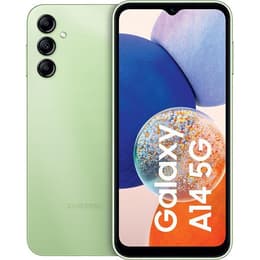



Galaxy A14 5G Vs Xiaomi Redmi Note 11 Pro 5G

Galaxy A14 5G
Galaxy A14 5G
Starting at

Refurbished price:102.00

Versus €289.00 new

See options
Xiaomi Redmi Note 11 Pro 5G
Starting at

Refurbished price:112.00

Versus €349.00 new

See options

Ratings

The Samsung Galaxy A14 5G, released in January 2023, and the Xiaomi Redmi Note 11 Pro 5G, launched in January 2022, are both smartphones designed for users seeking 5G connectivity. While the Galaxy A14 5G runs on Android 13 with One UI Core 5.0, the Redmi Note 11 Pro 5G debuted with Android 11 and MIUI 13. Key differentiators include their display technology and charging capabilities.

Scores

Durability

When considering the longevity of these devices, several factors come into play, including their release timelines, software support, and repairability.

  • Release Timeline: The Xiaomi Redmi Note 11 Pro 5G was released in January 2022, making it approximately a year older than the Samsung Galaxy A14 5G, which launched in January 2023. This difference in release date impacts the expected duration of software support.
  • Software Support: Samsung has committed to providing two major Android OS updates and four years of security updates for the Galaxy A14 5G. The Redmi Note 11 Pro 5G launched with Android 11 and MIUI 13, and while updates are expected, its older release date generally means a shorter remaining support window compared to the A14 5G.
  • Repairability: The Samsung Galaxy A14 5G has a notable repairability score of 8 out of 10, partly due to its user-friendly design that includes adhesive pull tabs for the battery, making replacements easier. Information regarding the specific repairability score for the Xiaomi Redmi Note 11 Pro 5G is not as readily available, though its construction typically involves standard smartphone assembly.

Year of Release

2023

2022

Compatible with latest Update

Yes

No

OS

Android

Android

Foldable

No

No

Performance

The performance of a smartphone is crucial for daily tasks, from app usage to multitasking and gaming. Both devices offer capabilities suited for general use, but with distinct characteristics.

  • Processor Capabilities: The Samsung Galaxy A14 5G is powered by a processor that delivers solid everyday performance, suitable for common applications and light usage. However, some users may notice lags or stutters during app opening and closing animations, particularly if they are accustomed to faster devices or engage in demanding tasks. The Xiaomi Redmi Note 11 Pro 5G features a processor that provides solid performance for day-to-day activities and multitasking, handling most apps without significant delays. While capable, it is not designed for flagship-level performance.
  • Storage and Responsiveness: Both devices offer various storage options, typically ranging from 64GB to 128GB, and support expandable storage via microSD cards up to 1TB, providing ample space for apps and media. The Galaxy A14 5G utilizes UFS 2.2 storage, which contributes to faster data access speeds. The Redmi Note 11 Pro 5G also uses UFS 2.2 storage.
  • Battery Behavior: Both smartphones are equipped with a 5000mAh battery, offering good battery life. The Galaxy A14 5G can last up to two days for moderate users. The Redmi Note 11 Pro 5G also provides excellent battery endurance, often lasting a full day even with heavy use, and potentially two days for lighter users. A significant difference lies in charging speed: the Redmi Note 11 Pro 5G supports 67W fast charging, capable of reaching 50% charge in about 15 minutes and a full charge in approximately 45 minutes, with the charger included in the box. The Galaxy A14 5G supports 15W wired charging, taking over two hours for a full charge, and does not include a charger.

Memory (GB)

4 GB

8 GB

Screen quality

The display is a primary interface for smartphone interaction, and both models offer different visual experiences.

  • Display Technology and Clarity: The Samsung Galaxy A14 5G features a 6.6-inch PLS LCD display with a resolution of 1080 x 2408 pixels (FHD+), providing decent sharpness and clarity for its category. The Xiaomi Redmi Note 11 Pro 5G boasts a 6.67-inch Super AMOLED display with a resolution of 1080 x 2400 pixels (FHD+). This technology typically offers deeper blacks and more vibrant colors compared to LCD panels.
  • Refresh Rate and Brightness: The Galaxy A14 5G has a 90Hz refresh rate, which provides a smoother scrolling experience compared to standard 60Hz panels. Its brightness is generally good indoors but can be challenging to view under harsh sunlight. The Redmi Note 11 Pro 5G features a higher 120Hz refresh rate, contributing to an even more fluid visual experience. It also offers higher peak brightness levels, reaching up to 1200 nits, which enhances visibility in bright outdoor conditions.
  • Screen Protection: The Redmi Note 11 Pro 5G includes Corning Gorilla Glass 5 for display protection. The Galaxy A14 5G does not specify a particular glass protection in the available information.

Resolution

1080 x 2408

1080 x 2400

Screen type

PLS LCD

Super AMOLED

Audiovisual

For many users, camera capabilities are a significant consideration, and both phones offer different photographic strengths.

  • Rear Camera Systems: The Samsung Galaxy A14 5G is equipped with a triple rear camera setup, featuring a 50MP main sensor, a 2MP macro lens, and a 2MP depth sensor. It notably lacks an ultrawide camera. The Xiaomi Redmi Note 11 Pro 5G also has a triple rear camera system, comprising a 108MP main sensor, an 8MP ultrawide lens, and a 2MP macro sensor.
  • Photography Performance: In good lighting conditions, the Galaxy A14 5G's main camera captures decent details and true-to-life colors, but its performance diminishes in low-light environments. The Redmi Note 11 Pro 5G's main camera also performs well in bright conditions, producing detailed images with vibrant colors. Its ultrawide camera can exhibit some softness and distortion at the edges. User reviews suggest the overall camera performance of the Redmi Note 11 Pro 5G can be considered adequate but not exceptional.
  • Video and Front Camera: Both devices support video recording at 1080p resolution at 30 frames per second from both their front and rear cameras. The Galaxy A14 5G features a 13MP front-facing camera, capable of good selfies in adequate lighting. The Redmi Note 11 Pro 5G has a 16MP front camera. Neither phone includes optical image stabilization (OIS) for their cameras.

Main camera

50 megapixels

108 megapixels

Front camera

13 megapixels

16 megapixels

Miscellaneous

Beyond core features, several practical elements contribute to the overall user experience of these smartphones.

  • Connectivity and Ports: Both the Galaxy A14 5G and the Redmi Note 11 Pro 5G support 5G connectivity and Wi-Fi 5 (802.11 a/b/g/n/ac). The Galaxy A14 5G uses Bluetooth 5.2, while the Redmi Note 11 Pro 5G uses Bluetooth 5.1. Both devices include a USB-C port for charging and data transfer, and notably, both retain a 3.5mm headphone jack. The Redmi Note 11 Pro 5G also features an IR blaster, allowing it to function as a universal remote control.
  • Sensors and Security: For security, both phones incorporate a side-mounted fingerprint sensor for convenient unlocking. They also include standard sensors such as an accelerometer, gyro, and proximity sensor.
  • Design and Durability Features: The Galaxy A14 5G has dimensions of 167.7 x 78.0 x 9.1 mm and weighs around 202-205g, featuring a textured plastic back. The Redmi Note 11 Pro 5G is slightly more compact at 164.2 x 76.1 x 8.1 mm and weighs 202g, with a glass back and plastic frame. The Redmi Note 11 Pro 5G also offers IP53 dust and splash resistance, providing a degree of protection against environmental elements.

Weight

201 g

202 g

Screen size (in)

6.6

6.67

Network

5G

5G

SIM card

Dual Physical SIM

Dual Physical SIM

Carrier compatibility

Unlocked

Unlocked

The Samsung Galaxy A14 5G and the Xiaomi Redmi Note 11 Pro 5G cater to users with varying priorities, each offering a distinct set of advantages.

Users often praise the Galaxy A14 5G for its extended software support, ensuring a longer period of security updates and Android version upgrades. Its repairability, highlighted by a high score and user-friendly design for battery replacement, is also a significant positive for those who value device longevity and maintenance. However, some users note that its performance can feel less responsive for demanding tasks, and the slower charging speed is a frequent point of criticism. The absence of an ultrawide camera is also a common concern.

Conversely, the Redmi Note 11 Pro 5G is frequently lauded for its vibrant Super AMOLED display with a high refresh rate, offering a superior visual experience, especially for media consumption. Its fast charging capability is a major highlight, allowing for quick power-ups. The inclusion of an ultrawide camera and an IR blaster also adds to its versatility. On the other hand, a common criticism is its launch with an older Android version, which can impact its overall software longevity compared to newer devices. Some users also find its general performance, while adequate, not as robust as some competitors.

Users prioritizing long-term software support and ease of repair may find the Samsung Galaxy A14 5G better suited to their needs. Its consistent updates and repair-friendly design make it a practical choice for those who intend to keep their device for an extended period. For individuals who value a superior display, rapid charging, and a more versatile camera system with an ultrawide lens, the Xiaomi Redmi Note 11 Pro 5G presents a compelling option. It is particularly well-suited for users who consume a lot of media or need quick battery top-ups throughout their day.

Both devices offer solid foundations for daily use, and considering a quality-assured refurbished option for either model can be an eco-friendly alternative to extend their lifecycle and make a sustainable choice.


See all articles

Our recent comparisons





