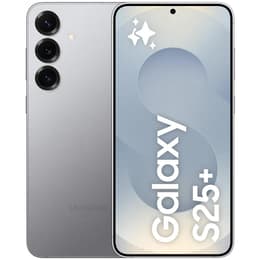
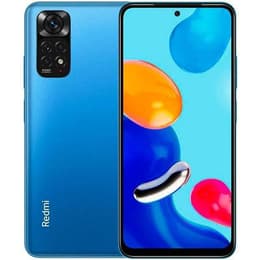


Galaxy S25+ Vs Xiaomi Redmi Note 11

Galaxy S25+
Galaxy S25+
Starting at

Refurbished price:624.00

Versus €1,401.57 new

See options
Xiaomi Redmi Note 11
Starting at

Refurbished price:108.00

Versus €249.99 new

See options

Ratings

The Samsung Galaxy S25 Plus, released in February 2025, and the Xiaomi Redmi Note 11, launched in January 2022, represent distinct segments within the smartphone market. While both devices operate on the Android platform, the Galaxy S25 Plus offers a more advanced and recent technological package, featuring a higher-tier processor and a more sophisticated camera system, whereas the Redmi Note 11 provides a capable experience with a focus on essential features.

Scores

Durability

The expected lifespan and software support differ significantly between these two devices due to their respective release timelines.

  • Release Timeline: The Samsung Galaxy S25 Plus, launched in February 2025, benefits from being a much newer device compared to the Xiaomi Redmi Note 11, which was released in January 2022. This age difference directly impacts their long-term usability.
  • OS Support: Samsung has committed to providing 7 years of operating system and security updates for the Galaxy S25 Plus, extending its software longevity until approximately 2032. The Redmi Note 11, initially running Android 11 with MIUI 13, has received updates to Xiaomi HyperOS based on Android 13, but its update cycle is shorter given its earlier release.
  • Repairability: The Galaxy S25 Plus has demonstrated a high repairability score of 9/10, featuring design elements like an improved battery pull pouch and the use of standard Philips screws, making component replacement more straightforward. The Redmi Note 11, while generally accessible for repairs, does not feature the same level of design considerations for ease of service.

Year of Release

2025

2022

Compatible with latest Update

Yes

No

OS

Android

Android

Foldable

No

No

Performance

Performance capabilities vary considerably, reflecting the different hardware generations and target user experiences.

  • Processor Capabilities: The Galaxy S25 Plus is equipped with a current-generation processor, enabling it to handle demanding applications, intensive multitasking, and graphic-rich games with smooth responsiveness. The Redmi Note 11 features a processor designed for efficient everyday use, capably managing common apps and general multitasking without significant delays.
  • System Responsiveness: Users of the Galaxy S25 Plus can expect a highly fluid and immediate response across the operating system and applications, benefiting from its advanced processing power and ample RAM. The Redmi Note 11 provides a responsive experience for its class, suitable for browsing, social media, and casual gaming.
  • Storage and Multitasking: The Galaxy S25 Plus typically offers 12GB of RAM and internal storage options of 256GB or 512GB, which is not expandable. This configuration supports extensive multitasking and storage for numerous applications and media. The Redmi Note 11 comes with 4GB or 6GB of RAM and 64GB or 128GB of internal storage, which can be expanded up to 1TB via a microSD card, offering flexibility for users who need more space for files.

Memory (GB)

12 GB

4 GB

Screen quality

The visual experience on both devices is shaped by their distinct display technologies and specifications.

  • Display Technology: The Samsung Galaxy S25 Plus features a 6.7-inch Dynamic LTPO AMOLED 2X display, known for its deep blacks, vibrant colors, and energy efficiency. The Xiaomi Redmi Note 11 utilizes a 6.43-inch FHD+ AMOLED DotDisplay, which also provides rich colors and good contrast.
  • Resolution and Brightness: The Galaxy S25 Plus offers a QHD+ resolution (3120x1440 pixels) and a peak brightness of up to 2600 nits, ensuring sharp images and excellent visibility even in bright outdoor conditions. The Redmi Note 11 has an FHD+ resolution (1080x2400 pixels) and a peak brightness of 1000 nits, providing clear visuals and adequate brightness for most environments.
  • Refresh Rate: The Galaxy S25 Plus boasts an adaptive 120Hz refresh rate, which can scale down to 1Hz for power saving, contributing to smoother scrolling and a more fluid user interface. The Redmi Note 11 features a 90Hz refresh rate, offering a noticeably smoother experience than standard 60Hz displays for everyday interactions.

Resolution

1440 x 3120 pixels

1080 x 2400

Audiovisual

Camera capabilities present a notable difference, with the Galaxy S25 Plus offering a more advanced and versatile system.

  • Rear Camera System: The Galaxy S25 Plus is equipped with a triple rear camera setup: a 50 MP wide-angle main sensor with optical image stabilization (OIS), a 12 MP ultra-wide lens, and a 10 MP telephoto lens capable of 3x optical zoom. The Redmi Note 11 features a quad-camera system, including a 50 MP main sensor, an 8 MP ultra-wide lens, a 2 MP macro lens, and a 2 MP depth sensor.
  • Photography Performance: The Galaxy S25 Plus benefits from advanced image processing, including a Pro Visual Engine and AI imaging features, enhancing low-light performance, object recognition, and color reproduction. The Redmi Note 11 provides capable everyday photography, with features like Night mode and Portrait mode, offering good results in well-lit conditions.
  • Video Recording: The Galaxy S25 Plus supports high-resolution video recording up to 8K at 30 frames per second, along with Super Steady video stabilization. The Redmi Note 11 records video at up to 1080p resolution at 30 frames per second.
  • Audio and Speakers: The Galaxy S25 Plus includes stereo speakers with Dolby Atmos support, providing good loudness and sound quality. The Redmi Note 11 also features dual stereo speakers, enhancing the media consumption experience.

Front camera

12MP

13 megapixels

Miscellaneous

Beyond core performance, several practical elements contribute to the overall user experience of each device.

  • Connectivity: The Galaxy S25 Plus supports advanced connectivity standards, including 5G, ensuring faster mobile data speeds. The Redmi Note 11 supports 4G connectivity, Wi-Fi 802.11 a/b/g/n/ac, and Bluetooth.
  • Ports and Sensors: Both devices feature a USB Type-C port for charging and data transfer. The Redmi Note 11 also includes a 3.5mm headphone jack and an IR blaster for controlling home appliances, which are absent on the Galaxy S25 Plus. For security, the Galaxy S25 Plus uses an ultrasonic in-screen fingerprint sensor, while the Redmi Note 11 has a side-mounted fingerprint sensor and AI Face Unlock.
  • Build Materials and Durability: The Galaxy S25 Plus features an aluminum frame and Gorilla Glass Victus 2 on both the front and back, offering robust protection and an IP68 rating for dust and water resistance. The Redmi Note 11 has a plastic back and frame with Gorilla Glass 3 protecting the display, and carries an IP53 rating for dust and splash protection.
  • Dimensions and Handling: The Galaxy S25 Plus measures 158.4 x 75.7 x 7.3 mm and weighs 190g. The Redmi Note 11 measures 159.9 x 73.9 x 8.1 mm and weighs 179g. The Galaxy S25 Plus is slightly thinner and heavier, while the Redmi Note 11 is marginally taller and lighter.

Weight

190 g

179 g

Screen size (in)

6.7

6.43

Network

5G

4G

SIM card

Physical SIM + eSIM

Dual Physical SIM

Carrier compatibility

Unlocked

Unlocked

The Samsung Galaxy S25 Plus and the Xiaomi Redmi Note 11 cater to different user needs and expectations, largely due to their generational gap and positioning in the market. Users frequently praise the Galaxy S25 Plus for its exceptional display quality, powerful performance, and advanced camera system, often highlighting its smooth operation and long-term software support. Some users note that while its battery life is good, it might not always represent a significant leap over its immediate predecessors in all usage scenarios.

Conversely, the Redmi Note 11 is often lauded by users for offering a strong feature set for its segment, particularly its vibrant AMOLED display, reliable battery life, and the inclusion of practical features like a headphone jack and expandable storage. Criticisms sometimes point to its less powerful processor compared to higher-end devices and its 4G-only connectivity.

Users prioritizing cutting-edge performance, a highly refined camera experience, and extended software longevity will find the Samsung Galaxy S25 Plus well-suited to their needs. Its robust build and advanced display technology also make it a strong contender for those seeking a premium device. On the other hand, individuals looking for a dependable smartphone for everyday tasks, with a good display and excellent battery life, and who value features like expandable storage and a headphone jack, may lean towards the Xiaomi Redmi Note 11. Both devices, whether new or as a quality-assured refurbished option, offer distinct advantages for different user profiles, enabling informed and sustainable choices.


See all articles

Our recent comparisons