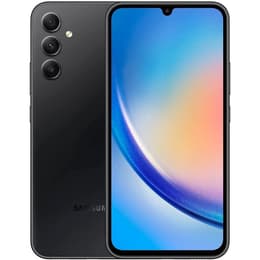



Galaxy A34 Vs Xiaomi Redmi Note 12 Pro

Galaxy A34
Galaxy A34
Starting at

Refurbished price:135.00

Versus €399.00 new

See options
Xiaomi Redmi Note 12 Pro
Starting at

Refurbished price:112.00

Versus €399.00 new

See options

Ratings

The Samsung Galaxy A34, released in March 2023, and the Xiaomi Redmi Note 12 Pro, with its global release in January 2023, are both mid-range smartphones offering a balance of features for everyday use. While they share several core specifications, key differentiators lie in their software support longevity, build materials, and specific camera capabilities. Both devices operate on the Android platform, providing a familiar user experience with their respective manufacturer's custom interfaces.

Scores

Durability

When considering the long-term usability of these devices, their release timelines and manufacturer support policies are important factors.

  • Software Longevity: The Samsung Galaxy A34 benefits from Samsung's commitment to providing four major Android OS updates and five years of security patches from its release date. This means the Galaxy A34 is expected to receive updates up to Android 17 and security patches until March 2028. In contrast, the Xiaomi Redmi Note 12 Pro was initially promised two major Android versions and three years of security patches. As of early 2026, the Redmi Note 12 Pro series is scheduled to receive its final major update, HyperOS 2 (based on Android 15), signaling the end of its software warranty.
  • Physical Durability: The Galaxy A34 features an IP67 rating, indicating a higher level of resistance to dust and water immersion. The Redmi Note 12 Pro carries an IP53 rating, offering protection against dust and splashing water. Both devices utilize Gorilla Glass 5 for screen protection. The Galaxy A34 has a plastic back, while the Redmi Note 12 Pro features a glass back.
  • Expected Practical Lifespan: Users prioritizing extended software support and enhanced water and dust resistance may find the Galaxy A34 offers a longer practical lifespan. The Redmi Note 12 Pro, while physically robust, will have a shorter period of official software and security updates.

Year of Release

2023

2022

Compatible with latest Update

Yes

No

OS

Android

Android

Foldable

No

No

Performance

Both the Galaxy A34 and the Redmi Note 12 Pro are equipped to handle daily tasks and moderate usage effectively.

  • Processor Capabilities: Both smartphones are powered by the MediaTek Dimensity 1080 processor. In real-world use, this translates to smooth navigation through interfaces, quick app loading, and efficient multitasking for typical applications. Users of the Galaxy A34 report that the device feels fast and responsive in general use, with minimal stuttering when navigating home screens or menus. The Redmi Note 12 Pro also provides strong performance without reported overheating issues during general use.
  • Multitasking and Storage: The Galaxy A34 is available with 6GB or 8GB of RAM, and 128GB or 256GB of internal storage, with support for microSD card expansion up to 1TB. The Redmi Note 12 Pro offers more RAM configurations, including 6GB, 8GB, and 12GB, with 128GB or 256GB of internal storage, though it does not support microSD expansion. For users who frequently keep many applications open simultaneously, the higher RAM options on the Redmi Note 12 Pro could offer a slight advantage.
  • Battery Behavior: Both devices are equipped with a 5000 mAh battery. The Galaxy A34 is noted for its good battery life, often lasting up to two days with light usage. The Redmi Note 12 Pro also delivers excellent battery performance, with users reporting over six hours of screen-on time even with a 120Hz refresh rate enabled.

Memory (GB)

6 GB

8 GB

Screen quality

The visual experience on both devices is characterized by vibrant displays suitable for media consumption and daily interactions.

  • Display Technology and Clarity: Both smartphones feature AMOLED display technology, known for deep blacks and vibrant colors. The Galaxy A34 has a 6.6-inch Super AMOLED display, while the Redmi Note 12 Pro features a slightly larger 6.67-inch AMOLED panel. Both offer a Full HD+ resolution (1080 x 2400 pixels for the Redmi Note 12 Pro and 1080 x 2340 pixels for the Galaxy A34), providing clear and sharp visuals for text and images.
  • Brightness and Smoothness: Both displays support a 120Hz refresh rate, contributing to smoother scrolling and a more fluid user experience. The Galaxy A34's display can reach a peak brightness of 1000 nits, while the Redmi Note 12 Pro can achieve up to 900 nits in High Brightness Mode (HBM) and 1100 nits peak brightness. This higher brightness on both devices ensures good visibility even in bright outdoor conditions.
  • Viewing Experience: The slightly larger screen of the Redmi Note 12 Pro might offer a marginally more expansive viewing area for videos and games. Both displays are protected by Corning Gorilla Glass 5.

Resolution

1080 x 2340

1080 x 2400

Screen type

Super AMOLED

AMOLED

Audiovisual

Both smartphones offer versatile camera systems designed for capturing a range of photos and videos in various conditions.

  • Rear Camera System: The Galaxy A34 features a triple-camera setup with a 48 MP main sensor with Optical Image Stabilization (OIS), an 8 MP ultrawide lens, and a 5 MP macro camera. The Redmi Note 12 Pro also has a triple-camera system, including a 50 MP main sensor with OIS, an 8 MP ultrawide lens, and a 2 MP macro camera. The main cameras on both devices are capable of producing detailed images in good lighting conditions, with the Galaxy A34 often delivering saturated colors and good contrast. The Redmi Note 12 Pro's main camera is also praised for its detail and dynamic range.
  • Low-Light and Video Performance: Both devices can record video at up to 4K resolution at 30 frames per second. In low-light conditions, the OIS on both main sensors helps in capturing clearer photos, though the ultrawide cameras on both tend to struggle more in challenging lighting. The Galaxy A34's main camera performs well in low light with Night mode enabled, managing noise effectively.
  • Front Camera and Audio: For selfies, the Galaxy A34 has a 13 MP front camera, while the Redmi Note 12 Pro features a 16 MP front camera. Both phones are equipped with stereo speakers, providing a more immersive audio experience for media consumption.

Main camera

48 megapixels

50 megapixels

Front camera

13 megapixels

16 megapixels

Miscellaneous

Beyond core features, several practical elements contribute to the overall user experience of these smartphones.

  • Connectivity and Ports: Both the Galaxy A34 and Redmi Note 12 Pro support 5G connectivity. The Galaxy A34 includes Wi-Fi 5 (802.11ac) and Bluetooth 5.3. The Redmi Note 12 Pro offers Wi-Fi 6 (802.11ax) and Bluetooth 5.2. Both devices feature a USB-C 2.0 port for charging and data transfer. A notable difference is the inclusion of a 3.5mm headphone jack on the Redmi Note 12 Pro, which is absent on the Galaxy A34.
  • Biometric Security: The Galaxy A34 incorporates an under-display optical fingerprint sensor. The Redmi Note 12 Pro utilizes a side-mounted fingerprint sensor, often integrated into the power button. Both methods offer convenient and secure unlocking.
  • Design and Handling: The Galaxy A34 measures 161.3 x 78.1 x 8.2 mm and weighs 199g. The Redmi Note 12 Pro is slightly taller and narrower at 162.9 x 76 x 7.9 mm, and lighter at 187g. The Redmi Note 12 Pro's glass back provides a different tactile feel compared to the Galaxy A34's plastic back.

Weight

199 g

187 g

Screen size (in)

6.6

6.67

Network

5G

5G

SIM card

Dual Physical SIM

Dual Physical SIM

Carrier compatibility

Unlocked

Unlocked

Connector

USB-C

USB-C

User feedback for the Samsung Galaxy A34 often highlights its robust software support policy, with a commitment to four major OS updates and five years of security patches, making it a compelling choice for long-term use. Its IP67 water and dust resistance is also a frequently praised feature, contributing to its overall durability. The vibrant 120Hz AMOLED display and reliable battery life are consistently noted as strong points. Some common criticisms include a sometimes slow under-display fingerprint reader and the performance of its ultrawide camera.

The Xiaomi Redmi Note 12 Pro receives praise for its bright 120Hz AMOLED display and capable 50 MP main camera, which performs well in various lighting conditions. Its strong battery life and fast charging capabilities are also frequently mentioned as significant advantages. However, users sometimes point out that the secondary cameras (ultrawide and macro) are less impressive than the main sensor. The software experience, based on Xiaomi's MIUI, can be a point of preference for some users, while others might find it less streamlined compared to other Android interfaces. Its shorter software update commitment compared to the Galaxy A34 is also a consideration for those seeking maximum longevity.

Users prioritizing long-term software updates, enhanced water and dust protection, and a consistent user experience may find the Samsung Galaxy A34 well-suited to their needs. Conversely, individuals who value a glass back design, a slightly larger screen, faster charging, and the inclusion of a 3.5mm headphone jack might lean towards the Xiaomi Redmi Note 12 Pro. Both devices offer a solid foundation for daily smartphone use, and considering a quality-assured refurbished option for either model can be an eco-friendly alternative.


See all articles

Our recent comparisons