

Galaxy A23 5G Vs Xiaomi Redmi Note 14 4G

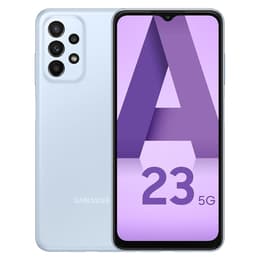
Galaxy A23 5G
Galaxy A23 5G
Starting at

Refurbished price:102.00

Versus €600.00 new

See options
Xiaomi Redmi Note 14 4G
Starting at

Refurbished price:162.00

Versus €229.99 new

See options

Ratings

The Samsung Galaxy A23 5G, released in August 2022, and the Xiaomi Redmi Note 14 4G, launched in late 2024 or early 2025, are both smartphones designed for everyday use. While the Galaxy A23 5G offers 5G connectivity and a robust software ecosystem, the Redmi Note 14 4G distinguishes itself with a newer release and an impressive software support policy. Both devices operate on the Android platform, with the Galaxy A23 5G running Samsung's One UI and the Redmi Note 14 4G featuring Xiaomi's HyperOS.

Scores

Durability

When considering the long-term usability of these devices, their release timelines and software support policies are key differentiators. The Samsung Galaxy A23 5G, having been released in August 2022, has already received several Android updates, shipping with Android 12 and subsequently updating to Android 15. Samsung typically provides two major Android updates and four years of security updates for this series. In contrast, the Xiaomi Redmi Note 14 4G, a newer device from late 2024 or early 2025, launched with Android 14 and is set to receive four major Android upgrades, extending its support to Android 18, along with six years of security updates until 2031.

  • Software Longevity: The Redmi Note 14 4G offers a significantly longer software support period, promising four major Android updates and six years of security patches, compared to the Galaxy A23 5G's two major Android updates and four years of security updates.
  • Physical Durability: Both devices feature Corning Gorilla Glass 5 for screen protection. The Redmi Note 14 4G also includes an IP54 rating for dust and splash resistance, offering a degree of protection against everyday elements, a feature not explicitly highlighted for the Galaxy A23 5G.
  • Repairability: The Galaxy A23 5G is considered a relatively repairable device, scoring 6.75 out of 10 on a repairability scale, with components like the back plate and battery being replaceable with appropriate tools. The Redmi Note 14 4G also appears to be designed with repair in mind, with guides available for screen replacement.

Year of Release

2022

2025

OS

Android

Android

Foldable

No

No

Performance

The performance of both smartphones is tailored for smooth daily operation, though they approach this with different internal components. The Galaxy A23 5G is equipped to handle demanding applications and multitasking efficiently, providing a responsive user experience. Users generally find its performance adequate for typical smartphone activities, though some have noted occasional sluggishness with lower RAM configurations.

  • Everyday Responsiveness: The Redmi Note 14 4G, with its current-generation processor, delivers smooth performance for multitasking, gaming, and streaming, ensuring a fluid experience across various applications.
  • Storage and Multitasking: Both devices offer multiple RAM and storage configurations, with options up to 8GB of RAM and 128GB or 256GB of internal storage, along with expandable storage via microSD cards, allowing users to choose based on their storage needs and multitasking habits.
  • Battery Endurance: The Redmi Note 14 4G features a larger 5500mAh battery with 33W fast charging, providing extended usage and quicker recharges. The Galaxy A23 5G comes with a 5000mAh battery and supports 25W fast charging, also offering long-lasting power for most users.

Memory (GB)

4 GB

6 GB

Screen quality

The visual experience on both devices is designed to be engaging, though they utilize different display technologies to achieve this. The Redmi Note 14 4G features a vibrant AMOLED display, known for its deep blacks and rich colors, while the Galaxy A23 5G uses a PLS LCD panel.

  • Display Technology and Clarity: The Redmi Note 14 4G boasts a 6.67-inch AMOLED display with a resolution of 2400x1080 pixels, offering sharp and vibrant visuals. The Galaxy A23 5G has a 6.6-inch PLS LCD display with a similar 2408x1080 pixel resolution, providing clear images.
  • Brightness and Refresh Rate: Both phones offer a 120Hz refresh rate for smoother scrolling and animations. The Redmi Note 14 4G's AMOLED screen can reach a peak brightness of 1800 nits, ensuring excellent visibility even in bright outdoor conditions, and includes certifications for eye comfort. The Galaxy A23 5G's display is also noted for its quality and 120Hz refresh rate.
  • Viewing Experience: Users of the Redmi Note 14 4G will appreciate the immersive viewing experience provided by its AMOLED panel, especially for media consumption. The Galaxy A23 5G's LCD panel also delivers a good viewing experience, particularly for casual video watching.

Resolution

1080 x 2408

1080x2400

Audiovisual

Both smartphones offer multi-camera setups, but their approaches to photography and video capabilities differ, catering to varying user preferences. The Redmi Note 14 4G emphasizes a high-resolution main sensor, while the Galaxy A23 5G provides a more versatile quad-camera array.

  • Primary Camera Performance: The Redmi Note 14 4G features a 108MP main camera with optical image stabilization (OIS) and 3x in-sensor zoom, capable of capturing detailed images in various lighting conditions. The Galaxy A23 5G includes a 50MP main camera with OIS, which delivers good results with accurate colors and dynamic range in daylight.
  • Additional Lenses and Features: The Galaxy A23 5G includes a 5MP ultrawide camera, a 2MP macro, and a 2MP depth sensor, offering a range of photographic options. The Redmi Note 14 4G, however, omits an ultrawide camera, relying on its 2MP macro and 2MP depth sensors alongside the main camera. Both devices offer an 8MP front camera for the Galaxy A23 5G and a 20MP front camera for the Redmi Note 14 4G for selfies and video calls.
  • Video Recording and Audio: Both phones are limited to 1080p video recording, with the Redmi Note 14 4G showing improved video stabilization. For audio, the Redmi Note 14 4G features stereo speakers with Dolby Atmos support and retains a 3.5mm headphone jack. The Galaxy A23 5G also includes a headphone jack and a single bottom-firing speaker.

Miscellaneous

Beyond their core features, both devices offer a range of practical elements that enhance the user experience, from connectivity options to physical design. These aspects can influence daily convenience and how the phones integrate into a user's lifestyle.

  • Connectivity and Ports: The Galaxy A23 5G supports 5G networks, offering faster mobile data speeds, while the Redmi Note 14 4G is limited to 4G connectivity. Both devices include Wi-Fi, Bluetooth, and a USB-C port for charging and data transfer. The Redmi Note 14 4G also features an IR Blaster and NFC (region-dependent).
  • Biometric Security: The Redmi Note 14 4G incorporates an in-screen fingerprint sensor for convenient and secure unlocking, along with AI Face Unlock. The Galaxy A23 5G features a side-mounted fingerprint reader integrated into the power button.
  • Design and Handling: The Galaxy A23 5G weighs around 197g and has dimensions of 165.4 x 76.9 x 8.4 mm. The Redmi Note 14 4G is slightly lighter at 196.5g and measures 163.25 x 76.55 x 8.16 mm, with rounded, ergonomic edges designed for comfortable handling. Both devices are constructed with plastic backs and Gorilla Glass 5 fronts.

Weight

197 g

196 g

Screen size (in)

6.6

6.67

Network

5G

4G

SIM card

Dual Physical SIM

Physical SIM + eSIM

Carrier compatibility

Unlocked

Unlocked

User feedback for the Samsung Galaxy A23 5G frequently highlights its strong camera performance, particularly the main sensor, and its impressive battery life, often lasting through a full day of heavy use. The display quality and user-friendly interface are also common praise points. However, some users have reported that the device can feel sluggish, especially models with less RAM, and its video recording capabilities are noted as sub-standard compared to higher-end phones.

For the Xiaomi Redmi Note 14 4G, users consistently commend its vibrant AMOLED display, robust build quality, and exceptional battery life. The main camera is generally well-regarded for its detail and performance. Criticisms often revolve around the absence of an ultrawide camera and the limited utility of the secondary macro and depth sensors. Some users have also mentioned instances of the device overheating or experiencing lag in certain applications.

Users prioritizing long-term software support and a modern AMOLED display may find the Redmi Note 14 4G well-suited to their needs, especially those who value extended security updates and Android version upgrades. Its larger battery and faster charging also cater to individuals who require prolonged usage between charges. Conversely, users who prioritize 5G connectivity and a more established software ecosystem with a dedicated ultrawide camera might lean towards the Galaxy A23 5G. Both devices offer a solid foundation for daily tasks, and choosing a quality-assured refurbished option for either model can be a sustainable choice for consumers.


See all articles

Our recent comparisons