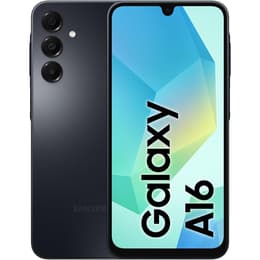
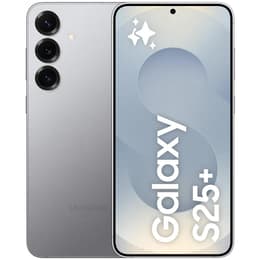


Galaxy A16 Vs Galaxy S25+

Galaxy A16
Galaxy A16
Starting at

Refurbished price:134.00

Versus €250.00 new

See options
Galaxy S25+
Galaxy S25+
Starting at

Refurbished price:624.00

Versus €1,401.57 new

See options

Ratings

The Samsung Galaxy A16, released in late 2024, is positioned as a budget-friendly smartphone, while the Samsung Galaxy S25 Plus, launched in early 2025, represents a premium flagship device. These two models cater to distinct user needs, offering different levels of performance, camera capabilities, and display quality. Both devices operate on the Android platform, featuring Samsung's One UI, but they diverge significantly in their hardware and overall user experience, reflecting their respective market segments. Choosing between them involves prioritizing either essential functionality and extended software support or cutting-edge technology and advanced features.

Scores

Durability

The longevity of a smartphone is influenced by its build quality, software support, and the demands of evolving applications. Both the Galaxy A16 and Galaxy S25 Plus offer substantial software commitment from Samsung, contributing to their practical lifespan.

  • Release Timeline: The Galaxy A16 was released in October 2024, with the 5G variant following shortly after, while the Galaxy S25 Plus debuted in February 2025. This gives the S25 Plus a slight advantage in terms of being a newer model.
  • Software Support: The Galaxy A16 is notable for its commitment to six years of OS and security updates, extending its usability until October 2030. The Galaxy S25 Plus, as a flagship, surpasses this with a promise of seven years of OS and security updates, ensuring support until 2032.
  • Durability Features: The Galaxy A16 features an IP54 rating, providing protection against dust and moderate water splashes. The Galaxy S25 Plus incorporates more robust materials, including Gorilla Glass Victus 2 on both its front and back, paired with an aluminum frame, suggesting a higher degree of resilience against daily wear and tear.

Year of Release

2024

2025

OS

Android

Android

Foldable

No

No

Performance

Performance is a key differentiator, with the Galaxy S25 Plus designed for demanding tasks and the Galaxy A16 focusing on essential daily usage.

  • Everyday Responsiveness: The Galaxy A16 handles basic applications and general navigation adequately, though users may experience occasional stutters and slower app loading times, particularly with more intensive applications or multitasking. In contrast, the Galaxy S25 Plus offers exceptionally smooth and rapid performance across all tasks, from launching complex applications to seamless multitasking and graphic-intensive gaming.
  • Multitasking Capability: The Galaxy A16, with its base 4GB RAM option, can struggle with numerous applications running simultaneously, often requiring apps to refresh when switching between them. The Galaxy S25 Plus, equipped with 12GB of RAM as standard, provides ample capacity for extensive multitasking without performance degradation.
  • Storage Speed: The Galaxy A16 utilizes UFS 2.2 storage, which offers respectable speeds for its class. The Galaxy S25 Plus likely incorporates faster storage technology, contributing to quicker app installations, file transfers, and overall system responsiveness.

Memory (GB)

4 GB

12 GB

Screen quality

The visual experience varies significantly between these two devices, primarily due to differences in display technology and resolution.

  • Display Technology and Clarity: Both phones feature Super AMOLED displays, known for vibrant colors and deep blacks. However, the Galaxy A16 offers a Full HD+ resolution (1080x2340 pixels), providing clear visuals for everyday content. The Galaxy S25 Plus elevates this with a Dynamic AMOLED 2X display and a Quad HD+ resolution (3120x1440 pixels), resulting in noticeably sharper images and finer detail, especially when viewing high-resolution media.
  • Refresh Rate and Smoothness: The Galaxy A16 features a 90Hz refresh rate, which provides a smoother scrolling experience than standard 60Hz displays. The Galaxy S25 Plus boasts an adaptive 120Hz refresh rate, capable of scaling from 1Hz to 120Hz, delivering exceptionally fluid motion for gaming and navigation while optimizing battery consumption.
  • Brightness and Outdoor Visibility: The Galaxy A16's display offers good brightness for indoor use, but it lacks HDR support and may be less visible in bright outdoor conditions. The Galaxy S25 Plus features a peak brightness of 2600 nits and HDR10+ support, ensuring excellent visibility even under direct sunlight and providing a more immersive viewing experience for HDR content.

Resolution

1080x2340

1440 x 3120 pixels

Audiovisual

Camera capabilities present a clear distinction, with the Galaxy S25 Plus offering a more versatile and advanced photography system compared to the Galaxy A16.

  • Rear Camera System: The Galaxy A16 includes a triple-camera setup with a 50MP main sensor, a 5MP ultrawide, and a 2MP macro lens. The main sensor performs well in good lighting, but the secondary lenses are considered less capable. The Galaxy S25 Plus features a more comprehensive triple-camera system, comprising a 50MP wide-angle main camera, a 12MP ultrawide lens, and a 10MP telephoto lens with 3x optical zoom, offering greater flexibility for various photographic scenarios.
  • Photography Performance: In daylight, both devices can capture decent images with the main sensor. However, the Galaxy S25 Plus generally produces more detailed and dynamic photos, with its main camera performing comparably to higher-end models in optimal conditions. The A16's low-light performance is limited, while the S25 Plus, despite some reported noise in very low light, generally handles challenging lighting better.
  • Video Recording and Front Camera: The Galaxy A16 supports Full HD video recording at 30 frames per second and has a 13MP front camera. The Galaxy S25 Plus offers significantly more advanced video capabilities, including 8K recording at 30 frames per second and 4K at 60 frames per second with HDR10+, alongside a 12MP front camera that delivers crisp selfies and video calls.

Miscellaneous

Beyond core specifications, several practical elements contribute to the overall user experience and daily convenience.

  • Connectivity and Ports: Both devices support 5G connectivity (for the A16 5G model), Wi-Fi, and Bluetooth. The Galaxy A16 typically features a USB-C port for charging and data transfer. The Galaxy S25 Plus also uses a USB-C port and offers advanced Wi-Fi standards and Bluetooth versions for faster and more reliable connections.
  • Biometric Security: The Galaxy A16 includes a fingerprint sensor for secure unlocking. The Galaxy S25 Plus incorporates an improved ultrasonic fingerprint sensor embedded within the display, offering a generally faster and more reliable biometric authentication experience.
  • Audio Experience: The Galaxy A16 is equipped with a single bottom-firing speaker, which provides adequate sound for casual listening but may distort at higher volumes and lacks stereo separation. The Galaxy S25 Plus features stereo speakers that deliver a louder, clearer, and more immersive audio experience, with good vocal clarity for media consumption and calls.

Weight

200 g

190 g

Screen size (in)

6.7

6.7

Network

4G

5G

SIM card

Physical SIM

Physical SIM + eSIM

Carrier compatibility

Unlocked

Unlocked

Connector

USB-C

USB-C

The Samsung Galaxy A16 and Galaxy S25 Plus cater to fundamentally different user expectations and budgets. The Galaxy A16 is frequently praised for its exceptional battery life and Samsung's commitment to long-term software updates, making it a reliable choice for users who prioritize endurance and extended usability without needing top-tier performance. However, common criticisms point to its modest processing power, which can lead to stutters during demanding tasks, and its less versatile camera system, particularly the secondary lenses.

Conversely, the Galaxy S25 Plus receives high marks for its blazing-fast performance, stunning high-resolution display, and comprehensive camera capabilities, including advanced video recording. Users appreciate its premium build and the seamless, AI-enhanced software experience. Some common concerns include its design, which some find to be an iterative update rather than a significant refresh, and its low-light camera performance, which, while capable, may not always match the best in its class.

Users prioritizing a device for essential communication, web browsing, and media consumption, coupled with excellent battery longevity and a long software support window, may find the Galaxy A16 well-suited to their needs. It represents a practical and sustainable choice, especially when considering quality-assured refurbished options. For those who demand cutting-edge performance for gaming, advanced photography, and a premium multimedia experience, the Galaxy S25 Plus is the more appropriate choice. It offers a powerful and refined smartphone experience for users who rely on their device for intensive tasks and desire the latest technological advancements. Ultimately, the decision hinges on balancing performance and features against individual usage patterns.


See all articles

Our recent comparisons