
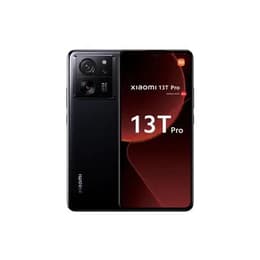


OnePlus 10 Pro Vs Xiaomi 13T Pro

OnePlus 10 Pro
OnePlus 10 Pro
Starting at

Refurbished price:228.00

Versus €999.00 new

See options
Xiaomi 13T Pro
Xiaomi 13T Pro
Starting at

Refurbished price:241.00

Versus €900.00 new

See options

Ratings

The OnePlus 10 Pro (2022) and the Xiaomi 13T Pro (2023) are both high-performance Android smartphones, each offering a distinct set of features for users. While the OnePlus 10 Pro, released earlier, focuses on a refined user experience with its display and camera system, the Xiaomi 13T Pro, a more recent entrant, emphasizes cutting-edge performance and rapid charging capabilities. Both devices run on the Android operating system, but they feature different custom user interfaces, offering varied software experiences.

Scores

Durability

The longevity of a smartphone is influenced by its release date, software support, and physical resilience.

  • Release Timeline: The OnePlus 10 Pro was unveiled in January 2022, making it an older model compared to the Xiaomi 13T Pro, which was released in September 2023. This difference in release year directly impacts their expected software support windows.
  • Software Longevity: The OnePlus 10 Pro is expected to receive three major Android version upgrades and four years of security updates, taking it from Android 12 to Android 15. Some reports indicate it has already received Android 16, exceeding initial expectations. In contrast, the Xiaomi 13T Pro benefits from a more extended policy, promising four major Android OS upgrades and five years of security patches, meaning it will likely receive updates up to Android 17 and security patches until 2028. This extended support makes the Xiaomi 13T Pro a more future-proof option in terms of software.
  • Physical Durability: Both devices feature an IP68 rating for dust and water resistance, indicating protection against submersion in fresh water up to 1.5 meters for 30 minutes. However, for the OnePlus 10 Pro, this official rating was initially only for specific carrier variants in some regions, though the underlying hardware was generally consistent. The OnePlus 10 Pro uses Gorilla Glass Victus on the front and Gorilla Glass 5 on the back, while the Xiaomi 13T Pro uses Gorilla Glass 5 on the front and either glass or a silicone polymer on the back.

Year of Release

2022

2023

Compatible with latest Update

Yes

Yes

OS

Android

Android

Foldable

No

No

Performance

Both smartphones are equipped with powerful internal components designed for demanding tasks, though they approach performance with different underlying architectures.

  • Processing Power: The OnePlus 10 Pro features a processor known for strong performance in its generation, capable of handling intensive applications and multitasking. The Xiaomi 13T Pro, being a newer device, incorporates a more recent and powerful processor, which generally translates to faster overall operation and improved efficiency for current and future applications.
  • Multitasking and Storage: The OnePlus 10 Pro offers configurations with 8GB or 12GB of RAM and storage options up to 256GB or 512GB. The Xiaomi 13T Pro provides more generous options, including 8GB, 12GB, or 16GB of RAM and storage up to 1TB, which can be beneficial for users who frequently manage large files or run many applications simultaneously.
  • Battery Behavior: Both devices are equipped with a 5000 mAh battery capacity. User experiences with the OnePlus 10 Pro suggest it generally provides a full day of use, though heavy gaming can reduce this. The Xiaomi 13T Pro also aims for a full day of use, with some reports indicating strong battery performance. The Xiaomi 13T Pro supports significantly faster wired charging at 120W, capable of reaching a full charge in approximately 19 minutes, while the OnePlus 10 Pro supports 80W wired charging (65W in some regions) and 50W wireless charging.

Memory (GB)

8 GB

12 GB

Screen quality

The visual experience on both devices is delivered through high-quality displays, each with distinct characteristics.

  • Display Technology and Clarity: The OnePlus 10 Pro features a 6.7-inch LTPO2 Fluid AMOLED display with a resolution of 1440 x 3216 pixels, offering sharp visuals and deep blacks. The Xiaomi 13T Pro has a slightly smaller 6.67-inch AMOLED display with a resolution of 1220 x 2712 pixels. Both displays support HDR10+ for enhanced contrast and color.
  • Brightness and Smoothness: The OnePlus 10 Pro's display can reach a peak brightness of 1300 nits, and its LTPO technology allows for an adaptive refresh rate from 1Hz to 120Hz, optimizing power consumption while providing smooth scrolling. The Xiaomi 13T Pro boasts a higher peak brightness of 2600 nits, making it exceptionally visible in bright outdoor conditions, and offers a fixed refresh rate of 144Hz for very fluid motion.
  • Viewing Experience: The OnePlus 10 Pro's display is curved, which can offer an immersive viewing experience, while the Xiaomi 13T Pro features a flat display.

Resolution

1440 x 3216

1220 x 2712

Screen type

LTPO2 Fluid AMOLED

AMOLED

Audiovisual

Both smartphones offer advanced camera systems, with each device bringing its own strengths to photography and videography.

  • Rear Camera Systems: The OnePlus 10 Pro features a triple camera setup co-developed with Hasselblad, including a 48 MP main sensor with optical image stabilization (OIS), a 50 MP ultrawide lens with a wide 150˚ field of view, and an 8 MP telephoto lens with 3.3x optical zoom and OIS. The Xiaomi 13T Pro also has a triple camera system, co-engineered with Leica, featuring a 50 MP main sensor with OIS, a 12 MP ultrawide lens, and a 50 MP telephoto lens with 2x optical zoom.
  • Photography Performance: Users generally praise the OnePlus 10 Pro's main and ultrawide cameras for good daytime photos, with the 150˚ ultrawide offering unique perspectives. The telephoto lens also performs well in good lighting. The Xiaomi 13T Pro's Leica-tuned cameras are noted for producing clear images with vivid colors, and its night mode and portraits are considered strong.
  • Video Capabilities: The OnePlus 10 Pro can record video up to 8K at 24fps and 4K at 30/60/120fps. The Xiaomi 13T Pro also supports 8K video recording at 24fps and 4K at 30/60fps. Some users have noted limitations in video recording resolution across all lenses on the OnePlus 10 Pro.
  • Front Camera: The OnePlus 10 Pro has a 32 MP front camera, while the Xiaomi 13T Pro features a 20 MP front camera.

Main camera

48 megapixels

50 megapixels

Front camera

32 megapixels

20 megapixels

Miscellaneous

Beyond core performance and display, several other features contribute to the overall user experience of these smartphones.

  • Connectivity: Both devices support 5G connectivity. The OnePlus 10 Pro includes Wi-Fi 6 and Bluetooth 5.2. The Xiaomi 13T Pro offers more advanced connectivity with Wi-Fi 7 and Bluetooth 5.4.
  • Ports and Sensors: Both phones utilize a USB-C port for charging and data transfer. The OnePlus 10 Pro features USB-C 3.1, while the Xiaomi 13T Pro uses USB-C 2.0. Both devices incorporate an under-display optical fingerprint sensor for secure unlocking. Neither phone includes a traditional 3.5mm headphone jack.
  • Design and Handling: The OnePlus 10 Pro weighs approximately 201g and has dimensions of 163 x 73.9 x 8.55 mm. The Xiaomi 13T Pro is similar in weight, around 200g to 206g depending on the back panel material (glass or silicone polymer), with dimensions of 162.2 x 75.7 x 8.5 mm (glass) or 8.6 mm (silicone polymer). The OnePlus 10 Pro features a curved display and a ceramic camera module, while the Xiaomi 13T Pro offers a flat display and a choice between glass or a vegan leather back.

Weight

201 g

200 g

Screen size (in)

6.7

6.67

Network

5G

5G

SIM card

Physical SIM

Physical SIM + eSIM

Carrier compatibility

Unlocked

Unlocked

Connector

USB-C

USB-C

The OnePlus 10 Pro and Xiaomi 13T Pro each present a compelling package for different user needs. The OnePlus 10 Pro, released in early 2022, is often praised for its vibrant, high-resolution curved AMOLED display and a camera system co-engineered with Hasselblad that delivers strong photographic results, particularly with its unique ultrawide lens. Users have also noted its generally reliable battery life and smooth software experience. Some criticisms have pointed to the inconsistent official IP rating across regions and occasional software quirks.

The Xiaomi 13T Pro, launched in late 2023, stands out with its exceptionally bright 144Hz AMOLED display, a powerful processor for demanding tasks, and an impressive 120W fast charging capability that can fully charge the device in minutes. Its Leica-tuned camera system is also highly regarded for its clarity and night photography. A significant advantage for the Xiaomi 13T Pro is its extended software support policy, offering more Android upgrades and security patches over a longer period.

Users prioritizing a highly immersive curved display and a unique ultrawide camera experience might lean towards the OnePlus 10 Pro. Conversely, those who value the latest in processing power, a brighter and smoother flat display, extremely fast charging, and a longer software support commitment may find the Xiaomi 13T Pro better suited to their requirements. Both devices offer robust performance and capable camera systems, making the choice dependent on specific preferences for display characteristics, charging speed, and long-term software updates. For those considering a more sustainable choice, quality-assured refurbished options for both models are available, offering an eco-friendly alternative.


See all articles

Our recent comparisons